Dark energy could be made of heavy (slow) particles or lighter (fast) ones. In one case we speak of cold dark energy (slow, heavy particles) or hot (light, fast particles). Its interaction with matter in the early stages of the universe would have different consequences for star formation. A new study on the subject is published in Science, thanks to the performance of numerical simulations.

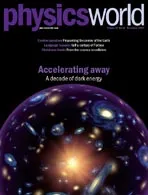
Cover of Science. Image: Liang Gao and Tom Theuns, Institute for Computational Cosmology, Durham University
The first stars in the early universe would have formed in chains, if dark energy were hot, according to a study published by the AAAS (American Association for the Advancement of Science) in the September 14 issue of Science. In contrast, simulations with cold dark energy generally show that the first stars would have formed in clusters.
The findings, based on numerical simulations, could enable a better understanding of when the first stars began to illuminate the universe and perhaps explain how certain black holes form.
After the Big Bang, the universe expanded rapidly but remained smooth and dark for about 100 million years. Dark energy began to form structures, pulling with its gravity hydrogen, helium and lithium that condensed to form stars.
Cold dark energy, which has been relatively well studied in simulations, propagated through the universe in waves. It would have collapsed into small, almost spherical structures, creating voids that attracted gases leading to star formation.
As the particles of hot dark energy move faster, however, preventing the formation of small structures. According to the authors, the gas would have condensed into long filaments, rapidly extending along its shorter axis due to gravity.
"The filaments would have been 9,000 light-years long, which is a quarter the size of the Milky Way. They would have fragmented into giant bursts of star formation, a spectacular event to behold," says author Liang Gao of Durham University.
In addition to producing the first light in the universe, these stars would have formed the first heavy elements, such as carbon and oxygen. These elements are crucial for forming solid objects like Earth and the other rocky planets.
Some of these stars would have very low mass, so their lifetime would be longer. That is, perhaps, some may still be detectable.
Hot dark energy could explain the existence of supermassive black holes. It's that with cold dark energy, although these very dense objects form, they are of relatively small size. But the filaments of hot dark energy would have eventually collapsed, says Gao and his colleague Theuns, forcing stars, gas and small black holes to come together, a perfect scenario for the growth of larger black holes.
In their simulation, the researchers assumed dark energy particles with 0.6% of the mass of an electron, which would be similar to the theoretical "gravitino" particle, a particle predicted by supersymmetry theory.
Sources and related links
- NewScientist: Warm dark matter solves mystery of giant black holes
- Note on EurekAlert
- Press release at AAAS
- Science: Lighting the Universe with Filaments, by Liang Gao of Durham University and Tom Theuns of Durham University