A fast-moving galaxy leaves a long tail of gas in which "orphan stars" are forming, according to new research.
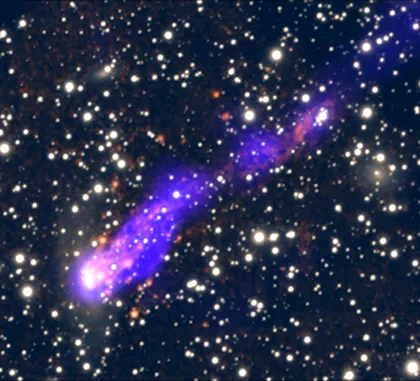
X-ray: NASA/CXC/MSU/M.Sun et al; H-alpha/Optical: SOAR (MSU/NOAO/UNC/CNPq-Brazil)/M.Sun et al.
Astronomers have found evidence that stars have been forming in a long tail of gas extending out from the host galaxy. The discovery suggests that orphan stars could be more common than thought.
The comet-like tail was observed by the Chandra Observatory in X-rays and in optical light by SOAR in Chile. It extends more than 200,000 light-years and was created as gas was stripped from the galaxy ESO 137-001 as it moves toward the center of Abell 3627, a giant cluster of galaxies.
The observations indicate that the gas tail has formed millions of stars. Since the large amounts of gas and dust needed to form stars are typically found in galaxies, astronomers thought it was not possible for a large number of stars to form outside of a galaxy.
"This is not the first time stars have been seen forming between galaxies. But the number of stars here is unprecedented," says Megan Donahue, a member of the research team.
Evidence of star formation in this tail includes 29 regions of ionized hydrogen glowing in optical light, presumably from new stars. These regions are in the tail or very close to it. Two X-ray sources are near these regions, another indication of star formation activity. The researchers think the stars formed in the last 10 million years or so.
The stars in this tail of the fast-moving galaxy, which is 220 million light-years away, would be much more isolated than the vast majority of stars in galaxies.
"By our galactic standards, these are extremely lonely stars," says Mark Voit.
The gas that formed these stars was stripped from its host galaxy by the pressure induced by the galaxy's motion through the gas that dominates the intergalactic space of the cluster. Eventually, the gas will run out and star formation will stop.
This process may represent an important but short stage in the transformation of a galaxy. Although apparently rare in the present universe, galactic tails of gas and orphan stars could have been common billions of years ago.
The results will appear in the December 10 issue of The Astrophysical Journal.