Scientists may have solved a problem of discrepancy between the number of small galaxies that should exist, according to theories, near the Milky Way and the number currently observed.
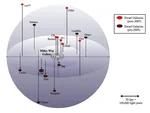
Distribution of dwarf galaxies orbiting the Milky Way. M. Geha
In an attempt to solve the problem of "the missing dwarf galaxies," two astronomers used the W.M. Keck Observatory in Hawaii to study a population of the smallest known galaxies, each containing 99% dark matter. The findings suggest the problem is not as severe as thought and could even be completely resolved.
"It seems that the very small, ultra-diffuse galaxies are much more abundant than we thought," said Dr. Marla Geha, co-author of the study.
The problem came from a prediction of the cold dark matter model, which explains the growth and evolution of the universe. It predicts that large galaxies like ours should be surrounded by a swarm of several hundred smaller galaxies known as dwarf galaxies. However, until now, only 11 such companions were known.
To explain this huge discrepancy, theorists suggested that perhaps many, many dwarf galaxies exist around us but with few stars. But proving the existence of such galaxies seemed problematic.
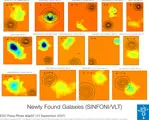
Dr. Josh Simon and Dr. Geha used the Keck II telescope with the DEIMOS spectrograph to conduct studies of 8 new dwarf galaxies discovered with the Sloan Digital Sky Survey. The results allowed them to calculate the mass of each galaxy. To their surprise, each system was among the smallest ever measured, more than 10,000 times smaller than the Milky Way.
"The formation of such galaxies is not well understood from a theoretical perspective. Explaining how stars form in these remarkably small galaxies is difficult, and so is predicting exactly how many dwarf galaxies there should be near our galaxy."
Repeated measurements of 814 stars in the eight dwarf galaxies were obtained at Keck. It was found that the stars move much slower than those in any other galaxy (between 4 to 7 km/sec). In comparison, the Sun orbits the center of our galaxy at 220 km/sec.
Some parameters of the cold dark matter theory can now be updated to match the observational conditions in the local universe. Based on the measured masses, the scientists conclude that ultraviolet radiation generated by the first stars, which formed a few hundred million years after the Big Bang, would have stripped all the hydrogen gas from the dwarf galaxies formed at that time. The loss prevented the galaxies from creating new stars, leaving them very diffuse or, in many cases, completely dark. When this effect is included in the theoretical models, the numbers of observed and expected galaxies agree.
"One of the implications of our results is that a few hundred completely dark galaxies must exist in the neighborhood of our galaxy," says Geha.
The paper, "Kinematics of the Ultra-Faint Milky Way Satellites: Solving the Missing Satellite Problem," will be published in the November 10 issue of Astrophysical Journal.
Sources and related links
- Note in ScienceDaily
- Press release at Keck