Mars Odyssey has discovered entrances to seven possible caves on the slopes of a Martian volcano. The discovery fuels interest in potential underground habitats and the search for caverns on the Red Planet.
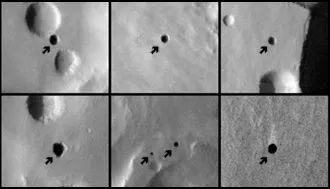
The "seven sisters". NASA/JPL-Caltech/ASU/USGS
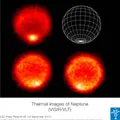
Dark, almost circular and between 100 and 250 meters were found in images taken by the Mars Odyssey and the Mars Global Surveyor. Using the Odyssey's infrared camera to check the day and night temperatures of the circles, scientists concluded they could be windows into underground spaces.
"They are colder than the surrounding surface during the day and warmer at night," says Glen Cushing of the astrogeology team at the University of Arizona. "Their thermal behavior is not as steady as large caves on Earth that often maintain an almost constant temperature, but it is consistent with these large holes in the ground."
A report on the discovery of the possible "skylights" was published online recently in Geophysical Research Letters.
"Somewhere on Mars, caves could be a protected niche for past or current Martian life, or a refuge for humans in the future."
The discovered holes, named "Seven sisters," are in some of the planet's highest latitudes, on a volcano called Arsia Mons near the highest mountain on Mars.
According to Cushing, these extreme altitudes make it unlikely they could be used as human habitats or harbor microbial life. However, it opens the possibility that other similar caves exist at lower altitudes that could indeed shelter life on the planet.
Sources and related links
- Press release at NASA
- Nasa Odyssey