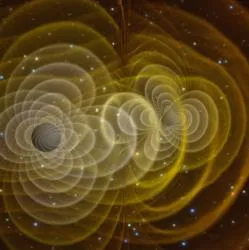
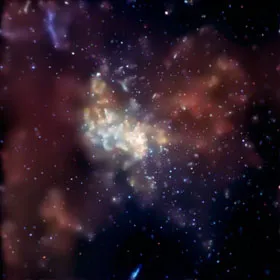
Astronomers believe that supermassive black holes exist at the centers of galaxies. These objects can have millions or hundreds of millions of times the mass of the Sun. Unlike stellar-mass black holes, that is, those that form from the collapse of a star, supermassive black holes could form directly, from a gas cloud to a black hole, skipping the stellar stage entirely.
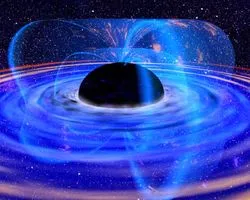
Dr. Mitchell C. Begelman, a professor in the Department of Astrophysical and Planetary Sciences at the University of Colorado, recently published a paper titled "Did supermassive black holes form by direct collapse?" in which he presents this alternative formation of black holes in the early Universe.
After the Big Bang, the Universe cooled enough for the first stars to form from the original hydrogen and helium. This was pure material, not "polluted" by previous generations of stars. Astronomers calculated that the first stars, called Population III, would have a maximum rate of material clumping to form a star.
In a normal star, material gathers relatively slowly, creating a central mass. With enough mass, the star ignites and this creates pressure that stops additional material from compacting too much.
But Dr. Begelman has calculated that if the rate is exceeded by a few tenths of a solar mass per year, the stellar core would be so compact that the energy released from nuclear fusion would not be enough to stop the contraction. In this case, there would be no star; it would go from a hydrogen cloud to a very compact central mass. And to a black hole.
The question is whether it is possible for material to gather so quickly. It is possible, if something is "pushing"... like dark matter. According to the scientist, there could be several situations in which an external force, such as the gravity of a dark matter halo, could force the gas into a central area.
Once there are a few solar masses of gas accumulated, the core begins to expand under the pressure of its increasing mass. The object goes through a brief period of nuclear fusion when it reaches 100 solar masses, but it passes through this stage so quickly that it does not have time to expand again.
Eventually, the object reaches several thousand solar masses and its temperature has climbed to several hundred million degrees. At this point, gravity takes over, collapsing the core and turning the object into a black hole of between 10 and 20 solar masses.
From this point, the black hole is able to efficiently attract material and grow to the maximum levels predicted by physics, eventually up to millions of times the mass of the Sun. If too much material falls, the supermassive black hole could act like a mini quasar - what Dr. Begelman called a "quasistar".
And there is good news: these quasistars could be detectable by powerful telescopes. However, they would have a short life, only 100,000 years. Perhaps the next Space Telescope, the James Webb, will be able to detect them.