Researchers from Duke and Cambridge Universities think there is a way to determine if some black holes are not such.
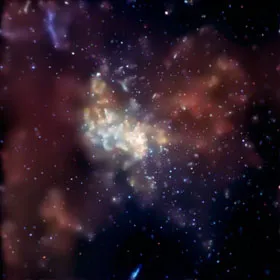
A black hole is thought to be hiding in Sagittarius A
Finding a naked form of what physicists call a "singularity" would shake the foundations of general relativity, says Arlie Petters, author together with Marcus Werner of the paper published online yesterday in Physical Review D.
Albert Einstein originally theorized that stars larger than the sun could collapse and compress into singularities, entities so confined and dense that the laws of physics would not hold inside them.
Since then, astronomers have found indirect evidence of these entities in black holes due to the "cosmic censorship conjecture". The conjecture is that true singularities, that is, those that can form in nature, must always be hidden behind a barrier known as the "event horizon" from which light cannot escape. That is why they appear dark -black- to the rest of the universe.
But this cosmic censorship is "a very difficult open conjecture to prove and very difficult to refute," says Petters.
And, despite the majority acceptance of black holes, Kip Thorne and John Preskill, two experts in relativistic cosmology at the California Institute of Technology, suggested more than ten years ago that naked singularities may exist in certain instances.
The conjecture was proposed in 1969 by Roger Penrose.
Now Petters and Werner have devised a way to test their presence.
Stephen Hawking: A Brief History of Time
(...)This remarkable fact led Roger Penrose to propose the cosmic censorship hypothesis, which could be paraphrased as 'God abhors a naked singularity'.
According to Petters, astronomers cannot be completely sure if black holes are really black, as they cannot penetrate the event horizon. Their best evidence is the effects of the massive gravitational pull. These effects include the emission of very energetic radiation or the very extreme orbits of nearby stars.
Petters is an expert in gravitational lenses, another effect of relativity that allows using massive sources of gravity to see background objects.
In previous reports in November 2005 and February 2006 in Physical Review D, he and Charles Keeton of Rutgers University suggested a way to use gravitational lenses to show if cosmic censorship can be violated.
However, that assessment was limited to non-rotating singularities, considered only theoretically possible. The singularities (black holes) that astronomers have found in space all seem to be very rapidly rotating.
So Petters and Werner teamed up to try to generalize the application of lenses to the more realistic rotating singularities. And apparently they have succeeded.
In a work supported by the National Science Foundation in the USA and the Science Council of the United Kingdom, the duo used the discovery that black holes can become naked singularities if their angular momentum is greater than their mass.
That would translate into a few thousand rotations per second in the case of a black hole about 10 times our Sun, according to Werner.
The calculations show that the massive gravity of a naked singularity would show the light of background stars in revealing ways that would be potentially detectable by current instruments or those soon to be deployed.
These possible ways are outlined in six different equations in their study that connect the spin of a singularity to the separations, angular alignments and brightness of two split images.
"In a sense, I hope they (the naked singularities) are not there. I would prefer to have covered black holes. But I am still open-minded enough to consider the other possibility," adds Petters.
Sources and related links
- Note in EurekAlert
- Press release at Duke Univ.
- La Singularidad desnuda, excellent blog
- Paper: Magnification relations for Kerr lensing and testing cosmic censorship, by M. C. Werner and A. O. Petters