The Hubble Space Telescope took photographs of four beautiful planetary nebulae.
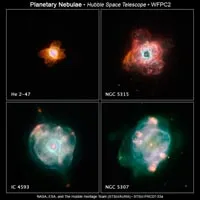
NASA, ESA, and The Hubble Heritage Team (STScI/AURA)
The images reveal how the bright gas ejected by dying stars evolves dramatically over time. These gaseous clouds, called planetary nebulae, are created when stars in their final stages of life expel their outer layers into space. The photos of the nebulae He 2-47, NGC 5315, IC 4593, and NGC 5307 were taken in February 2007 with the Wide Field Camera 2.
The first one, top left, is He 2-47, also called "starfish" due to its shape. It has six different lobes, indicating that the star ejected material three times, in three different directions. In each ejection, the star expelled double jets of material.
On the right we find NGC 5315, which appears to have suffered two ejections of material.
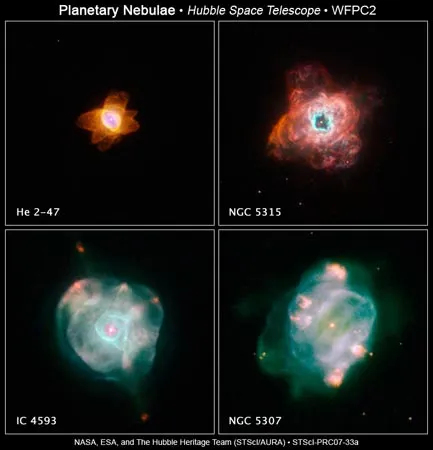
IC 4593, bottom left, is in the northern constellation Hercules. Phil Plait gave a very good description on his very good blog Bad Astronomy.
There he talks about FLIERs. In IC 4593, two points (or knots) of gas can be seen, in red, at the top left and bottom right of the IC 4593 image. They are in opposite directions from the star, move quickly compared to the rest of the gas, are mostly nitrogen (indicated by the red color) and are not at as high a temperature as the rest of the gas.
They are Fast Low-Ionization Emission Regions. Regions of fast low-ionization emission. This, as Phil tells us, is seen in many planetary nebulae.
The origin of this phenomenon is a mystery; although there are papers on the subject, a good understanding of it is not yet available.
Finally, NGC 5307, bottom right, with a complex figure and a certain spiral design, perhaps due to some wobble of the star.
Let's say that these stars, when their time comes, assume it with a glamorous glow as if they had put on their best dresses of gauze and color.