Hungry. Stepped on. Poisoned. All this common cockroaches must endure in a day's work. The resilience of these creatures is incredible.
But astronomers have found something even more resilient: "polycyclic aromatic hydrocarbons", says Achim Tappe from the Harvard Center for Astrophysics. "They can survive a supernova".
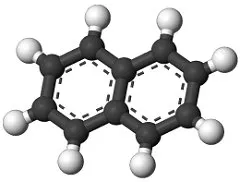
"Polycyclic aromatic hydrocarbons (PAHs for short) are ring-shaped molecules made of carbon and hydrogen. PAHs are organic pollutants that appear in, for example, car exhaust fumes or cigarette smoke. The EPA has classified seven PAH components as carcinogens.
But even PAHs have their virtues: Similar molecules are found in DNA and there is a broad consensus among biologists that PAHs were present on Earth 4,500 million years ago when life began. By serving as building blocks of life, PAHs may have played an essential role in the chemical process of genesis.
That is why Archim Tappe's discovery could be so important.
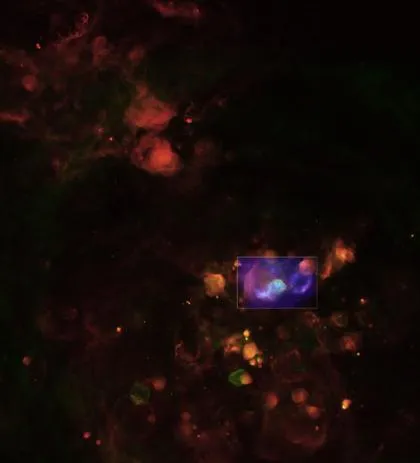
The story begins 3000 years ago when a massive star in the Large Magellanic Cloud exploded. It was, in many ways, a typical supernova explosion, releasing in a few days the energy our Sun produces in about 10 billion years. Hot gas and radiation were expelled through stellar systems while the star itself was mostly (and perhaps completely) destroyed.
The expanding shell of the supernova, cataloged as "N132D", remains visible from Earth.
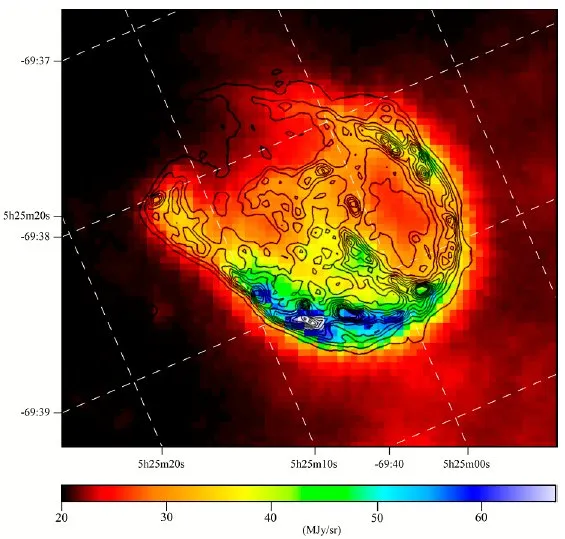
Last year "we scanned N132D using the Spitzer Space Telescope", says Tappe. The observations revealed the existence of PAHs everywhere in the shell of the supernova remnant. They appear to have been swept up by a shock wave of 8-million-degree gas. This is causing some damage to the molecules, but many of the PAHs are surviving".
Astronomers think PAHs are abundant not only on Earth but throughout the cosmos. "This is our first evidence that PAHs can withstand a supernova explosion", says the scientist.
Their ability to survive may be the key to life on Earth. Many astronomers are convinced that a supernova exploded in our galactic corner 4 to 5 billion years ago when the solar system was coalescing from primitive interstellar gas. In one scenario of the origin of life, the PAHs survived and made their way to our planet. It turns out that PAHs can form in water, in the primordial sea, and provide the scaffolding for nucleic acids with architectural properties similar to RNA and DNA.
"It's an exciting and promising theory. But more experiments and observations are needed to decide its success or failure" says Tappe, who is conducting a new round of observations with Spitzer: "We are mapping the distribution of PAHs around N132D, comparing the locations of the molecules to the shock arc revealed by Chandra", he explains.
Sources and related links
- Note on Science@NASA
- In search of the origins of life on Earth
- PAH
- Naphthalene
- Aromatic hydrocarbon