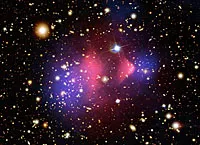
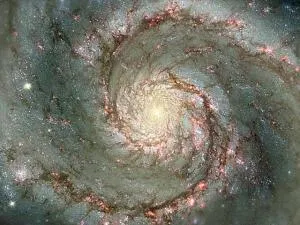
One of the most important unanswered questions in modern astronomy is how galaxies evolved into their current form. To approach this problem it is vital to observe ancient galaxies, that is, distant ones. The Japanese satellite has carried out one of the most extensive studies at infrared wavelengths.
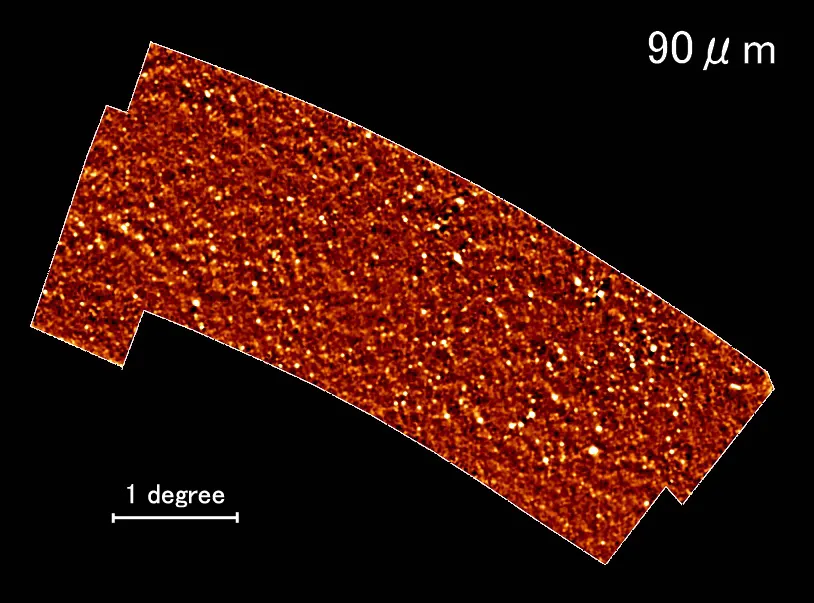
To ensure obtaining the best possible results, the chosen area of the sky had to be carefully selected to minimize contamination from material of our own Galaxy, that is, they had to look for a transparent "window" of our Galaxy to observe the distant Universe. Another point of the observations was to carry them out simultaneously at four infrared wavelengths (65, 90, 140 and 160 micrometers). This information is essential to investigate the radiation mechanisms responsible for the infrared light emission from galaxies and estimate their distance using the relative brightness of the different wavelengths.
Figure 2a (above) shows the far-infrared Universe through this "galactic window". It is possibly the finest image of the Universe over a large area of 10 square degrees and is the culmination of about 200 observations with AKARI repeated over 16 months. This particular image was taken at a wavelength of 90 micrometers. In image 2b the four wavelengths are shown.
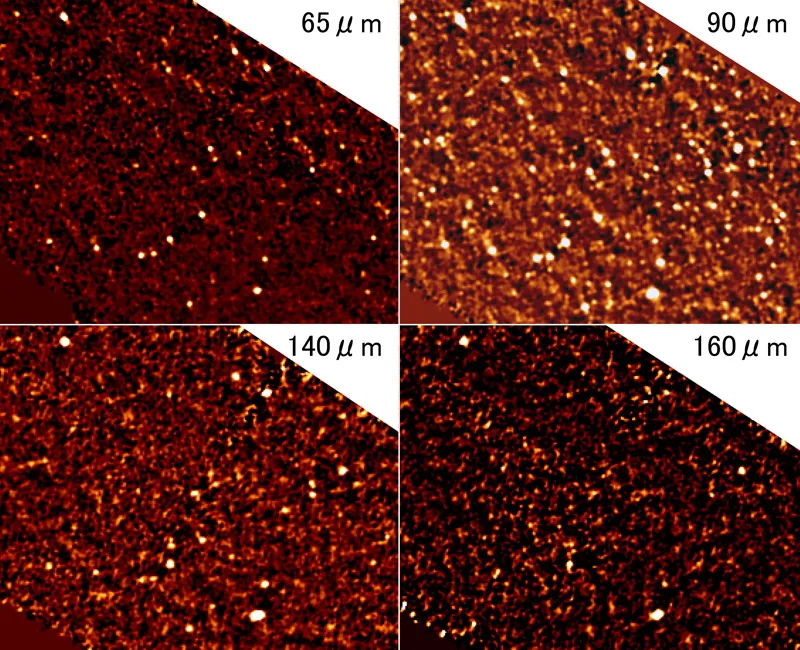
The white dots are diffuse galaxies of different brightnesses. The results imply that ordinary galaxies we see today shone much more in their young years.
Examining the images carefully it is evident that some galaxies seem to have different brightnesses at different wavelengths than others. It is suspected that some of these galaxies could be illuminated by the energy of black holes in their nuclei.
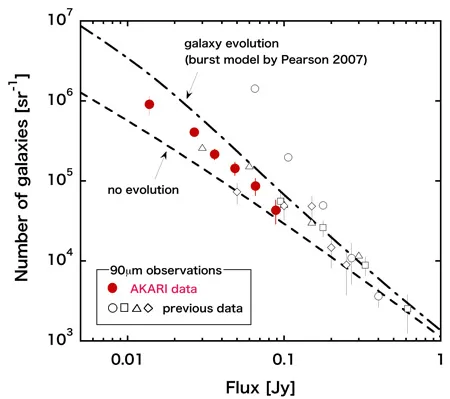
Figure 2c shows a count of these galaxies at different brightnesses in another region of the Galaxy known as the "Lockman Hole". In general, galaxies near Earth are bright and are located on the right-hand side of the lines while distant galaxies appear more diffuse and on the left. If galaxies did not evolve over time and the intrinsic luminosity and number density of galaxies did not change with time, the counts should follow the line indicated as "no evolution". However, AKARI's data show that the numbers of galaxies increase rapidly as they become diffuse. For reference, the results from the European Space Agency's Infrared Space Observatory (ISO) from observations made the last decade are indicated. The line denoted as "galaxy evolution model" is the expected number assuming there was significant star formation in the past. This model fits the data obtained from the
Spitzer Space Telescope. The new data indicate similarity with the evolution model but also show a slightly lower number of galaxies than the model predicts. Spitzer's observations were made at 60 and 160 micrometers and the line in the figure is based on the evolution model currently assumed. Therefore, the new results seem to indicate the need for a new model.
Questions about whether active star formation in the past took place throughout the Universe and how galaxies look like now are very important for studying the evolution and structure of the Universe.
AKARI ends its "cold" observations
The infrared satellite AKARI finished consuming its supply of liquid helium on August 26, 2007, after a successful operation that began on May 8, 2006. This ends the phase of observations in the far and mid infrared including the All-Sky Survey study.
The expected lifetime before launch, of 550 days, was achieved. During the period the satellite completed the All-Sky Survey in the far infrared covering 94% of the entire sky and in the mid infrared with more than 5000 observations. The data obtained are now intensely analyzed by project scientists and astronomers.
AKARI plans to continue the "warm" observation phase using the surviving instruments that can operate under the conditions provided by the mechanical coolers on board. The preparation and evaluation of the next phase of the mission will be carried out in the coming months.
Sources and related links
- Press release at JAXA
- AKARI site