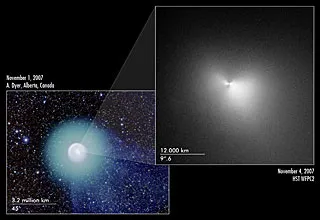
The normally diffuse traveler became incredibly visible these days, even becoming visible to the naked eye.
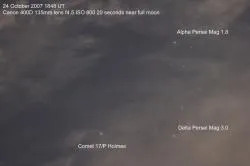
The comet had a magnitude of 17 and surprisingly increased its magnitude to 2. The comet is located in the constellation of Perseus near the star Mirphak, is visible to the naked eye, and can be seen very well with binoculars.
It is presumed that a fracture in its nucleus left ice in contact with space, which would have generated this enormous increase in brightness.
As reported by Phil Plait of Bad Astronomy, David Morrison, a NASA expert on asteroids, commented in a newsletter:
Approximately 36 hours ago, Comet Holmes (a normally discreet comet from Jupiter's family with an aphelion in Jupiter's orbit and perihelion at 2.2 AU) brightened by a factor of one million. This is equivalent to the planet Saturn becoming as bright as the full Moon.
Between October 23 and 24, Holmes went from magnitude 17 to magnitude 2.8 in just a few hours, doubling its brightness every half hour. At its discovery in 1892, the comet also had a similar surprising brightness, presumably due to a large ejection of gas and dust.
The comet is now visible to the naked eye as a bright yellow "star" in the constellation Perseus. (...) I have never seen anything like it.
Sources and related links
- CfA press release
- Comet ephemerides
- Note on BadAstronmy
- The image in the note corresponds to the note on the topic in UniverseToday