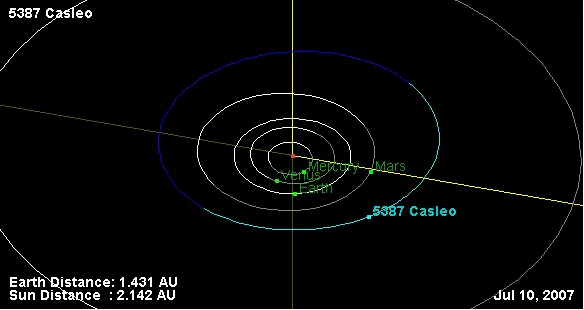
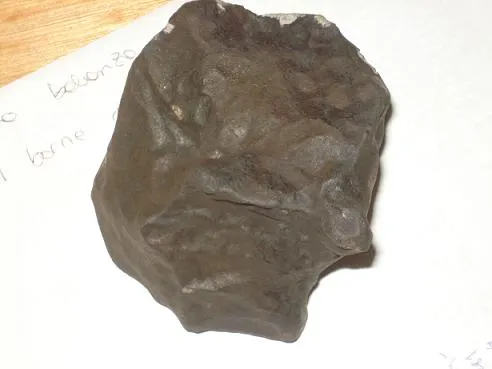
The AsiPEG Group (Solar System Astronomy and Galactic Structure Parameters) of the "Doctor Carlos Ulrico Cesco" High Altitude Astronomical Station (San Juan) has designated several asteroids with the name of Argentine astronomers
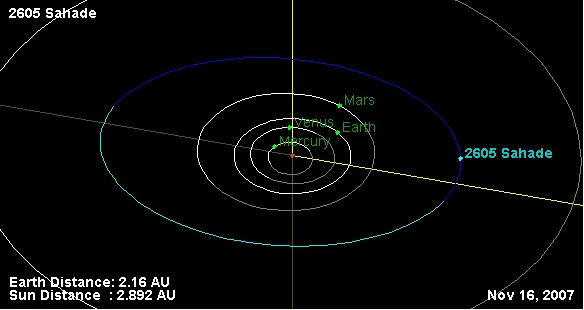
Orbit of 2605 Sahade (1974 QA)
This Station is located at 2500 meters above sea level in El Leoncito and is one of the dependencies of the Félix Aguilar Astronomical Observatory (OAFA) of the National University of San Juan.
We spoke with Lic. Carlos López, Director of AsiPEG.
- What tasks do you develop in the Group and what topics do you work on?
I am the director of the AsiPEG group (Solar System Astronomy and Galactic Structure Parameters). We operate the Double Astrographic Telescope. We dedicate ourselves to tracking asteroids, mainly NEOs, and we observe areas of the southern hemisphere for the determination of proper motions. Lately I have been very involved in the astrometric use of various tools from the Virtual Observatory.
- About this recent designation of asteroids by the Group you direct: Are they asteroids observed by you? If so, with what instrument?
Yes, they are asteroids discovered by us in the course of the last few years. The instrument used was the Double Astrographic Telescope, the only telescope of its kind in the entire southern hemisphere.
- When did you make the proposal? How long does the response usually take in case the International Astronomical Union (IAU) approves it?
The IAU takes about 4 or 5 months to accept the proposals.
- Did they all come out in a single ruling?
Yes, the Nominations Committee made a single ruling.
- Briefly, what are the steps for a certain name to be designated for an asteroid.
Within the working group, someone proposes a name, justifying their proposal. If we all agree, we send the proposed name to the IAU.
- What criteria do you adopt when submitting names?
We wanted to honor outstanding astronomers from our country or people who - regardless of their activity (case of the asteroid Favaloro) - have contributed to Argentine science. An exceptional case is that of asteroid 7724 Moroso, which is in honor of the marriage of Pascuala Moroso - Rafael Villalobos, local ranchers from the area of our observatory who gave us unconditional support AT ALL times for our activity.
Over the years we have been changing our criteria for giving a name to an asteroid discovered by us. Thus, there were times when we preferred historical figures and - consequently, we named asteroids with the names of: 1920 Sarmiento, 2745 San Martín, 2808 Belgrano. At another time we went for geography, and therefore we have asteroids like: 1917 Cuyo, 3833 Calingasta, etc. If my memory serves me, I think there are eight people who work or have worked at the La Plata Observatory whose surnames we have used to designate our asteroids.
- Can you sketch a brief outline of the Dr. Cesco Station?
Regarding the Dr. Cesco Station, I can tell you that it was inaugurated on March 31, 1965. It started as a private initiative of two American universities (Yale and Columbia). In 1974, Columbia University withdrew from the project and Yale University invited the National University of San Juan - through its Félix Aguilar Observatory - to be part of what is now internationally known as the Yale - San Juan program.
The Yale - San Juan project aims to determine southern proper motions over a wide range of magnitudes. To date we have already published three catalogs containing more than 40 million entries.
- What are your days like in the mountains, how often do you go up, what is a day and a night of work like at the Cesco Station?
At the Dr. Cesco Station we basically work in three different groups: solar telescopes, automatic meridian circle, and double astrographic. Each group has its own operating rules but, in general, the technical staff works from one Tuesday to the next, then has time off until the Monday of the following week and ends up completing two weeks of work at OAFA, in the city of San Juan. With this they complete the 4 weeks of the month.
For their part, the support staff (cooks - maids and maintenance) works one week on duty and one week off.
- -----------------
(2605) Sahade (Dr. Jorge Sahade); (5793) Ringuelet (Dr. Adela Ringuelet); (5758) Brunini (Dr. Adrián Brunini); (6505) Muzzio (Dr. Juan Carlos Muzzio); (5386) Bajaja (Dr. Esteban Bajaja of the Argentine Institute of Radio Astronomy)
Deceased astronomers (2964) Jaschek (Dr. Carlos Jaschek); (2179) Platzeck (Dr. Ricardo Platzeck); (5289) Niemela (Dr. Virpi Niemela)
Last December, a few days before passing away, Dr. Virpi Niemela, researcher and professor at the Faculty of Astronomical and Geophysical Sciences of the National University of La Plata, learned of this "gift" during the International Workshop on Massive Stars.
The Double Astrographic Telescope Group of the Carlos Ulrico Cesco Station of the Félix Aguilar Observatory, of the National University of San Juan, sent a letter to Dr. Niemela that said: Your asteroid is Number 5289; we discovered it on May 29, 1990. Since then - the letter continues - we were waiting for you to turn 70, for us to ask the International Astronomical Union (IAU) to accept our suggestion to give it your name. The day finally arrived: from today and as long as there is a Solar System and human beings inhabiting this planet, asteroid 5289 is called Niemela, I repeat, it is called Niemela for you.
This letter was signed by Carlos López, one of the members of the aforementioned group of observational astronomers.
Asteroids
Dr. Adrián Brunini, astronomer and researcher at the Faculty of Astronomical and Geophysical Sciences of UNLP, outlined some aspects of asteroids.
Asked about them he said that "they are minor bodies of the Solar System, solid-type objects, very hard. To be graphic, let's say they are rocks, their size can vary from a few centimeters in diameter to the largest discovered so far, which is called Ceres and is one third the size of our Moon, about 1000 km. In the Solar System there are millions of these objects and the vast majority are scattered in a fairly flattened disk between the orbits of Mars and Jupiter. Some of them approach Earth periodically and are part of the group called Near-Earth Asteroids.
Asteroids discovered at the Dr. Cesco Station that already have a definitive name.
(1770) Schlesinger
(1829) Dawson
(1837) Osita
(1867) Deiphobus
(1917) Cuyo
(1919) Clemence
(1920) Sarmiento
(1943) Anteros
(1958) Chandra
(1991) Darwin
(2035) Stearns
(2075) Martinez
(2124) Nissen
(2179) Platzeck
(2189) Zaragoza
(2219) Mannucci
(2284) San Juan
(2308) Schilt
(2309) Mr. Spock
(2311) El Leoncito
(2370) van Altena
(2381) Landi
(2399) Terradas
(2490) Bussolini
(2504) Gaviola
(2507) Bobone
(2548) Leloir
(2550) Houssay
(2605) Sahade
(2680) Mateo
(2691) Sersic
(2745) San Martin
(2808) Belgrano
(2893) Peiroos
(2928) Epstein
(2964) Jaschek
(2997) Cabrera
(3083) OAFA
(3118) Claytonsmith
(3296) Bosque Alegre
(3438) Inarradas
(3578) Carestia
(3633) Mira
(3649) Guillermina
(3833) Calingasta
(4008) Corbin
(4140) Branham
(4168) Millan
(4232) Aparicio
(4270) Juanvictoria
(4390) Madreteresa
(4397) Jalopez
(4617) Zadunaisky
(4652) Iannini
(4725) Milone
(4914) Pardina
(5042) Colpa
(5077) Favaloro
(5079) Brubeck
(5081) Sanguin
(5289) Niemela
(5299) Bittesini
(5386) Bajaja
(5757) Ticha
(5758) Brunini
(5793) Ringuelet
(5886) Rutger
(5929) Manzano
(5987) Liviogratton
(6109) Balseiro
(6505) Muzzio
(6810) Juanclarià
(7213) Conae
(7626) Iafe
(7724) Moroso
(8128) Nicomachus
(14812) Rosario
(19079) Hernandez
(19080) Martinfierro
Sources and related links
- Solar System Dynamics, to see orbits of small objects
- Bulletin 232 (News from the La Plata Observatory)Text writing and interviews: Jour. Alejandra Sofía
- Argentine Astronomers, on Wikipedia
- Related notes