Astronomers have used the Hubble Space Telescope to study the nucleus of Comet 17P/Holmes for clues about why it brightened so much.
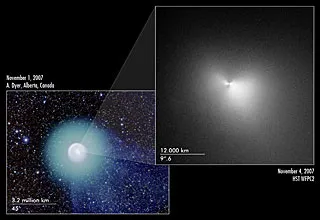
Credit: NASA, ESA, and H. Weaver (The Johns Hopkins University Applied Physics Laboratory) and A. Dyer, Alberta, Canada
The observatory's WFPC2 camera monitored the comet for several days, taking images on October 29 and 31 and November 4. Hubble's detailed eye can see details as small as 54 kilometers in diameter.
The image on the right, taken on November 4, shows the heart of the comet. The central portion of the image has been specially processed to highlight variations in the dust distribution near the nucleus. About twice as much dust lies along the east-west direction (the horizontal direction) giving the comet a bow tie or bowtie appearance.
The composite image on the left, from November 1, by amateur astronomer Alan Dyer, shows the complex structure of the coma, consisting of concentric layers of dust and a faint tail emanating from the right side of the comet.
The nucleus—the small solid body that is the source of the comet's activity—is still shrouded in bright dust, even 12 days after the spectacular outburst.
"Most of what Hubble sees is sunlight scattered from microscopic particles," explained Hal Weaver of Johns Hopkins University, who led the investigation. "But we may be starting to detect the emergence of the nucleus itself in this Hubble image."
The first time the Telescope observed the comet was on June 15, 1999, when the nucleus was not shrouded in dust. Although Hubble cannot resolve the nucleus, astronomers can infer its size by measuring its brightness. They deduced that the diameter of the nucleus was approximately 3.4 kilometers. They now hope to use the Hubble images to determine the size of the nucleus and thus estimate how much was lost during the outburst.
The two previous images, from October 29 and 31, show some interesting things, such as three "spurs" of dust emanating from the nucleus and an outburst of dust to the west of the nucleus.
However, they do not show large fragments near the heart of Holmes, unlike Comet 73P/Schwassmann-Wachmann 3 (SW3). Last year Hubble observations revealed a multitude of "mini-comets" ejected by SW3 after it dramatically increased in brightness. Ground-based images showed a large, spherical dust cloud suggesting the breakup of a fragment of the nucleus. Unfortunately, the large amount of dust near the nucleus and the relatively great distance from Earth (240 million kilometers or 1.6 AU for Holmes versus 15 million km or 0.1 AU for SW3) conspire to make detections of fragments near Holmes difficult, unless the fragments were almost as large as the nucleus itself.