Astronomers have detected a huge burst of radio energy from the distant universe that could open a new field in astrophysics.
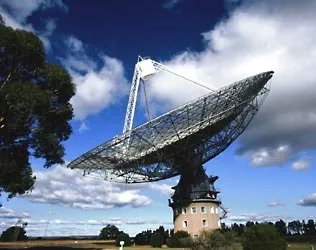
CSIRO Telescope
The research team, led by Duncan Lorimer of West Virginia University, reported its discovery to Science Express.
The radio burst appears to have originated at least 1.5 billion light-years away and was very strong.
"Normally the kind of cosmic activity we look for at that distance would be very weak but this one was so bright that it saturated the equipment," said Professor Matthew Bailes of Swinburne University.
So strong was it that it was dismissed as human interference. The energy (10 to the 33 Joules) is equivalent to a large power station working for billions of years.
"The burst would have been produced by an exotic event such as the collision of two neutron stars or the last gasp of a black hole as it evaporates completely," said Lorimer.
The burst, which lasted 5 milliseconds, was found by David Narkevik, upon reanalyzing the data taken with the Commonwealth Scientific and Industrial Research Organisation (CSIRO) Parkes telescope six years ago.
The researchers will reanalyze data from telescopes in search of more bursts like this one. The discovery is similar to the gamma-ray bursts found in the '70s.
To find and better study these bursts of incredible energy, better equipment would be needed, such as the Australian SKA Pathfinder, which will be built in 2012 and will have a wide field to see a large part of the sky.
Sources and related links
- Note at CSIRO
- Note at EurekAlert