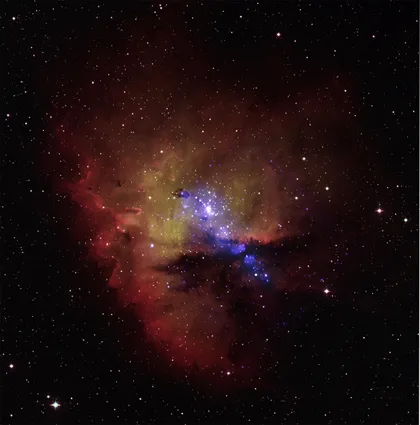
NASA/CXC/CfA/S.Wolk et al; Optical: NSF/AURA/WIYN/Univ. of Alaska/T.A.Rector
NGC 281 is a lively star formation region about 9,500 light-years away. This composite image (optical and X-ray) includes regions where new stars are forming and older regions containing stars about 3 million years old.
The optical data (seen in red, orange, and yellow) show a small open cluster of stars, long dark lanes of gas and dust, and dense knots where stars might still be forming. The X-ray data (purple), based on Chandra observations, show a different view. More than 300 individual X-ray sources are seen, most associated with IC 1590, the central cluster. The edge-on view of NGC 281 allows scientists to study the effects of powerful X-rays on the region's gas, the raw material for star formation.
A second group of X-ray sources is seen on both sides of a dense molecular cloud, known as NGC 281 West, a cold cloud of dust grains and gas. Most of the sources around the molecular cloud coincide with polycyclic aromatic hydrocarbon emission, a family of organic molecules containing carbon and hydrogen.
There also appears to be cold diffuse gas associated with IC 1590 that extends toward NGC 281 West. The X-ray spectrum of this region shows that the gas is at a few million degrees and contains significant amounts of magnesium, sulfur, and silicon. The presence of these elements suggests a recent supernova event in the area.
Chandra Blog
Did you know that the Chandra X-ray Observatory now has a blog?
The Chandra Blog offers fresh news from the Observatory and joins its other public communication services: Photo Album, press office, and resources.