Last Sunday, residents of various towns in the province of Entre Ríos reported seeing a luminous object. Based on the testimonies, the assumption was that a meteorite had fallen in the eastern part of the province.
The event quickly and massively resonated in the media, so I didn't think it was valuable to echo it, just to repeat the same information.
In a previous note, reader TR Marcelo asks me what news there was about the case, as he hasn't heard anything more about it.
Mass media, especially television, have the (bad) habit of covering events that generate public impact and then letting the event fall into oblivion.
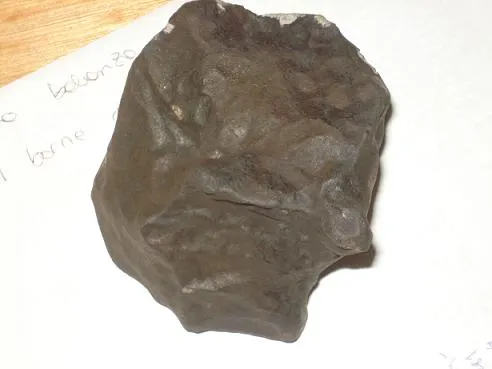
The fact is that the Asociación Entrerriana de Astronomía (AEA) reports that on Tuesday, April 8, they found rocks whose origin is presumed to be meteoritic. It is a piece the size of a fist that weighs approximately 700 gr and 4 to 5 small stones about 3 cm. All responded positively to magnetization and present the typical blackish color resulting from the heating of these objects as they descend in the atmosphere and are heated by friction.
The small pieces were found in a shade cloth in a nursery and a few meters away in a hole, the largest fragment. Our coordinator Mariano Peter presumes it could be a meteorite of rocky and metallic composition. He has described it as fragile, which opens the possibility that the impact fragmented the rock into a myriad of fragments that could have scattered across the terrain, thus complicating their search.
The Entre Ríos Police and Gendarmería used helicopters for an aerial survey but no crater has been found so far. The area is not very accessible, surrounded by wetlands, eucalyptus forests, and swamps.
A judge determined that the meteorites may only be used for scientific research and/or outreach.
The final confirmation about the presumed extraterrestrial origin of these pieces must be confirmed by laboratory tests and proper observation by specialists. The AEA has already been contacted by professionals interested in collaborating with this investigation.
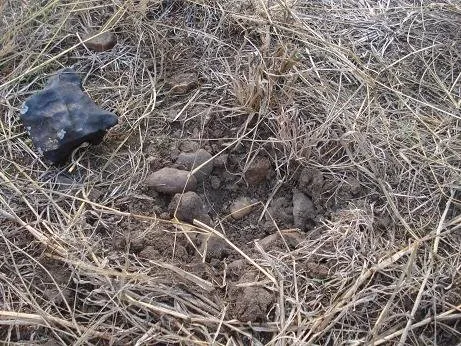
With the collaboration of the Provincial Police and locals, a new combing of the entire area of Colonia Berduc (Dto. Colón) was carried out and small pieces of about 3 cm in diameter were recovered. Images and measurements of the small crater where the largest fragment was found were also taken.
On this occasion, the AEA research group was composed of Juan Pablo Sotera, Milton Blumagen, and agricultural engineer Gustavo Blettler.
Soon they will release a special edition of their weekly television program "Ecos de Un Mundo Estrellado" on this topic, which can be seen on channel 11 Paraná and on the web at www.cielosur.com/ecos. I take the opportunity to suggest you visit the excellent site Cielo Sur. It offers much more than news and with the possibility of receiving its updates via newsletter or subscribing to El Mensajero de los Astros by Jaime García, via RSS.
This information is provided by Luis Trumper, President of the Asociación Entrerriana de Astronomía, from the institution's website, who, it's worth saying, behaved very professionally and with the patience required, in the face of the journalistic requests generated by the prominence the event had in the mass media.
Furthermore, Mariano Andrés Peter, coordinator of the Observatorio de Oro Verde - AEA, invites the public to go on Saturday, April 12 at 19:30 h. to the Observatorio de Oro Verde to attend an illustrated talk about the search and recovery work of these meteorite fragments carried out by our research team.
Finally, the AEA requests the collaboration of anyone who has information about any site where new fragments of these space rocks might be found.
Sources and related links
- Asociación Entrerriana de Astronomía
- Another good source of news is Axxón, where you can also subscribe via RSS.
Axxón: Latest data on the fall of a meteorite in Entre Ríos, Argentina
About the images
The two images belong to the Asociación Entrerriana de Astronomía.