Astronomers have found the best evidence so far of matter coming out of a young star in formation in the form of jets. Due to the spiraling motion, the jets help the star grow by removing angular momentum from the surrounding accretion disk.
"The theorists knew that a star has to lose angular momentum as it forms. Now, we see evidence to support the theory," says astronomer Qizhou Zhang of the Harvard-Smithsonian Center for Astrophysics (CfA).
Angular momentum is the tendency of a rotating object to continue rotating. It applies to a forming star because a star forms at the center of a rotating disk of gas. A star grows by gathering material from the disk. However, the gas cannot fall toward the star until the gas loses its excess angular momentum.
As hydrogen approaches the star, a fraction of the gas is ejected outward in a direction perpendicular to the disk in opposite directions in a bipolar jet.
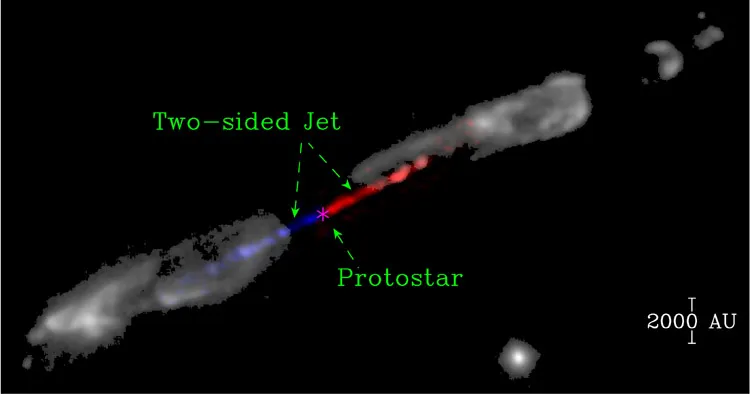
Using the Submillimeter Array SMA, an international team observed a Herbig-Haro object (HH) 211, located 1000 light-years away in the constellation Perseus. HH 211 is a bipolar jet traveling through space at supersonic speeds. The central protostar is about 20,000 years old with a mass of only 6% the mass of our Sun. It will eventually grow to become a star like ours.
Astronomers found clear evidence of rotation in the bipolar jets. The gas in the jets rotates at speeds of over 3000 miles per hour as it leaves the star at speeds greater than 200,000 miles per hour.
"HH 211 is essentially an 'inverted whirlpool.' Instead of water swirling down the drain, we see gas swirling outward," explained Zhang.
In the future, the team plans to carry out more detailed observations of the object and hopes to observe other protostellar jet systems.
"These are intrinsically difficult measurements. We need narrow jets to be able to detect signs of rotation and they must be close enough to observe them with high resolution," notes CfA astronomer Tyler Bourke.
The Submillimeter Array is an 8-element interferometer located on the summit of Mauna Kea and is a collaboration between the Smithsonian Observatory and the Academia Sinica Institute of Astronomy and Astrophysics (ASIAA).
ASIAA director Paul Ho notes that "A more powerful radio interferometer, the Atacama Large Millimeter/Submillimeter Array (ALMA) is under construction in northern Chile, as a more powerful version of the SMA. It will allow us to get closer to these stellar birthplaces with finer details and reveal the formation process directly."
Sources and related links
- CfA: Jets Are a Real Drag
- Paper: Submillimeter arcsecond-resolution mapping of the highly collimated protostellar jet HH 211, Chin-Fei Lee, Paul T.P. Ho, Aina Palau, Naomi Hirano, Tyler L. Bourke, Hsien Shang, Qizhou Zhang. DOI: 10.1086/522333
See abstract | arXiv
About the images
This composition of Herbig-Haro 211 shows submillimeter data from the SMA (blue and red) and near-infrared data from the VLT (gray). The SMA data were coded in blue for material approaching and in red for material moving away. The VLT shows emissions from hydrogen molecules produced by the jet.
Credit: SMA/Chin-Fei Lee & VLT/Naomi Hirano