It was a record-breaking year for astronomy. Astronomers identified the solar system with the most planets, measured the fastest flows of matter, and discovered the largest cosmic void. We were surprised by rare discoveries, such as the star with a tail and enigmatic bursts of radio waves whose source is still unknown.
On the national scene, we saw Comet McNaught pass by, the III Telescope Party was held at the Planetarium, and the 50th Meeting of the AAA took place. But the detection of cosmic rays and their link to AGNs was the news of the year.
Many of the year's astronomical discoveries were related to exoplanets:
Hubble studied the atmosphere of an exoplanet, water was detected on a planet in another solar system, the fifth planet around a star was discovered - the most populated solar system, aside from the one we inhabit. Recently, theoretical studies were conducted that predict the habitability of an exoplanet in Gliese 581.
Black Holes
Black holes did not cease to amaze us: hundreds and hundreds of these voracious ultradense objects were detected, the heaviest hole and then another black hole that broke records. We even came to wonder if these beasts really exist. And as if that weren't enough, the central black hole of a galaxy "attacked" a neighboring galaxy!
Top Observatories
There was good and bad news in the world of large instruments. The venerable Hubble Space Telescope made news when one of its most important instruments, the ACS, broke. One of the gyroscopes that help maintain its position also had no luck. The great instrument eagerly awaits the new year for its next servicing mission.
The Arecibo radio telescope suffered from political games, threatened with closure due to lack of funds.
But there was also good news, such as the opening of the Gran Telescopio Canarias, the largest optical observatory.
The Dark Side
Scientists continued to speculate about two of the greatest enigmas that permeate the Cosmos.
It was suggested that dark energy could be an illusion caused by the travel of light through a hypothetical distribution of matter in the Universe, as if it were a Gruyère cheese. Hubble detected rings of dark matter and a dark galaxy was discovered. They continued collecting data on dark energy, although we still have the same doubts as a decade ago.
The Unexpected Universe
Many times, scientists found what they did not expect, to their astonishment. For example, the bright star Mira and its comet-like tail extending several light-years, a phenomenon never seen before. Cosmologists try to explain the giant billion-light-year void and the strange ownerless burst.
Super-Supernovas
At the beginning of the year, astronomers discovered a rare new form of supernovas, based on observations of SN 2006gy.
Chandra and its X-ray "eyes" detected the brightest supernova and then another even more powerful stellar death was detected.
Galaxies and More Galaxies
The most distant galaxies and the largest collisions in the Universe were discovered. Also, the brightest galaxies. Galactic interactions, collisions, mergers, or clashes of galaxies that strongly activate star formation continued to be studied in 2007. And a detailed study of our Milky Way was conducted.
The fabulous GalaxyZoo project began, which is about to publish its first scientific results, and it was suggested that the Magellanic Clouds would be recent visitors.
Astronomy in Argentina
The Universidad de La Punta put into operation the Astronomical Observatory and the Fixed Planetarium.
It will also store images taken by telescopes located in space, and experts from the SOHO/LASCO Mission trained scientists through an agreement between ULP and NASA.
The 3rd Telescope Party and the 50th Annual Meeting of the Asociación Argentina de Astronomía were held. Some asteroids were named with Argentine names.
We saw Comet McNaught pass by across the country and the unexpected comet 17p/Holmes.
Rays and Lightning
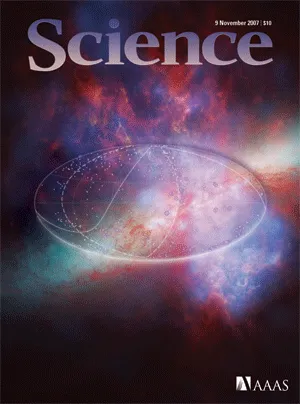
The big news of the year has undoubtedly been the discovery by scientists at the Pierre Auger Observatory, announced on November 8, that Active Galactic Nuclei are the most likely candidates to be the sources of the highest-energy cosmic rays that reach Earth.
The magazine Ciencia Hoy publishes a good article on the subject in its issue 102 of December/January. Clicking on the image of the note gives access to the Auger Observatory press release.
Sources and Related Links
The note is based on the article "2007: The year in astronomy", NewScientist.com by David Shiga
About the Images
Cover of Science November 9, 2007:Vol. 318. no. 5852
Projection of the high-energy cosmic rays detected by the Pierre Auger Observatory (circles) that are related to the positions of nearby quasars (crosses), a measure of the local galaxy distribution. The galactic plane and the Milky Way plane are marked. The background shows a composite of the nearby galaxy M82 observed by Spitzer, Hubble, and Chandra.
Kelly Krause/Science (figure: Auger Collaboration; photo: NASA/JPL-Caltech/STScI/Chandra X-ray Center/Univ. of Arizona/ESA/AURA/Johns Hopkins Univ.)