Legions of small black holes created during the Big Bang could be hidden in the center of the galaxy, creating a large amount of antimatter, according to a new study.
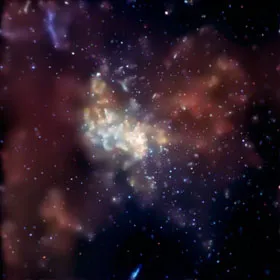
Astronomers know the galactic center is flooded with antimatter because it generates a vast cloud of gamma rays when it collides with normal matter. But none of the explanations given for the source of the antimatter (supernovae, binaries, dark matter decay) seems to be correct.
"It is clear that the antimatter cannot be explained using conventional astrophysics," says author Cosimo Bambi of Wayne State University.
Instead, the researchers propose that an enormous number of black holes provide the antimatter.
Cosmologists have already suspected that the Big Bang could have created trillions of primordial black holes. These small black holes would have been wandering through space while evaporating through the process called Hawking Radiation.
The evaporation rate depends on their mass - the more massive, the fewer particles it can evaporate.
The new study suggests that if primordial black holes have a mass of around 1016 grams - close to the same mass as an average-sized asteroid - they would naturally produce the correct amount of antimatter to explain the observations.
Bambi estimates that up to 1024 primordial black holes could exist in the galactic center. In this quantity they could even provide a significant fraction of dark matter.
The new study also suggests a way to test the hypothesis. Bambi calculated the number of particles that would be radiated from black holes with a mass of 1016 grams and found it would produce a notable increase in the high-energy glow of gamma rays toward the galactic center.
But observing the radiation could be very difficult. The gamma-ray satellite ESA's INTEGRAL carries an instrument called SPI that is capable of making the observation, but, according to the study's author, the amount of time needed to make a definitive measurement would be prohibitive. And NASA's GLAST mission will not operate at the energies relevant for testing the idea.
Sources and related links
- *NewScientist:Milky Way's antimatter linked to exotic black holes
- *Primordial black holes and the observed Galactic 511 keV line
Authors: Cosimo Bambi, Alexander D. Dolgov, Alexey A. Petrov
arXiv:0801.2786v1 - *Antimatter in the Milky Way
Authors: C. Bambi, A.D. Dolgov
arXiv:astro-ph/0702350v3 - *An asymmetric distribution of positrons in the Galactic disk revealed by big gamma-rays
Nature 451, 159-162 (10 January 2008) | doi:10.1038/nature06490; Received 30 March 2007; Accepted 16 November 2007
Georg Weidenspointner, Gerry Skiner, et al.
About the images
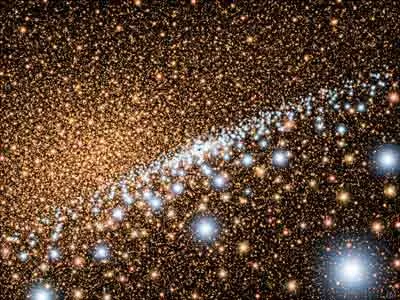
Young blue stars surrounding a supermassive black hole at the heart of the Andromeda galaxy.
Credit: NASA, ESA and A. Schaller (STScI)