Detailed analyses of two continent-sized storms in Jupiter's atmosphere in March 2007 show that the planet's internal heat plays a significant role in generating atmospheric disturbances.
An international team coordinated by Agustin Sánchez-Lavega of the University of the Basque Country presents its findings about the event in the January 24 issue of Nature.
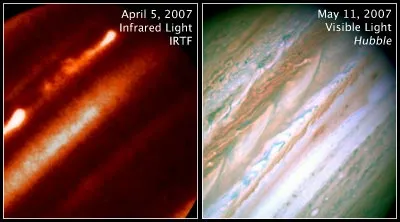
The team monitored the eruption and its evolution with unprecedented resolution using the Hubble Space Telescope, the infrared telescope in Hawaii, and telescopes in the Canary Islands (Spain).
A network of smaller telescopes around the world also supported the observations.
"Fortunately, we captured the start of the storm with Hubble when Jupiter was being observed in support of the observations being made by the 'New Horizons' spacecraft on its flyby on the way to distant Pluto. We saw the storm grow rapidly from about 400 kilometers to more than 2,000 kilometers in less than 24 hours," explains Agustín Sánchez-Lavega.
According to the research, the bright storms form in the planet's deepest water clouds, rising vigorously and injecting a mixture of ammonia and water ice up to more than 30 kilometers above the visible clouds. The storms move at the jet's maximum speed, over 600 kilometers per hour, disturbing it and generating behind them a wake of turbulent reddish clouds that encircle the entire planet. The infrared images perfectly show the bright festoons formed by the storms spreading downwind of the jet stream.
The jet stream remained practically unchanged during the development of the disturbance and after it ceased. Computer models simulating the development of the phenomenon suggest that the jet stream extends into Jupiter's deep atmosphere, more than 100 km below the visible clouds, where solar energy does not reach.
This phenomenon and the two observed in 1975 and 1990 show similarities for which scientists still find no explanation; thus, the three eruptions have occurred with a recurrence of about 15 to 17 years; the storms emerged at the peak of the jet, where the speed is maximum and there have always been two; and finally they moved in all cases at the same speed. As Sánchez-Lavega points out, "if in the future we are able to solve this puzzle, we will probably come to understand the mysteries hidden beneath Jupiter's clouds."
Sources and related links
- *HubbleSite:Internal Heat Drives Jupiter's Giant Storm Eruption
- *Diario Vasco:Researchers from the UPV reveal new data on Jupiter's meteorology
*Nature 451, 437-440 (24 January 2008) | doi:10.1038/nature06533; Received 30 July 2007; Accepted 29 November 2007
Depth of a strong jovian jet from a planetary-scale disturbance driven by storms;
A. Sánchez-Lavega et al.
About the images
Credit:NASA, ESA, IRTF, and A. Sánchez-Lavega and R. Hueso (Universidad del País Vasco, Spain )