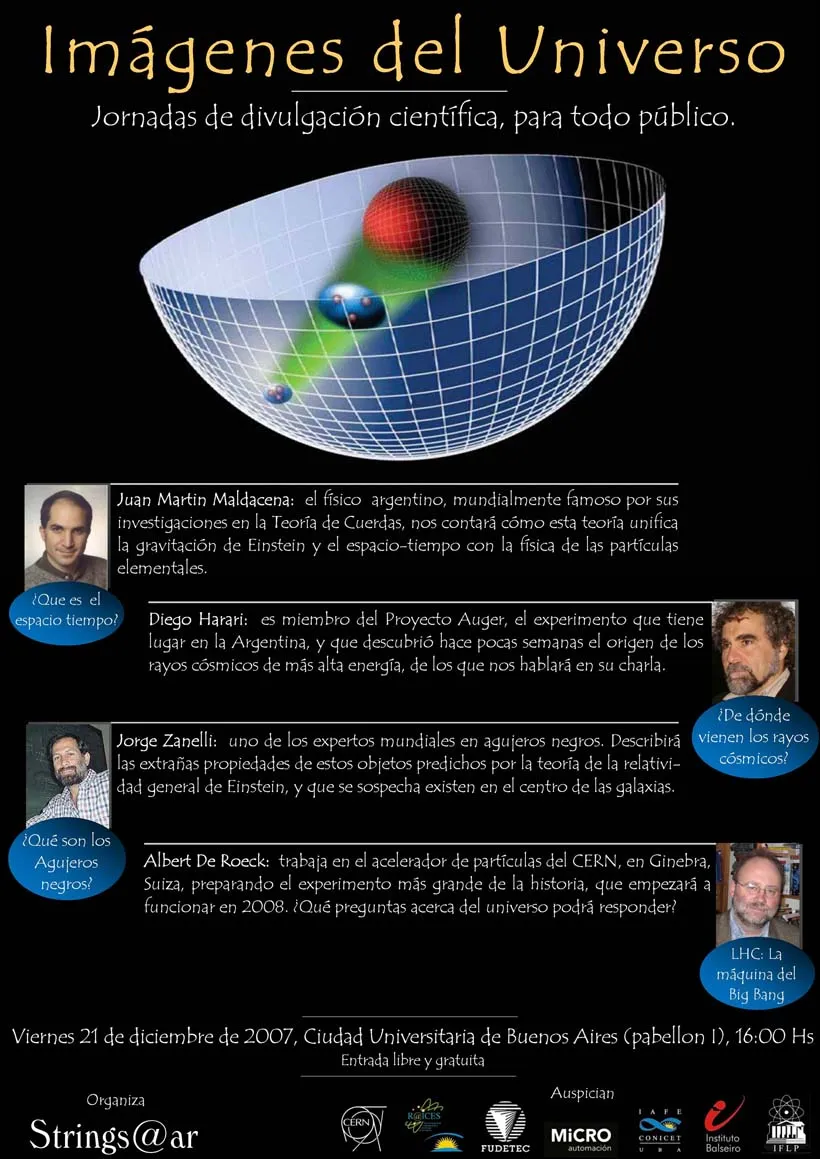
A scientific look at the topics that keep us up at night, at the Planetarium every Thursday at 20 h.

The Galileo Galilei Planetarium has scheduled a series of 7 talks, weekly, on Thursdays at 20 h, starting today. As reported on its website, the talks will be:
First Talk - 01/17/08 - Galo Soler Illia - Nanotechnology
Nanotechnology: Size does matter
At the beginning of the 21st Century, we are witnessing a revolution in the way we understand matter. Nanotechnology gives us the possibility to master matter in a way previously unthinkable, which has enormous consequences for our culture: production of new materials, cleaner and more sustainable energies, advances in medicine, environmental care. In this brief talk, I will show scientific and technological aspects of this new topic, which is already knocking on our doors.
Brief CV: Galo Soler-Illia was born in Buenos Aires on 05-31-1970. He is a Lic. and Dr. in Chemistry from UBA, an Adjunto Researcher for CONICET, an Associate Professor at FCEN, UBA and a Professor at the Graduate School of UNSAM. He has worked for ten years in the area of micro- and nanomaterials, in Argentina and in France. He currently heads the Nanomaterials Group of the Chemistry Department of the Comisión Nacional de Energía Atómica. He has published more than 60 scientific articles in the area of nanomaterials, and has received the “Venancio Deulofeu” prize in Chemistry 2006 (Acad. De Cs. Exactas y Naturales) and the Bernardo Houssay 2006 prize, for Young Researcher in Exact Sciences (SECyT)
Second Talk - 01/24/08 - Diego Golombek - Chronobiology
Summary: What time is it in the body when we live in a changing world? Does biological time exist? Is it different from physical time? What happens when we work at night, or in shifts, or if our soccer team has to travel to Japan to play the intercontinental cup? What time is best to take medicine, take an exam, play a tennis match or take a shower? How can we estimate the passage of time? All this, and much more, in the fascinating world of chronobiology, the study of the time machine we all carry inside.
CV: Doctor in Biology (UBA), Researcher for CONICET, Full Professor and Director of the Chronobiology Laboratory (Universidad Nacional de Quilmes). He has published about 80 scientific papers in international journals and 12 books on science and science communication. He has received, among others, the Guggenheim Fellowship, the national science prize "Bernardo Houssay", the IgNobel prize, the Konex merit prize and the "Ciudad Capital" prize from the Instituto de Ciencia y Tecnología de México.
Third Talk - 01/31/08 - Carolina Vera - Climate Change
Talk summary
Human-induced climate change has recently emerged as one of the scientific problems with the greatest impact on our society. In this sense, the talk will address questions such as: How can human activities alter the climate? How are future climate scenarios obtained at global and regional scales? How does the national and international scientific community approach this task? What are the current progress and limitations in estimating climate change scenarios?
Brief biographical sketch
Carolina Vera is a Doctor from the Universidad de Buenos Aires with a specialization in Atmospheric Sciences.
She is currently a Professor and Vice Dean of the Facultad de Ciencias Exactas y Naturales of UBA, and a Researcher and Deputy Director of the Centro de Investigaciones del Mar y la Atmósfera (CIMA), CONICET-UBA Institute.
Her current research lines focus on climate variability and change in the Southern Hemisphere and its influences on South America. She has made numerous publications in international journals on the subject, supervises undergraduate and doctoral students and has active participation in international scientific programs, being in particular a member of the Scientific Committee of the World Climate Research Program (WCRP).
Fourth Talk - 02/07/08 - Daniel Carpintero - Astronomy
Topic: Today's cosmology: the new vision of the Universe - At the beginning of the SXX, it was discovered that the Universe is expanding, giving rise to the Big Bang theory. In the mid-SXX, it was discovered that most matter is invisible. At the end of the SXX, it was discovered that there is a form of energy, Dark Energy, that accelerates the Universe. A curious and exciting journey to the ends of the Universe using these three milestones of modern cosmology as a springboard.
Dr. Daniel Carpintero, professor and researcher at the Facultad de Ciencias Astronómicas y Geofísicas of UNLP.
Fifth Talk - 02/14/08 - Héctor Vucetich - Physics
Topic: The origin of ideas about space and time - Ideas about space and time originated at the dawn of civilization, but matured slowly over three thousand years.
We describe that process, and its relationship with art.
Dr Héctor Vucetich - Brief CV: He obtained the title of Doctor in Physical-Mathematical Sciences at the Universidad Nacional de La Plata in the year 1967. He has been a Full Professor at the Facultad de Ciencias Astronómicas y Geofísicas of the Universidad Nacional de La Plata since the year 1983, is a Member of the Asociación Argentina para el Progreso de las Ciencias, the International Astronomical Union, the International Committee on General Relativity and Gravitation and the Asociación Argentina de Astronomía.
He has received numerous grants from CONICET, the Municipality of La Plata and the Fundación Antorchas.
He has supervised 20 doctoral theses and has taught numerous graduate courses.
The doctor Vucetich has published more than 80 papers in national and international peer-reviewed journals and more than 40 publications in conference proceedings
Sixth Talk - 02/21/08 - Sebastián Apesteguía
Talk framework: Argentina before History / History of dinosaurs / CRETACEOUS ARGENTINA / ARGENTINA 235.000.000 of years ago / Dinosaurs, evolution and extinction / Argentina: Terra Dinosaurorum
CV - Brief: He is a paleontologist from the Universidad de La Plata and works at the Fundación Félix de Azara.
He teaches Herpetology at Universidad CAECE and has taught Paleontology courses in Bolivia, Ecuador and Argentina. He specializes in Cretaceous reptiles. He is a member of the Asociación Paleontológica Argentina, the Sociedad Científica Argentina, the Fundación “Félix de Azara”, the Asociación “Tierra de Exploradores” and the Society of Vertebrate Paleontology.
Seventh Talk - 02/28/08 - Guillermo Martínez
Borges and mathematics: Guillermo Martinez illuminates the aesthetic relationship between literature and mathematics, traces the elements of this science in Borges's work and demonstrates the deep articulation of the mechanisms of abstraction and logical structuring in his stories, in his style and in his artistic creed
Guillermo Martínez: He completed his degree in Mathematics at the Universidad del Sur in 1984 and has lived in Buenos Aires ever since, where he earned a doctorate in Mathematical Sciences, specializing in Logic. Simultaneously, he developed his career as a writer. In 1985, he won first prize (shared) for short story in the 1st Biennial of Young Art. In 1988, his second book of short stories, Infierno
Grande, won the 1st prize from the Fondo de las Artes and was published in 1989 by Editorial Legasa.
In 1993, his first novel, Acerca de Roderer, published by Planeta, appeared. That same year, he traveled to Oxford, where he lived for two years conducting postdoctoral studies in mathematics.
In 1998, he published his second novel, La mujer del maestro, which also appeared in Spain and Serbia. He regularly contributes articles, short stories, and reviews to the Buenos Aires newspapers La Nación, Clarín, and Página 12.
His novel Crímenes Imperceptibles became an international success. In Argentina alone, it sold more than 100,000 copies.
Sources and related links
About the images
Image from the Planetario website