The end of January is a somber time for NASA due to the anniversary of three of the greatest tragedies in the history of American spaceflight.
On January 27, 1967, three astronauts who were part of NASA's first astronaut group - Virgil "Gus" Grissom, Edward White and Roger Chaffee - died during a routine ground test of the Apollo 1 capsule.
The astronauts suffocated when an electrical spark started a fire that consumed the oxygen in their pressurized cabin.
Another tragic event that occurred in January is the remembered Space Shuttle Challenger accident, which occurred on January 28, 1986. The spacecraft was carrying the first teacher-astronaut, Christa McAuliffe, who died along with the rest of the STS 51-L crew, 73 seconds after liftoff.
In June 1986, a commission appointed by President Reagan to investigate the accident, chaired by William P. Rogers, found that rubber O-rings that were supposed to seal the joint between the booster rocket segments had failed at liftoff due to the low temperature. The spacecraft crew were Francis "Dick" Scobee, Michael J. Smith, Ronald McNair, Ellison Onizuka, Gregory Jarvis, Judith Resnik and Christa Corrigan McAuliffe.
Roger Boisjoly, an engineer at Morton Thiokol, the company that built the engines, warned his superiors and NASA officials that the joints would not withstand low temperatures.
Seventeen years later, tragedy struck NASA again. On February 1, 2003, after a 16-day mission, STS-107, the space shuttle Columbia disintegrated upon reentry. The problem originated at liftoff, when the orbiter was struck on the underside of the left wing by a piece of polyurethane foam that came off the external tank insulation.
Due to the impact of this fragment, thermal protection tiles near the landing gear were dislodged; in this way, the searing heat of the plasma that forms during atmospheric reentry entered, causing the melting destruction of the internal structure of the left wing, large enough to produce destabilization and detachment.
The next mission, STS-122, will see the Space Shuttle Atlantis fly to the International Space Station (ISS) to deliver the Columbus laboratory. The crews will use robotic arms and a series of spacewalks to attach the laboratory to the station. The 24th shuttle mission to the ISS was scheduled to launch on February 7, 2008.
This year, on October 1, the North American Space Agency celebrates 50 years of exploration and discovery thanks to a huge community of technicians and scientists and the courage of those who knew how to give their lives in pursuit of this very human space adventure.
Sources and related links
- *Note based on an article from Space.com: NASA Remembers Three Space Tragedies, by Clinton Parks
- *Wikipedia: Space Shuttle Challenger disaster
- *Microsiervos: Seven myths about the Challenger disaster
- *Portal PlanetaSedna: The Challenger tragedy
- *Astroguía: Video of the disastrous Challenger shuttle accident
- *NASA: Challenger STS 51-L Accident
- *Sondas Espaciales: Special: Space Shuttle Columbia accident
- *NASA: Space Shuttle site
About the images
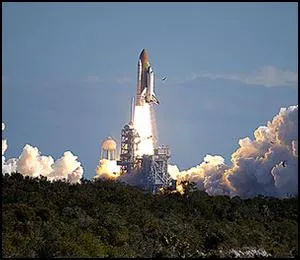
Launch of Space Shuttle Columbia, STS-107. Credit NASA