The European Space Agency (ESA) orbital gamma-ray observatory Integral has made the first unambiguous discovery of very energetic X-rays coming from a galaxy cluster.
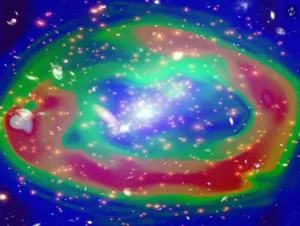
The Ophiuchus galaxy cluster is one of the brightest in the sky in X-ray wavelengths. The detected X-rays are too energetic to originate from the gas within the cluster and suggest that gigantic shock waves must be traveling through the gas, turning the cluster into a giant particle accelerator.
Most of the X-rays come from the cluster's hot gas, which in the case of Ophiuchus is extremely hot, at 100 million degrees Kelvin. Four years ago, data from the Italian/German satellite BeppoSAX showed a possible extra component of energetic X-rays in the Coma cluster.
"Two groups analyzed the data. One group saw the component but the other did not," says Dominique Eckert, of the Integral Science Data Centre (ISDC), University of Geneva. So Eckert and colleagues at the ISDC launched an investigation into it.
They returned to Integral's all-sky survey and found that it indeed showed an unambiguous detection of very energetic X-rays coming from the galaxy cluster. These rays could be produced in two ways, but both involve high-energy electrons.
The first option is that the electrons are captured in the magnetic field and would spiral around the magnetic lines, releasing synchrotron radiation in the form of X-rays. The electrons would be extremely energetic, carrying more than 100,000 times the energy of the electrons in the alternative scenario.
The other option is that the electrons are colliding with microwaves left over from the origin of the Universe that bathe space. In those collisions, the electrons lose some energy emitted as X-rays.
Determining which scenario is correct will be the next work for the team. They plan to use radio telescopes to measure the cluster's magnetic field. They also plan to use HESS (High Energy Stereoscopic System) in Namibia. This giant telescope looks for the brief flash generated when high-energy gamma rays collide with particles in Earth's atmosphere. If HESS sees those flashes coming from Ophiuchus, astronomers will know that the synchrotron scenario is correct.
In any case, the electrons themselves are probably accelerated to high energies by shock waves traveling through the cluster's gas. The shock waves are produced when two clusters collide and merge. The question is how recently Ophiuchus "devoured" its companion cluster.
In the synchrotron scenario, the high-energy electrons cool very quickly. If the team finds that this is the case, then the collision must still be in progress. In the alternative, cooling takes a long time and the collision could have taken place at any time in the past.
One thing is certain: nature has transformed the galaxy cluster into a powerful particle accelerator, perhaps 20 times more powerful than CERN's LHC (Large Hadron Collider), which would begin its operations this year.
"Of course, the Ophiuchus cluster is somewhat larger. While the LHC is 27 km, the cluster is over two million light-years in diameter," says Stéphane Paltani, a member of the ISDC team.
A paper with the results will appear in an upcoming edition of Astronomy and Astrophysics.
Sources and related links
- *ESA: X-rays betray giant particle accelerator in the sky
- *ScienceDaily: Giant Particle Accelerator Discovered In The Sky
- *'Integral discovery of non-thermal hard X-ray emission from the Ophiuchus cluster' by D. Eckert, N. Produit, S. Paltani, A. Neronov and T. Courvoisier;
Accepted: 05 December 2007
DOI: 10.1051/0004-6361:20078853
PDF File (219.4 KB) - *El Tamiz: How does a particle accelerator work? - Acceleration
About the images
Shock waves traveling through the gas (in red) as two galaxy clusters collide and merge.
Credit: ESA (Image by Christophe Carreau)
Note: On the ESA site cited above, an animation on the topic can be downloaded.