First results from a new instrument at the W.M. Keck Observatory in Hawaii are helping scientists to knock down assumptions about the powerful explosions called novae and produced the first unified model for a nearby nova, RS Ophiuchi.
"We were preparing for a routine engineering process when the nova appeared. It was very bright and easy to observe, so we took this opportunity and turned it into gold," says team member Marc Kuchner from NASA's Goddard Space Flight Center.
Kuchner and his colleagues used the Keck interferometer in its "nulling" mode. The instrument combines starlight using two 10-meter telescopes. In the nulling form, the interferometer suppresses the blinding light of a star so researchers can study its surroundings. This helps observe very diffuse objects that are near bright sources and produces a resolution power 10 times greater than a Keck telescope working alone. It is a unique instrument of its kind in operation.
Tests were being carried out on February 12, 2006 when a nova appeared in the constellation Ophiuchus. The system, known as RS Ophiuchi, consists of a white dwarf and a red giant. The giant is gradually shedding its massive outer layers and the white dwarf is accumulating mass. Finally, the surface of the white dwarf will reach a critical temperature that will ignite a thermonuclear explosion causing a huge brightening of the system. This has already occurred and has been observed at other times: 1898, 1933, 1958, 1967, and 1985.
Almost 4 days after the detection of the nova, the group observed the explosion with the Keck Nuller. The team prepared the instrument to block the light from the nova, allowing them to see the more diffuse surrounding material. Subsequently, the equipment was adjusted to observe the extremely bright zone of the explosion.
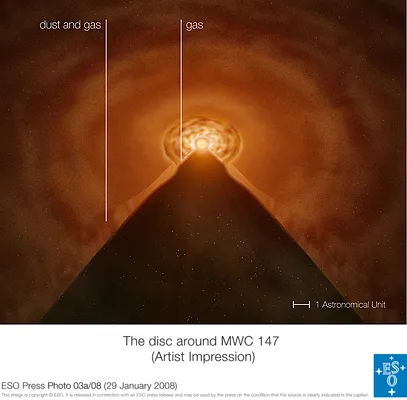
The nuller saw no dust in the bright zone, presumably because the explosion vaporized the dust particles. But farther from the white dwarf, at distances beginning around 20 times the Earth-Sun distance, the nuller recorded the spectral signature of silicate. The blast wave had not yet reached that zone, so the dust predated the explosion.
"Astronomers had previously thought that nova explosions actually create dust," says Richard Barry, author of the paper on the observations to be published in Astrophysical Journal.
The team thinks that the dust is created when the white dwarf strips material from the red giant's winds, swirling regions of higher density, like the arms of spiral galaxies. Within those arms, atoms reach sufficiently low temperatures and high densities to join together and form dust particles. The blast wave has already destroyed that swirling pattern but it should re-form in the coming years and future observations with the Spitzer Space Telescope will be able to see it.
Most studies of the system relied on spectroscopic models, but those models have not been able to distinguish various components in as much detail as the interferometer.
The paper "Milliarcsecond N-Band Observations of the Nova RS Ophiuchi: First Science with the Keck Interferometer Nuller" will be published in the May 1st edition of Astrophysical Journal.
Sources and related links
- *EurekAlert: NASA-funded instrument nails nova
- *W.M.Keck: NOVA PHENOMENON EXPLAINED WITH NULLING MODE AT KECK OBSERVATORY
About the images
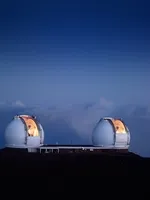
The two 10m telescopes of the W.M. Keck Observatory. Credit: Rick Peterson