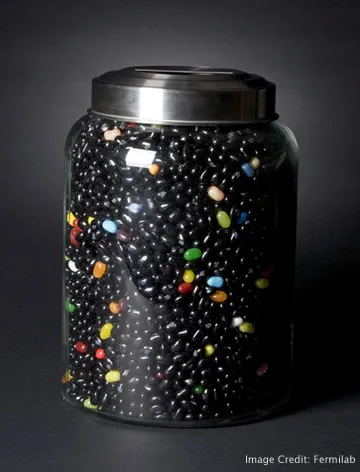
Like the jelly beans in this jar, the Universe is mostly dark: 70% dark energy and 26% dark matter. Only 4% (the same proportion as the colored jelly beans in the jar) of the Universe - including the stars, planets, and us - is made of familiar atomic matter.
The Chandra Observatory site proposes an exercise: How many jelly beans fill a one-liter container?
There are many possibilities, but here is one:
How big is a jelly bean?
A typical jelly bean would be about 2 cm long and 1.5 cm in diameter.
Do the jelly beans completely fill the container?
The irregular shape of the jelly beans results in them not being tightly packed; approximately 80% of the bottle's volume is filled.
The number of jelly beans is the occupied volume of the container divided by the volume of a single jelly bean.
The formula would be:
number of jelly beans = occupied volume / volume of 1 jelly bean
The volume of a jelly bean is approximately that of a small cylinder of 2 cm x 1.5 cm.
To calculate it, we use the formula:
pi x r^2 x h
This formula is used to calculate the volume of a cylinder.
We have a constant: pi (which we know is 3.14159...), the radius squared, and h which is the height.
Note: the symbol ^ is used to express exponentiation. That is, ^2 is squared, r^2 is the radius squared.
Our jelly bean, we said, has a diameter of 1.5 cm. The radius is half the diameter. The height (h) we said would be 2 cm.
Substituting, the formula would be:
pi x (1.5 cm/2)^2 x 2 cm =
= 3.14 x 0.75^2 x 2
= 3.14 x 0.5625 x 2
=3,53
The result is expressed in cubic centimeters.
So the volume of a jelly bean would be, on average, about 3.5 cm3.
Returning to the equation to calculate the number of jelly beans in the container:
Number of jelly beans = occupied volume of the container / volume occupied by 1 jelly bean.
If the bottle or jar is one liter and we said that since they are not all very, very tightly packed they don't occupy all the space, that there are empty spaces, and we said that therefore, the jelly beans occupy, more or less, 80% of the one-liter bottle, then the occupied volume is:
80% of 1 liter. 1 liter is 1000 cm3.
Therefore, the occupied volume is 80% of 1000 cm3, that is, 800 cm3.
The volume of the jelly bean we said is 3.5 cm3, so we arrive at the result:
Number of jelly beans = 800 cm3 (the occupied volume) / 3.5 cm3 (the volume of one jelly bean) = 228.5 jelly beans.
The idea was implemented at the meeting of the American Astronomical Society held in Austin, Texas, with a 1.5-gallon jar filled with jelly beans in the same proportion as the mass distribution of the Universe, that is, 96% dark. The younger attendees had to participate with their answer on how to calculate the number of jelly beans in the jar. The winner took home the jar with the jelly beans (hmmm!) and a Chandra calendar.
Sources and related links
*Chandra Blog: Do We Live in a Jelly Bean Universe?
About the images
Credit Fermilab