An international team of astronomers is conducting a long-range study of the movements of the gigantic jets produced by active galactic nuclei. They are using the capabilities of the VLBA (Very Long Baseline Array) to image 200 galactic jets at regular intervals, tracking their movements and studying the properties of their magnetic fields.
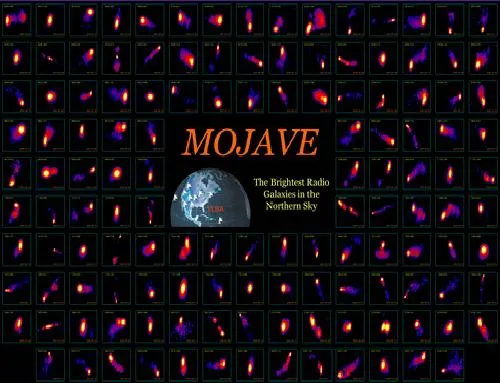
The research team produced movies of 100 of the jets, allowing measurement of their speed and direction of movement. "These results add to a rich and still growing dataset that is available to the astronomical community as a tool for understanding the many unresolved questions about these jets," says Matthew Lister of Purdue University.
The study is called MOJAVE - Monitoring Of Jets in Active galactic nuclei with VLBA Experiments - and began in 2002. It is the successor to a previous study that imaged about 200 jets between 1994 and 2002 (VLBA 2 cm Survey).
The jets are caused by the gravitational energy of black holes containing hundreds of millions of times the mass of the Sun.
These time-lapse movies have revealed a variety of interesting behaviors in the jets. For example, the powerful radio galaxy 3C279 produced a bright emission that moved along a straight path for 15 years, then suddenly increased in brightness, showed a change in its magnetic field, and changed direction.
"These time-lapse movies of complex movements are real-world data that allow researchers to refine their computational simulations of the jets, leading them to a much better understanding of the physics involved in these impressive cosmic particle accelerators," adds Lister.
The MOJAVE data will be valuable for comparison with the gamma-ray information that will be collected by the upcoming GLAST satellite.
Sources and related links
- *Physorg: VLBA Movies Reveal New Details of Cosmic Jets
- *MOJAVE Project
- *NRAO: VLBA Movies Reveal New Details of Cosmic Jets
About the images
Cover of the MOJAVE Project site.
Credit: NRAO VLBA