In the supernova remnant Kes 75 there is a pulsar whose behavior is very similar to magnetars, so they think the object could be a "link" between those two objects.
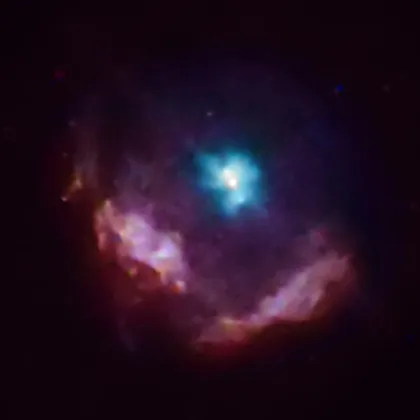
In the image from the Chandra X-ray Observatory, the supernova remnant Kes 75 is shown, located almost 20,000 light-years away. The explosion of a massive star created the remnant along with a pulsar, a rapidly rotating neutron star.
Low-energy X-rays are colored red and high-energy ones, blue. The pulsar is the bright point at the center of the image. The pulsar's rapid rotation and strong magnetic field generated a wind of energetic matter and antimatter particles that travel at nearly the speed of light. This wind has created a large magnetized bubble of high-energy particles called a pulsar wind nebula, seen as the blue region around the pulsar.
The magnetic field of the pulsar in Kes 75 is thought to be more powerful than most pulsars but less powerful than magnetars, a class of neutron star with the most powerful magnetic fields known in the Universe. Scientists are trying to understand the relationship between these two classes of objects.
Using Chandra's RXTE (Rossi X-ray Timing Explorer) instrument, scientists Fotis Gavriil of the Goddard Space Flight Center and his colleagues discovered powerful X-ray bursts from this pulsar that are similar to those previously observed in magnetars. It is thought that these bursts occur when the surface of the neutron star is altered by sudden changes in the magnetic field. These bursts were accompanied by magnetar-like changes in the pulsar's spin rate. Fortuitously, Chandra observed the pulsar near the time of the bursts and it was much brighter than it had been in observations obtained six years earlier. This brightness and the changes in the pulsar's X-ray spectrum are consistent with the behavior of a magnetar. It is therefore thought that this object fills the gap between pulsars and magnetars.
Harsha Sanjeev Kumar and Samar Safi-Harb of the University of Manitoba have independently used Chandra observations to argue that the pulsar in Kes 75 is revealing itself as a magnetar.
Sources and related links
Chandra:Kes 75:One Weird Star Starts Acting Like Another
About the images
Credit:NASA/CXC/GSFC/F.P.Gavriil et al.