The space around Earth is a place crowded with traffic. More than 500 active satellites are there now. Some are transmitting radio, television, and telephone signals; others are gathering information about the atmosphere and weather; others help with navigation (GPS) and the rest conduct space research.
Soon, the space around the Moon will also be quite busy. China, Japan, India, Russia, and the United States have sent or are planning to send satellites to orbit it.
The reason for this is that the Moon is there nearby. We can see it better than anything else in space. And it is reachable even by countries whose space programs are in their infancy.
In fact, two of those nations are already there: Japan and China are orbiting the Moon right now.
Japan's Kaguya spacecraft, formerly known as SELENE, reached the Moon in October 2007. Its mission is to make detailed maps of the surface, search for water (a key resource for future human landings) frozen in deep craters, and study the gravitational field of our natural satellite.
Barbara Cohen, a self-described "lunatic" scientist from the Marshall Space Flight Center, says "Kaguya is the Cadillac of missions now. It's huge, consisting of three separate satellites and has excellent instruments. It will do a lot of particles and fields work that no other orbiter currently has planned. Plus, it will be able to point all its instruments at the same spot on the Moon simultaneously."
The main satellite carries 13 scientific instruments, including a high-definition camera that is sending incredible images of lunar landscapes.
About a month after Japan reached the Moon, China followed with the entry into orbit of the Chang'e-1 spacecraft on November 5, 2007. During its first year of mission it will map the Moon by taking three-dimensional images of the entire surface. It will send the first detailed images of some areas near the poles where frozen water is most likely to be found.
Chang'e-1 is the first of a series of three spacecraft: Chang'e-2 will land and have a rover and Chang'e-3 will bring samples from the Moon. The Chinese hope, someday, to send humans to build an outpost but for now they focus on gathering knowledge and experience.
Towards the end of the year India plans to send its own probe: Chandrayaan-1. In Sanskrit "Chandrayaan" means "Lunar Craft". A NASA instrument, the Moon Mineralogy Mapper, will make a detailed map of mineral locations. Chandrayaan-2, planned for 2010 or 2011, will put a rover on the Moon, to bring samples and perform chemical analyses.
NASA plans to send the Lunar Reconnaissance Orbiter (LRO), a spacecraft with many instruments to map the Moon and locate key resources.
"The LRO mission will provide the highest resolution images - about 50 cm per pixel. This means it will be able to see rocks about two feet in diameter. This allows us to search for potential landing sites to evaluate the terrain and hazards for a human return. It will also have an instrument to assess radiation damage to human skin," explains Cohen.
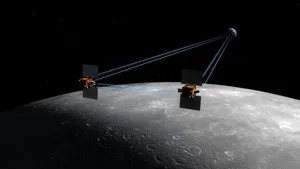
In 2011, NASA's Gravity Recovery and Interior Laboratory (GRAIL) spacecraft will spy into the depths of the Moon to reveal its anatomy and history. The mission, part of the Discovery program, will send two twin spacecraft around the Moon for several months to measure its gravitational field in great detail and to try to answer questions about how Earth and other planets in our solar system formed.
All the data collected will help with a human return to the Moon. But no return would be complete without a lunar pioneer: Russia. After the space race in the '70s, the Soviet Union virtually abandoned lunar exploration. Now, the Russian space program could launch its Luna-Glob project in the coming years.
"There is a bit of overlap between the missions, but that's OK in science. We will have more coverage and better resolution by being able to add data from similar instruments." adds Cohen.
It also happens that NASA does not want to rely on data collected by other countries to return humans to the Moon, as they do not want to depend on third parties who might cancel their commitment. Hence they want to have their own data and instruments.
How long will it take for the Moon to be as crowded with satellites as Earth? Not long, with the current rush. By the end of 2011, nine satellites could be making noise up there.
I allow myself to add, that we should think very seriously about a space debris program, as we are filling Earth's orbits -and soon the Moon's- with waste that should not be there indefinitely.
Sources and related links
Science@NASA: Who's Orbiting the Moon?
About the images
Artist's conception of the GRAIL mission, with its two twin spacecraft that will orbit the Moon in tandem for several months to measure its gravitational field in great detail.
Credit: NASA/JPL