Investigating a bright bubble of gas and dust surrounding a dying star similar to our Sun, the Hubble Space Telescope reveals the richness of previously unseen structures in the planetary nebula NGC 2371.
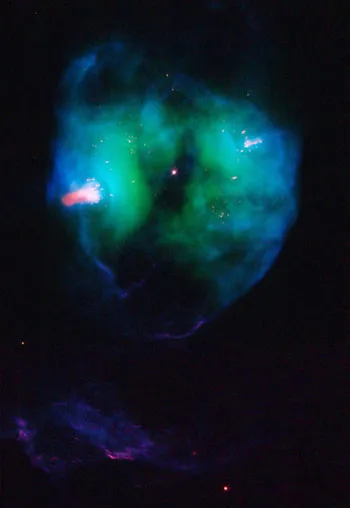
The visible remnant star at the center is the super-hot core of what was once a red giant, now without its outer layers. Its surface temperature is 240,000 degrees Fahrenheit, about 130,000 degrees Celsius. Prominent pink clouds of cold, dense gas lie on opposite sides of the central star. They are called FLIERs, for Fast Low-Ionization Emission Regions. These are bubbles of material that form a symmetrical design in some planetary nebulae. Also striking are the numerous, very small pink dots that mark the relatively dense and small knots of gas that also lie on diametrically opposite sides of the star.
These elements appear to represent the ejection of gas from the star along a specific direction. The direction of the jets has changed over time. The reason for this behavior is not well understood, but it could be related to the possible presence of a second star orbiting the visible central star.
We have seen other beautiful examples of planetary nebulae here and there we also mentioned FLIERs, for example in Hubble captures 4 stars with glamour.
A planetary nebula is an expanded cloud of gas ejected from a star that is near the end of its life. In this episode, dense winds occur, vast volumes of gas that expand from the star and shape exotic forms.
The nebula glows due to ultraviolet radiation from the hot remnant at the center. In just a few thousand years the nebula will dissipate into space. The central star will gradually cool until it finally becomes a white dwarf, the final stage of evolution for almost all stars.
NGC 2371 is located 4,300 light-years away in the constellation Gemini. The images from the Wide Field Planetary Camera were taken in November 2007.
Sources and related links
- Hubblesite: The Last Confessions of a Dying Star.
More information at Hubble Heritage program - Bad Astronomy: Frankenstein nebula
About the images
The Hubble image is false color, prepared from exposures taken through filters that detect light from sulfur and nitrogen (red), hydrogen (green), and oxygen (blue).
Credit: NASA, ESA, and the Hubble Heritage Team (STScI/AURA)