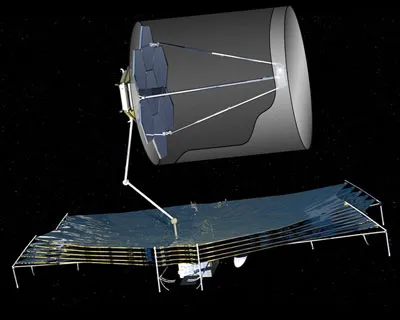
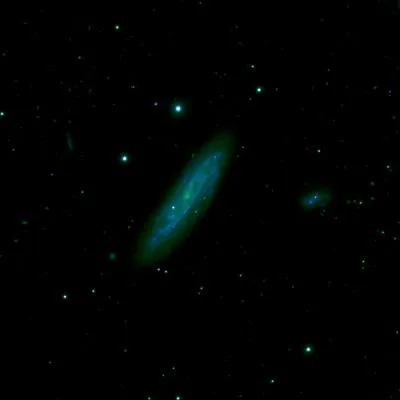
Astronomers from the University of Nottingham will study icy cosmic dust millions of light-years away using the largest space telescope ever built.
Experts from the School of Physics and Astronomy will use the Herschel Space Observatory as part of a huge survey to learn more about the coldest objects in the Universe.
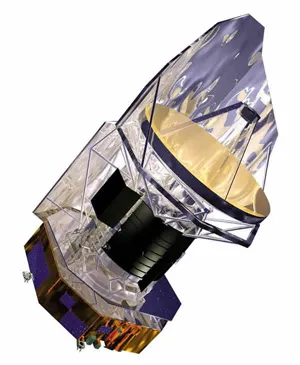
The Herschel observatory, to be launched by the European Space Agency (ESA), promises to take our knowledge of the Universe to a new level. It will have the largest mirror of any space telescope - twice that of Hubble - and will detect the glow of cosmic dust at -250° C. As well as being able to see nearby star-forming regions in our galaxy, it will be able to see into the distant Universe, more than 10 billion years ago.
It will operate in the submillimeter spectrum, between the far infrared and microwaves. Much of that light -0.055 to 0.67 mm in wavelength- cannot penetrate the atmosphere, so the only way to study it is from space.
Dr. Loretta Dunne, from Nottingham, explains that cosmic dust "plays an important role in helping hot gas cool and collapse to form galaxies and stars and is the raw material for forming planets like ours. Earth is truly a giant ball of cosmic dust! Discovering how it is created, how much survives and how much is out there are important pieces of the puzzle about why the Universe is as we see it."
The telescope is named after astronomer Sir William Herschel (1738–1822), who demonstrated the existence of infrared light, among other discoveries, such as that of the planet Uranus.
Cosmic dust consists of small particles of carbon and silicates that form in stars and supernovae. They are very small particles - about 800 times smaller than the width of a human hair - which makes them very good at capturing starlight, creating dark patches seen in galaxies. The grains are heated by the starlight in which they bathe and the special detectors on board Herschel will image that faint glow.
The observations will take 600 hours over the three-year lifetime of the mission.
Among other things, it will investigate:
The "stolen" light from stars in more than 100,000 galaxies, absorbed by dust and radiated at longer wavelengths
gravitational lenses
how the birth of dust and stars in local galaxies depends on their environment
galaxy births frustrated by a giant black hole
Herschel is scheduled for launch on an Ariane-5 rocket from the Guiana Space Centre in July of this year.
Sources and related links
- Scientific Blogging:'Stolen' Starlight In 100,000 galaxies - Coming Your Way In 2008
- Univ. of Nottingham:Cool spacedust survey goes into orbit
- Science and Technology Facilities Council: Herschel
- ESA:Herschel in 3D
About the images
Herschel Space Observatory. Credit ESA