The SCUBA-2 camera has a unique resolution and will be used on the James Clerk Maxwell Telescope (JCMT) where it is expected to make major discoveries related to the origins of galaxies, stars, and planets.
The instrument detects submillimeter radiation, sensitive for detecting the coldest dust in the Universe. That material is associated with the mysterious early stages of galaxy, star, and planet formation. Normally, the dust temperature is around -200°C and detecting these faint emissions is a real technological challenge.
Dr. Wayne Holland, project leader at the UK Astronomy Technology Centre (UK ATC) says, "Our latest camera is the most powerful to date: it detects the equivalent of the heat of a candle on the surface of the Moon."
To detect such low levels of heat, the detectors inside the camera must be very sensitive and must be cooled to a temperature close to absolute zero (-273°C). The camera's internal optics must also be cooled. As a result, the camera is the size of a family car and weighs about 4 tons.
The cold Universe
One of the most exciting astronomical discoveries of the last decade was made by the predecessor camera: SCUBA. Astronomers were surprised to detect a population of distant galaxies completely shrouded in dust that had never been seen before. Those galaxies are usually invisible to telescopes that detect visible light. (1) Over its eight-year lifetime, SCUBA was able to produce images of only about a hundred of those galaxies, for which several days of valuable telescope time were used for each one. In contrast, SCUBA-2 would be capable of pointing and imaging many hundreds of those galaxies in a single night.
With over 10,000 pixels, the camera will push the limits of technology far beyond what was imagined. Regarding this, Ian Robson, Director of UK ATC says: "The nearest rival camera has only a few hundred pixels. SCUBA-2 will be able to probe the sky 1000 times faster than any other instrument, with the exciting possibility of producing the first detailed map of the sky, a true atlas of the cold Universe."
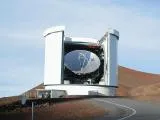
The 15-meter James Clerk Maxwell Telescope is the largest astronomical telescope in the world designed specifically to operate in the submillimeter wavelength of the spectrum. It is located near the summit of Mauna Kea, Hawaii, at an altitude of 4092 meters.
Sources and related links
- Science and Technology Facilities Council (2008, February 25).
SCUBA-2 Camera Will Explore Earliest Phases Of Galaxy Formation. ScienceDaily.
Retrieved March 1, 2008, from http://www.sciencedaily.com /releases/2008/02/080221095420.htm - Science and Technology Facility Council:Edinburgh astronomers deliver "Origins" Camera
- (1)Astronomers detect stellar ashes at the dawn of time
About the images
The top image is of the James Clerk Maxwell Telescope
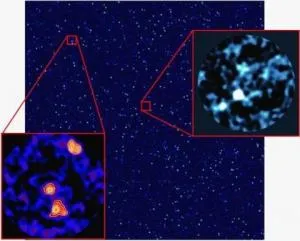
The bottom image: the larger square is a simulation of a part of the sky covering an area of about 4 full moons, the type of area SCUBA-2 will explore with ease.
The two enlargements show small areas that have been studied so far at submillimeter wavelengths, revealing superluminous primeval galaxies.
Credit:Science and Technology Facilities Council