The Hubble Space Telescope captured this image of galaxy NGC 1132. At first glance it is a single, gigantic elliptical galaxy, but X-ray data and dark matter found there seem to indicate that it is, most likely, a cosmic fossil, the result of the merger of multiple galaxies.
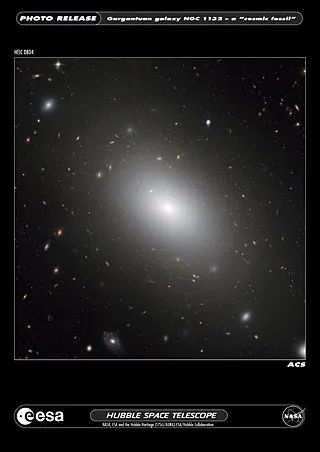
NGC 1132 belongs to the category of giant elliptical galaxy. Together with the small galaxies that surround it, they form a "fossil group" since they are most likely the result of the merger of a group of galaxies.
In visible light, NGC 1132 appears as an isolated and gigantic galaxy, but that is only the tip of the iceberg. Scientists have found that NGC 1132 resides in an enormous halo of dark matter, comparable to the amount of dark matter that can be found in an entire group of tens or hundreds of galaxies. It also possesses a strong X-ray brightness from the abundant amount of gas (an amount normally found in a group of galaxies). Its X-ray brightness extends over a region in space ten times larger than the 120,000 light-year radius in visible light. An X-ray brightness equal in size to an entire group of galaxies.
The origin of the fossil group remains a mystery. The most likely explanation is that they are the final products of a frenzy of mergers in which the larger galaxies devour their neighbors. A less likely explanation is that they are rare objects that formed in a region or period of time where the growth of moderately sized galaxies was somehow suppressed and thus an enormous galaxy formed.
Many galaxies reside in groups that are gravitationally bound, including our Milky Way, which is part of the so-called Local Group. Sometimes gravity makes galaxies collide and finally merge. There is strong evidence that the Milky Way has "cannibalized" some smaller galaxies during its lifetime, inheriting their stars in the process.
In this Hubble image, NGC 1132 is surrounded by hundreds of ancient globular clusters, orbiting the galaxy like bees around a hive. These globular clusters are perhaps the survivors of the disruption of their cannibalized galaxies that have been devoured by NGC 1132 and could reveal its history. In the background, there is an imposing tapestry of numerous galaxies that are much farther away.
Elliptical galaxies are smooth, monotonous, without distinctive features. They contain hundreds of millions to trillions of stars, and their shapes vary from very spherical to very elongated. Their yellowish color is a sign of their great age. And as they contain a lot of cold gas they can no longer generate new stars.
NGC 1132 is located approximately 320 million light-years away in the constellation of Eridanus, the river. The image was taken with the Advanced Camera for Surveys. Data obtained in 2005 and 2006 through green and near-infrared filters were used to produce a color composite.
Sources and related links
- *HubbleSite:Isolated Galaxy or Corporate Merger? Hubble Spies NGC 1132
- *SpaceTelescope:Gargantuan galaxy NGC 1132 – a cosmic fossil?
- *NGC 1132:A Mysterious Elliptical Galaxy
About the images
Credit:NASA, ESA and the Hubble Heritage (STScI/AURA)-ESA/Hubble Collaboration. Acknowledgment: M. West (ESO, Chile)