The Hubble Space Telescope, with a boost from a gravitational lens, has found the strongest evidence yet for a galaxy with a redshift significantly greater than 7, which means it discovered an extremely distant and therefore very primitive galaxy.
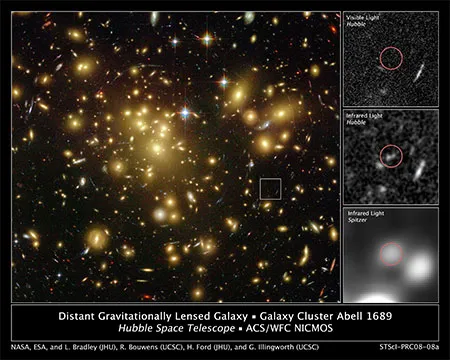
Detailed images from the Near Infrared Camera and Multi-Object Spectrometer (NICMOS) revealed an infant galaxy, named A1689-zD1, forming stars as it emerges from the "dark ages," the time that followed the Big Bang and before the first stars completed the reheating of the cold and dark Universe. Images from the Spitzer Space Telescope provide additional evidence that it was a young star-forming galaxy in the dark ages.
"We certainly were surprised to find such a bright young galaxy 13 billion years in the past," commented astronomer Garth Illingworth of the University of California, Santa Cruz and a member of the research team. "This is the most detailed observation to date of such a distant object in time."
According to the authors, the measurements are "highly reliable." "This object is the strongest candidate for the most distant galaxy to date," stated Piero Rosati of ESO and a team member. The object's redshift is ~7.6.
"The Hubble images allow us to understand the structure of the galaxy that we cannot get with any other telescope," added Rychard Bouwens, an astronomer at the University of California and co-discoverer of the galaxy.
The new images should offer elements to understand the formative years of galaxy birth and evolution and provide information about the types of objects that could have contributed to ending the dark age.
Throughout its lifetime, the Hubble telescope has looked ever farther back in time, seeing galaxies at successively younger stages of evolution. These images have helped astronomers create a photo album of galaxies, from their infancy to their adulthood. The new Hubble and Spitzer images of A1689-zD1 show a time when galaxies were in their infancy.
Current theories hold that the dark ages began about 400,000 years after the Big Bang, when matter in the expanding Universe cooled and formed clouds of cold hydrogen. These clouds permeated the Universe like a thick fog. At some point in this era, stars and galaxies began to form. Their collective light heated and cleared the fog of cold hydrogen and ended the dark age about a billion years after the Big Bang.
"This galaxy is presumably one of many that helped end the dark age," noted astronomer Larry Bradley of Johns Hopkins University and leader of the study. "Astronomers are fairly certain that high-energy objects like quasars do not provide enough energy to end the Universe's dark age. But many young star-forming galaxies have produced enough energy to end it."
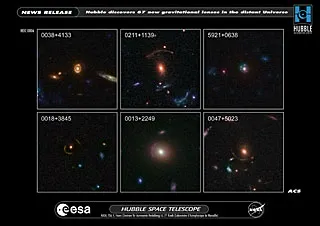
The galaxy is so distant that it does not appear in visible-light images taken by Hubble's Advanced Camera for Surveys because its light was stretched to infrared wavelengths by the expansion of the Universe. It was therefore necessary to use Hubble's NICMOS instrument and the infrared orbital observatory Spitzer to see so far. But in addition, there was a little extra help from nature: a gravitational lens.
Astronomers used a massive cluster of relatively nearby galaxies known as Abell 1689, nearly 2.2 billion light-years away, to magnify the light from the more distant galaxy directly behind it. This natural "telescope" is what is called a gravitational lens. Abell 1689 is one of the most spectacular and its properties are well known.
Because the diffuse light of the distant object is almost impossible to see, the gravitational lens increased its brightness by about 10 times, making it bright enough to be detected by the orbital Observatories. It is possible to realize the use of the gravitational lens by a sign that reveals them: the diffuse arcs in the image.
"The galaxy lies near the region where the galaxy cluster produces the greatest magnification, which was essential for Hubble and Spitzer to manage to observe the galaxy," explains Piero Rosati.
The Spitzer images show that the galaxy's mass is typical of those in the early Universe. Its mass is equivalent to several billion stars like our Sun, or a small fraction of the mass of the Milky Way.
"This observation confirms previous Hubble studies that star birth occurs in very small regions compared to the size of the final galaxy," Illingworth added.
The extremely distant galaxy is an ideal target for Hubble's successor, the James Webb Space Telescope (JWST), scheduled for launch in 2013. Even with the magnification from the gravitational lens, Hubble only sees knots of the brightest and heaviest stars in the galaxy. It cannot see more diffuse, lower-mass individual stars or the material around the star-forming region. To see there, astronomers will need the infrared capabilities of JWST, which are currently being developed by the space agencies NASA, ESA, and CSA. The planned infrared observatory will have a mirror seven times the area of Hubble's primary mirror and will thus collect more light from diffuse objects. Furthermore, it will be able to observe more remote galaxies whose light has been stretched further into the infrared than can be reached with the NICMOS instrument (which works in the near-infrared).
"This galaxy will certainly be one of the first objects we observe with JWST," says team member Holland Ford.
The astronomers noted that the distant galaxy would be an ideal target for the Atacama Large Millimeter Array (ALMA), the Atacama submillimeter array, which—when completed in 2012—will be the most powerful radio telescope in the world. Illingworth says that JWST images and ALMA measurements will provide revolutionary insights into the youngest galaxies.
The astronomers will conduct further observations with infrared spectroscopy to confirm the galaxy's distance using ESO's Very Large Telescope and the Keck telescope atop Mauna Kea in Hawaii.
The study results will be published in Astrophysical Journal.
Sources and related links
- SpaceTelescope:Hubble finds strong contender for galaxy distance record
- Spitzer:Astronomers Eye Ultra-Young, Bright Galaxy in Early Universe
- The fish dies by its mouth: The Light Of The Dark Age
- Astroseti: Seeing the edge of the Universe
About the images
Distant Gravitacionally Lensed Galaxy - Galaxy cluster Abell 1689
Hubble Space Telescope - ACS/WFC NICMOS
Credits:NASA/ESA/L. Bradley (JHU)/R. Bouwens (UCSC)/H. Ford (JHU)/G. Illingworth (UCSC)