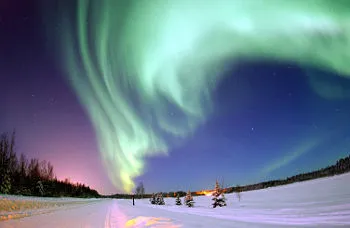
Imagine living on a planet where auroras fill the sky around the clock, not just at night. Bright curtains of light waving across the sky and hypnotizing whoever observes them.
Well, astronomers discovered such a planet. It's called Earth.
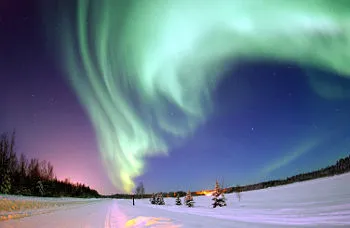
"Our planet has auroras 24 hours a day," says Jim Spann of the Marshall Space Flight Center, "and we can see them in broad daylight." The trick, he explains, is to choose the right wavelength. "If we look at Earth from space using an ultraviolet (UV) filter, we see the ongoing auroras there around the clock. It's a beautiful image."
The extent of the phenomenon was revealed 20 years ago by the NASA satellite called Polar. As its name suggests, Polar orbits over our planet's poles, slowly arcing 57,000 km above the Arctic where it can get a good view of the auroras below. Polar is equipped with special UV filters that allow photographing the auroras through the solar glare and "we were amazed to see the Northern and Southern Lights continuously active," says Spann, one of the scientists who developed the instrument.
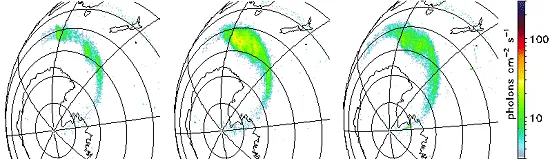
The image above corresponds to a movie (animated GIF image) that can be seen by clicking on it, from Science@NASA, of the UV auroras over Antarctica (It weighs about 2 Mb).
The image highlights an ancient mystery. Long ago, observers of the Arctic sky noted that the gentle auroras could, at times, erupt without warning into a stunning profusion of light and color. 20th-century scientists modestly called these events "substorms." A good substorm can release 10 14 Joules of energy (that is 100,000,000,000,000, or 100 trillion), as much as a magnitude 5 earthquake.
Although auroras, generally speaking, are understood (they are caused by solar activity), the sudden power of substorms is one of the greatest mysteries of space science.
Polar is assisting THEMIS, a fleet of five spacecraft launched by NASA in February 2007 to better understand the phenomenon of auroras and substorms. What triggers these events and where does their power come from?
The five THEMIS satellites are equipped with sensors to map the complicated flow of particles and fields in Earth's magnetosphere. A single spacecraft could get confused by the magnetosphere's sudden electrodynamic changes, but the quintet, working together, are able to make sense of the complicated events.
Polar is valuable because there is no other spacecraft that can match its global view of the auroras, while THEMIS observes the crucial details.
At the age of 12, Polar has long outlived its designed lifespan, although its union with THEMIS revived its mission.
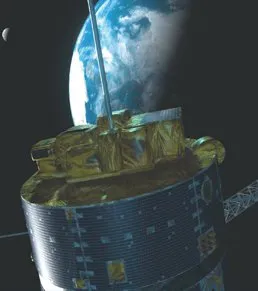
However, the spacecraft ran out of fuel, limiting its ability to track Earth's poles. Nevertheless, mission managers believe they can stretch out one or two months of valuable observation with THEMIS support. The final images could be key to the aurora puzzle.
Thus bids farewell Polar, a satellite that provided valuable data, by all accounts.
Sources and related links
- Science@NASA: Auroras in Broad Daylight
- NASA's Polar satellite site
About the images
The images (of the Polar satellite and the UV auroras) are from NASA.
The aurora image is from Wikimedia Commons at Aurora Borealis (A 3,008 × 1,960 pixel, 4.42 MB image can be obtained from there)