Researchers using the Spitzer Space Telescope discovered a large amount of simple organic gases and water vapor in a possible planet-forming region around an infant star, along with evidence that those molecules were created there. They also found water in the same zone around two other young stars.
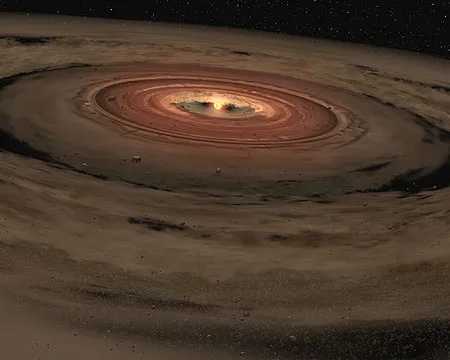
John Carr of the Naval Research Laboratory and Joan Najita of the National Optical Astronomy Observatory developed a new technique using Spitzer's infrared spectrograph to measure and analyze the chemical composition of the gases in the protoplanetary disk.
"Most of the material in the disk is gas, but until now it has been difficult to study the composition of the gas in the regions where planets should form. Much more attention has been given to the solid dust particles, which are easier to observe," explains Carr.
In their project, the scientists performed deep observations of the gases in the planet-forming region of the disk around the star AA Tauri. At less than a million years old, AA Tauri is a typical example of a young star with a protoplanetary disk.
With their new procedures, they were able to detect the spectral signatures of three simple organic molecules—hydrogen cyanide, acetylene, and carbon dioxide—in addition to water vapor. Furthermore, they found more of these substances in the disk than in the dense interstellar gas called molecular clouds from which the disk originated. "So this is evidence of active organic chemistry occurring in the disk, forming and generating these molecules."
Spitzer's infrared spectrograph detected these same organic gases in a protoplanetary disk before. But the observation depended on the star's disk being oriented the right way. Now the researchers have a new method for studying the primordial mix of gases in the disks of hundreds of young stellar systems.
Astronomers will be able to fill an important gap—they know that water and organics are abundant in the interstellar medium but not what happens to them after they are incorporated into a disk. Now that they can identify these molecules and inventory them, they will be able to better understand the origins and evolution of the basic building blocks of life.
The results appear in the March 14 edition of the journal Science.
In search of water
Another group of scientists looked for water molecules in the disks around stars and found them in double measure. "This is one of the few times that the existence of water vapor in the innermost part of a protoplanetary disk, the most likely place for terrestrial planets to form, has been directly shown," says Colette Salyk of the California Institute of Technology in Pasadena. She is the author of a paper about the results in the March 20 edition of Astrophysical Journal Letters.
Salyk and her colleagues used Spitzer to search dozens of young stars and found water in several. They focused on two stars and followed the initial water detection with complementary high-resolution measurements from the Keck II Telescope in Hawaii. Although they do not find as much water as in the oceans of our planet, they think it must be abundant since they are only observing the surface of the disk, according to co-author Geoffrey Blake.
"This is a much bigger story than just one or two disks. Spitzer can efficiently measure these water signatures in many objects, so it's just the beginning of what we are going to learn."
Sources and related links
- Spitzer: Spitzer Finds Organics and Water Where New Planets May Grow
- Organic Molecules and Water in the Planet Formation Region of Young Circumstellar Disks
John S. Carr and Joan R. Najita
Science 14 March 2008:Vol. 319. no. 5869, pp. 1504 - 1506
DOI: 10.1126/science.1153807 - H2O and OH Gas in the Terrestrial Planet–forming Zones of Protoplanetary Disks
Colette Salyk, et al.
The Astrophysical Journal, 676:L49–L52, 2008 March 20
DOI: 10.1086/586894
About the images
Illustration of a protoplanetary disk.
Credit: NASA/JPL-Caltech