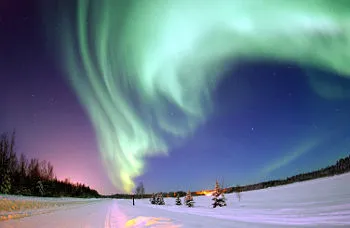
Data from Cluster have helped scientists better understand magnetic processes, challenging existing theories about the storms that cause auroras and disturbances in GPS signals.
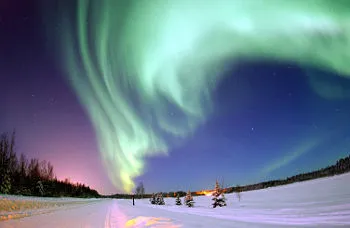
Aurora in Alaska. - Wikipedia
Magnetic storms that originate in the magnetosphere have been explained by two models that are challenged by new data collected with ESA's Cluster and Double Star satellites. A study published on January 20, 2007 in Geophysical Research Letters suggests a third type of explanation.
Magnetic storms frequently cause the bright and colorful auroras at high latitudes, in places like Scandinavia or Canada. These auroras are caused by energetic electrons that spiral along Earth's magnetic field lines and collide with atoms in the atmosphere at an altitude of about 100 km. The electrons come from the magnetic tail, located on the night side of Earth where the solar wind stretches the magnetic field lines into a long tail.
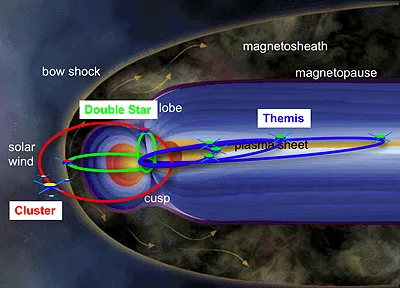
In the center of the magnetic tail there is a dense region known as the plasma sheet. Plasma is a gas composed of ions and electrons that is electrically neutral. It extends over large distances in space and is guided by the action of magnetic and electric fields. A storm induces violent changes in the plasma sheet. It energizes ions and electrons and hurls them toward Earth.
Besides producing the beautiful lights, the storms also excite a large portion of the ionosphere, disturbing the reception of GPS signals and communication between Earth and orbiting satellites.
There are three events associated with the storms: the auroral brightening, the current disruption, and the magnetic reconnection.
The auroral brightening is a sudden change in light at an altitude of 100 km, visible from the ground. The current disruption occurs at about 60 thousand km and is associated with turbulent fluctuations of the magnetic field.
Magnetic reconnection is the process by which magnetic field lines from different magnetic domains collide and reconnect, heating and accelerating the plasma. It occurs at one third of the distance to the Moon or at an altitude of 120 thousand km.
The difference between the two existing theories about magnetic storms is that they differ in the order in which the events occur.
Prof. Sergeev, of St Petersburg State University, Russia, and his colleagues from Europe, the USA and China studied three consecutive storms from data collected by the Cluster and Double Star satellites on September 26, 2005. For the first time, the data indicate that the disruption and reconnection processes can coincide in space and time, possibly showing two faces of the same process.
Furthermore, they found in this case that the reconnection occurred closer to Earth than usual, between 60 thousand and 90 thousand km. The auroral brightenings were captured a few tenths of a second later.
In February 2007, NASA launched THEMIS, a mission of five satellites dedicated to the study of these phenomena.
The results are presented in the paper "Observation of repeated intense near-Earth reconnection on closed field lines with Cluster, Double Star and other spacecraft" by V. Sergeev, V. Semenov, M. Kubyshkina, V. Ivanova, W. Baumjohann, R. Nakamura, T. Penz, A. Runov, T. L. Zhang, K. Glassmeier, V. Angelopoulos, H. Frey, J. Sauvaud, P. Daly, J. Cao, H. Singer, and E. Lucek. The paper was published in the January 20, 2007 issue of Geophysical Research Letters.
Sources and related links
- Press release at ESA
- Note in EurekAlert