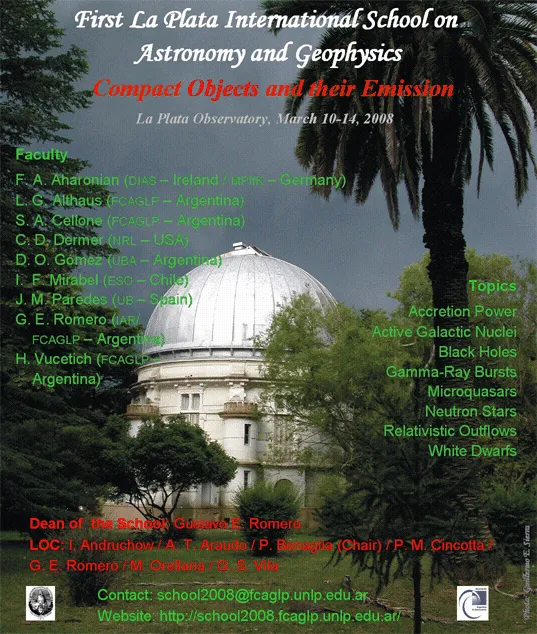
The First International School in Astronomy and Geophysics taught at the Faculty of Astronomical and Geophysical Sciences of the University of La Plata concludes. Renowned scientists from different countries converged in La Plata for this international meeting; young graduates attended classes for five days that offer them an update on topics related to high-energy astrophysics and compact objects. Thus, subjects such as black holes, neutron stars, gamma-ray bursts, and the instruments used for this branch of science have been the focus of the presentations and consultations.
See images at:
http://www.fcaglp.unlp.edu.ar/~extension/237/escuela
LAPIS "La Plata International School on Astronomy and Geophysics", will have a minimum periodicity of two years on different topics and in this first experience the thematic axis was high-energy astrophysics and compact objects.
More than 60 students participated in the aforementioned School; Mexicans, Poles, Chileans, Uruguayans, Finns, Swedes, Colombians, Brazilians, French, Spanish, and Argentines from different research centers.
"This School -pointed out its Director, Dr. Gustavo E. Romero- provides students -particularly those doing their doctorate- and young doctors, the opportunity to interact with top-level figures in each specialty. The school allows them to have access to update courses taught by the faculty. This is very important for the development of the students, because it is increasingly difficult for young people to travel: there are no longer external scholarships, while grants have a lower percentage for travel."
At the start of the activity that took place between March 10 and 14, the Dean of the Faculty of Astronomical and Geophysical Sciences, Dr. Pablo Cincotta said that "today we are witnessing a very special moment for our institution, as we are beginning a series of international schools on current topics in Astronomy and Geophysics.
These schools aim to introduce students and young researchers to the most current research topics in both fields of science.
Among the Argentine professors were Drs. Daniel Gómez, from the University of Buenos Aires, who spoke about accretion in compact objects, that is, how matter falls towards a black hole and what effects it produces. Dr. Héctor Vucetich gave a talk on neutron stars, while Dr. Sergio Cellone gave an overview of the nature of active galactic nuclei; Dr. Leandro Althaus spoke about white dwarfs". Dr. Romero spoke about black holes.
* Dr. Gustavo E. Romero, in addition to being a researcher and professor, is the current President of the Argentine Association of Astronomy, which sponsors this School organized by the aforementioned Faculty.
More information at the original source:
News from the La Plata Observatory
Year 7 Number 237
Text writing and interviews: Jour. Alejandra Sofía
Sources and related links
About the images
Faculty of Astronomical and Geophysical Sciences
Photo by Guillermo E. Sierra.