Using two spacecraft from the European Space Agency (ESA), scientists are observing the atmospheres of our two closest neighbors. The simultaneous observations give scientists the data they need to investigate the evolution of the two planetary atmospheres.
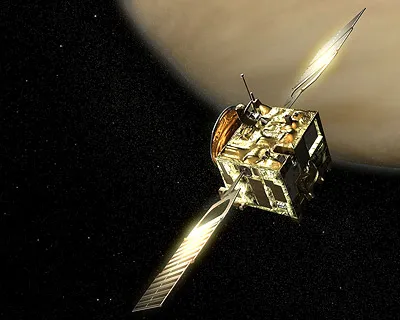
This work is called comparative planetology. The two European spacecraft Mars Express and Venus Express carry very similar scientific instruments. In the case of the Analyser of Space Plasmas and Energetic Atoms (ASPERA) instruments, they are virtually identical. This allows scientists to make direct comparisons between the two planets.
The new results investigate directly the magnetic regions that are channels through which electrically charged particles escape. They present the first detection of atoms escaping from Venus's atmosphere and show that the escape rate increased up to ten times on Mars when a solar storm struck in December 2006.
By observing the current rate of loss of the two atmospheres, planetary scientists hope to be able to "turn back the clock" and understand how they were in the past. "These results give us the potential to measure the evolution of planetary climates," says David Brain, a Venus Express researcher at the University of California, Berkeley.
The new observations show that, despite differences in size and distance from the sun, Mars and Venus are surprisingly similar. Both planets have beams of charged particles flowing from their atmospheres. The particles are being accelerated by interactions with the solar wind, a constant stream of charged particles released by the Sun.
On Earth, the solar wind does not interact directly with the atmosphere, as it is deflected by a natural layer of magnetism. Neither Mars nor Venus have appreciable magnetic fields generated within the planet, so each atmosphere suffers the impact of the solar wind.
Interestingly, this interaction creates a weak magnetic field that covers each planet and extends behind the night side in a long tail. Venus's atmosphere is thick and dense, while Mars's is light and tenuous. Despite the differences, the instruments discovered that the structure of the magnetic fields on both planets is similar.
"This is because the density of the ionosphere at 250 km altitude is surprisingly similar," says Tielong Zhang, a Venus Express researcher. The ionosphere is the layer of electrically charged particles created by the impact of sunlight on the upper atmosphere of the planets.
Venus's proximity to the Sun creates, on the other hand, an important difference. The solar wind becomes thinner as it moves through space, so the closer to the Sun it is, the more concentrated its force. This creates a stronger magnetic field, making the particles escaping from the atmosphere move collectively like a fluid.
On Mars, the weaker field means that the escaping particles act as individuals.
Another difference is that Mars shows strong small-scale magnetic fields locked in the planet's crust. In some regions, these pockets protect the atmosphere, in others they help channel the atmosphere into space.
The complexity of the different processes revealed on Venus and Mars means that scientists do not yet have the full picture. There is much to do because there are many different mechanisms that could cause atmospheric particles to escape. Unraveling it will take time. "The longer the spacecraft work together, the more we will be able to see what is really happening," says Brain.
Sources and related links
ESA: Mars and Venus are surprisingly similar
About the images
Credit: ESA (Image by AOES Medialab)