The surprises continue. Scientists discovered, from among the harvest of photos from the MESSENGER spacecraft that approached the planet during the flyby of January 14, several craters with strange dark aureoles or halos and a particularly bright crater.
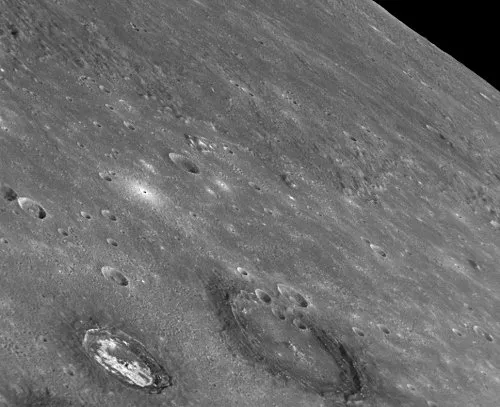
These halos are truly exceptional, says Clark Chapman, a member of the MESSENGER science team. "We never saw anything like this on Mercury before and their formation is a mystery."
Let's see:
The two craters in the bottom part of the photo are located in the giant Caloris Basin, a depression 1,300 km wide formed billions of years ago when Mercury collided with a large comet or asteroid. To get an idea of scale, the larger of the two is about 64 km wide. Both craters have dark edges or halos and the one on the left is partially filled with an unknown bright material.
Chapman offers two possible explanations for these halos:
1. The layer cake theory: They could be a layer of dark material beneath the surface of the Caloris Basin. If those underground layers exist, however, they cannot be unique to this basin. "We have found a number of dark halos outside Caloris as well -for example, these two near Mercury's south pole."
2. The impact glass model: The thermal energy of the impacts melted part of Mercury's rocky surface. Perhaps the molten rock splashed onto the rim of the craters where it re-solidified as a dark, glassy substance. Similar "impact melts" are found around craters on Earth and the Moon. If the hypothesis is correct, future astronauts on Mercury exploring the rim of craters would find themselves walking through fields of small glassy fragments.
Chapman notes that the Moon also has some craters with dark halos: "Tycho is a very good example." But lunar halos tend to be subtle and/or fragmentary. "The ones we see on Mercury are much more striking and distinctive."
The difference could be gravity. The Moon's gravity is low. Any dark material flying from a crater on the Moon travels a great distance, spreading out in a diffusion that can be hard to see. On the other hand, Mercury's surface gravity is more than double that of the Moon. On the planet closest to the Sun, debris cannot fly as far; it falls in a concentrated form closer to the impact site where it can catch the human eye.
However, none of this explains the bright crater. "That's an even bigger mystery," says Chapman.
Superficially, the bright spot resembles an expanse of ice shining in the Sun, but that's not possible.
The surface temperature of the crater at the time of the photo was around 400 degrees Celsius. Perhaps the bright material is part of another underground layer and the bright mixes with the dark. That would be the Marble Layer Cake Theory. "I haven't heard any really convincing explanation from our science team. We still don't know what the material is, why it's so bright, or why it's located in this particular crater."
Fortunately, MESSENGER may have gathered the data researchers need to solve the puzzle. The spectrometers on board the spacecraft scanned the craters during the flyby; the colors they measured should eventually reveal the minerals involved. "The data are still being calibrated and analyzed," says Chapman.
What if that data doesn't provide an answer?
There are still two more flybys -one in October of this year and another in September of 2009- before the spacecraft enters the planet's orbit in 2011 to collect more data and try to solve this and other mysteries about Mercury.
Sources and related links
- Science@NASA: Dark Halos Discovered on Mercury
- MESSENGER website
About the images
Credit: NASA