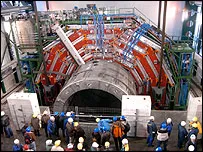
At a press conference on April 14, Abe Seiden of the University of California, Santa Cruz, showed, at the April Meeting of the American Physical Society, a timeline that graphs the amount of data to be collected by the Large Hadron Collider over time. And he pointed out when physicists expect to make certain discoveries, if they exist in nature waiting to be found.
As reported by David Harris in Symmetry Breaking, in summary, the potential milestones would be:
2009: Supersymmetry, if the appropriate energy scale is 1TeV
2009/2010: Higgs particle, if it has a mass of about 200 GeV
2010/2011: Higgs particle, if it is around 120 GeV in mass
(At lower energy it is more difficult to detect because at that energy it could be confused with other signals that would decay in a similar way. But at a higher energy, the particle would decay first into W bosons, with determined characteristics)
2012: Extra dimensions of space, if the energy scale is 9 TeV
2012: Compositeness, if quarks are composite particles instead of being fundamental, and if the nature of that compositeness is revealed at an energy scale of 40 TeV.
2017: supersymmetry, if the appropriate scale is 3 TeV
2019: Z': if there is a new type of force that comes into play at 6 TeV. If so, the particle that communicates the force is represented with the temporary name Z', in analogy with the Z that transmits the weak force.
The timeline depends, of course, on the LHC starting according to the current plan, scheduled for the second half of the year.
The Large Hadron Collider is being installed in a 27-kilometer underground ring, in Geneva, Switzerland. When its operation begins, it will be the world's largest particle accelerator.
High-energy protons in two counter-rotating beams will collide in search of the signatures of supersymmetry, dark matter and the origins of mass.
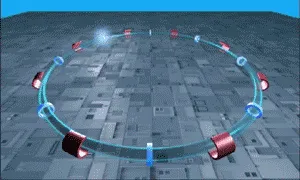
The beams of billions of protons will travel at a speed close to that of light around the ring, circulating through the ring and guided by hundreds of powerful magnets. There are four points where the protons can collide. These are the experiments known as: ALICE, ATLAS, CMS and LHCb. The collisions will be carefully observed in search of exotic particles.
TeV and GeV are units of measurement of energy: the electronvolt
The scale of these units includes Mega electronvolt MeV, Giga (GeV), Tera (TeV), Peta (PeV) and Exa (EeV)
What is a particle accelerator like?
An accelerator usually consists of a vacuum chamber surrounded by a long sequence of vacuum pumps, magnets, radio frequency cavities, high-voltage instruments and electronic circuits. Each piece has its specific function:
The vacuum chamber is a metal pipe where the air is permanently evacuated (by the vacuum pumps) to prevent the accelerated particles from colliding with normal matter, with air molecules for example, and being annihilated or deflected.
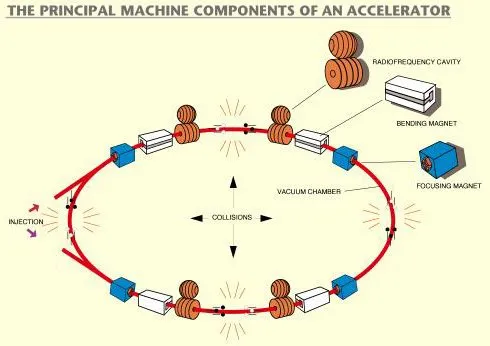
Inside the pipe, particles are accelerated by electric fields. These are provided by the radio frequency cavities. Every time charged particles pass through a radio frequency cavity, the electric field inside the cavity gives them a push, part of the energy of the radio wave is transferred and they are accelerated. To make more effective use of a limited number of cavities, accelerator designers can force the particle beam to pass through there many times, by curving the beam's trajectory in a loop. This is why most accelerators are nearly circular.
This curvature of the beam path is achieved by the magnetic field of the dipoles (which have a North and a South, like horseshoe magnets). They are also called bending magnets. This is because the magnetic force exerted on moving charged particles is always perpendicular to their velocity, perfect for curving the trajectory. The higher the energy of a particle, the stronger the field needed to curve the trajectory. This means that, as the maximum magnetic field is limited, the more powerful the machine, the larger it needs to be.
In addition to bending the beam, it is necessary to focus it, which allows limiting its width and height so that it remains in the vacuum chamber. This is achieved with four-pole magnets, which act on the beam of charged particles in the same way a lens would act on a beam of light. These are some of the basic ingredients of an accelerator, but there are more: other magnets, to fine-tune its trajectory and focus more precisely; injection/ejection elements, to put the beam into the accelerator or remove it, measurement devices, to give operators information about the beam's behavior; safety elements, to ensure the accelerator's operation.
Why is it called that?
LHC, which stands for Large Hadron Collider, or in Spanish, Gran Colisionador de Hadrones, comes from the fact that it will collide protons, which in particle physics are classified as hadrons. Particle physicists call hadrons those particles that are composed of other more elementary ones.
Previously it had been conceived as a collider of electrons and their counterpart, positrons (which are like electrons but with a positive charge). Electrons and positrons belong to the group of particles called leptons.
What is LHC@home?
It is a collaborative software program. It serves to analyze data on your computer. Basically, the program will download data, analyze it and return the result. The LHC@home program is called SixTrack which simulates the journey of particles in the LHC to study the stability of their orbits. These results are essential to verify the long-term stability of high-energy particles in the LHC. Essentially, the program simulates 60 particles at the same time traveling around the ring and runs the simulation for 100 thousand (or sometimes 1 million) turns around the ring. Although it may sound like a lot, it is less than 10 seconds in the real world, but enough to test whether the beam will remain in a stable orbit.
This collaborative program runs on the Boinc platform. We have already talked about it here other times (see "Doing Particle Physics at Home"). The Boinc program is very easy to download from the Boinc website, it installs easily and then you can simply add projects. Besides being able to add the LHC@home project, there are many others you might be interested in participating in. On the Boinc projects page, you can choose the ones you want. Each has its own characteristics, meaning they analyze different types of data and results, but they all run essentially the same way and can be added just by entering an address in the Boinc program. Although you will first need to create an account for the project you have decided to run. You can add many projects at the same time and, of course, you can suspend or remove them if you wish.
The program allows different configurations, where you can select whether the software should run always, or only during certain hours, or if you want it to run when you are not using your computer.
During installation, there are also some options, for example it can be installed normally, which will allow, for instance, the program to start running when you are not using your PC and a screensaver to appear, if you wish. Or, you can install it as a "service", which will not run any screensaver and, I think, works more effectively.
As your PC analyzes data and returns results, you will earn "credits". No, it's not money, nor are they good for anything else, they just give you an idea that your PC is working. I don't recommend comparing your results with other people's, as there are those who have impossible-to-beat credits, since they perhaps have the ability to run the software on many machines, at their job, etc.
You can also join a group or create one. There are groups of people from the same workplace or who share studies or simply by country.
In short, there is much more you can discover by visiting the related links.
Is the world going to explode if an experiment goes wrong?
Ahh, urban legends and stupid myths, which on the net seem like hot bread. No, the world is not going to end because of that. There are many other particle accelerators operating for a long time. Errors and accidents can happen, of course, but nothing of such magnitude. But surely the world runs a serious risk if we keep spreading stupidity. Especially if we throw a bomb at those who think differently. That is...
Sources and related links
About the images
The two illustrations belong to LHC@home.