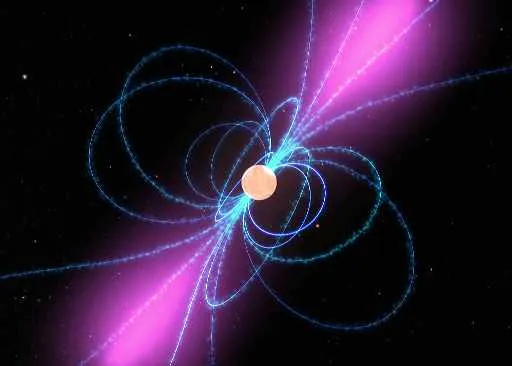
Thanks to a unique cosmic configuration, astronomers have measured an effect predicted by Albert Einstein's General Theory of Relativity in the extremely strong gravity of a pair of neutron stars.
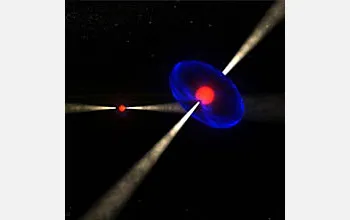
Scientists from McGill University used the Robert Byrd Telescope in Green Bank to conduct a four-year study of a stellar system unlike any other known in the universe. The system is a pair of neutron stars that appear as pulsars emitting radio waves.
"Of the 1700 known pulsars, this is the only case where two pulsars orbit each other," says Rene Breton of McGill. Furthermore, the orbital plane of the stars is aligned almost perfectly with their line of sight to Earth. This causes the signal from one to be blocked or eclipsed as it orbits the other.
"Those eclipses are the key to making measurements that could never be made before," says Breton.
Einstein's 1915 theory predicts that in a closed system of two very massive objects, such as neutron stars, the gravitational pull of one object should cause a slight 'wobble' or precession in the other.
Studies of other pulsars in binary systems have indicated that this occurs, but precise measurements of the amount of this motion could not be made.
The eclipses allowed astronomers to determine the geometry of the binary system and track changes in the orientation of the spin axis of one of them.
The pair of pulsars is 1700 light-years from Earth. The average distance between the two is only twice the distance from Earth to the Moon. The two orbit each other in less than two and a half hours.
"A system like this, with two very massive objects very close to each other, is precisely the kind of extreme 'cosmic laboratory' needed to test Einstein's prediction," says Victoria Kaspi, leader of the McGill group.
"It is not correct to say that we have now 'proven' General Relativity," Breton says cautiously. "However, so far, Einstein's theory has passed all the tests that have been performed, including ours."
The work was published in the July 4 issue of Science.
Sources and related links
- In Unique Stellar Laboratory, Einstein's Theory Passes Strict, New Test
- Relativistic Spin Precession in the Double Pulsar
Rene P. Breton, Victoria M. Kaspi, et al.
Science 4 July 2008: Vol. 321. No. 5885, pp. 104 - 107
DOI: 10.1126/science.1159295
About the images
Credit: NRAO