A spectacular new image shows how complex the death of a star can be. By studying the details of this image from the Chandra X-ray Observatory, astronomers can better understand how stars die and scatter elements like oxygen toward the new generation of stars and planets.
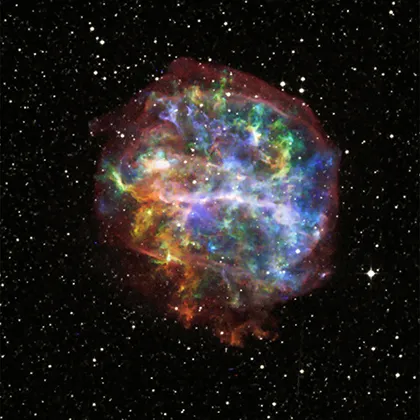
At a distance of 20,000 light-years, G292.0+1.8 is one of the three remanentes de supernova in the Milky Way that contain large amounts of oxygen. The image shows a rapid expansion of a complex debris structure containing, along with oxygen, other elements like neon and silicon that were forged in the star before it exploded.
By mapping the distribution of X-rays in different bands, the Chandra image locates the distribution of chemical elements ejected in the supernova. The results imply that the explosion was not symmetric. For example, the blue (silicon and sulfur) and green (magnesium) are seen strongly in the upper right part, while the yellow and orange (oxygen) dominate the lower left side. These elements light up at different temperatures, indicating that the temperature is higher in the upper right part.
Slightly below and to the left of the center is a pulsar, a dense, rapidly rotating neutron star that remained after the stellar explosion.
Around the pulsar there is a stellar wind nebula, a magnetized bubble of high-energy particles. A jet structure from north to south, parallel to the pulsar's rotation axis, is perceived (in X-rays).
Another intriguing element is the bright equatorial belt of X-rays extending in the center of the remnant. It is thought to have been created when the star -before dying- expelled material from its equator. The orientation suggests that the star maintained the same rotation axis before and after exploding.
The results will appear in an upcoming edition of The Astrophysical Journal Letters.