Three times per second, a 10,000-year-old stellar corpse sends a beam of gamma rays toward Earth. Discovered by the Large Area Telescope (LAT), aboard the Fermi Gamma-ray Space Telescope, the object -a pulsar- is the first known one that only "blinks" in gamma rays.
"This is the first example of a new class of pulsars that will give us fundamental insights into how these collapsed stars work," says Peter Michelson, of Stanford University, a Fermi investigator in Palo Alto.
The pulsar lies in the supernova remnant known as CTA 1, located 4,600 light-years away in the constellation Cepheus. Its beam of light -like a lighthouse- sweeps Earth every 316.86 milliseconds. The extraordinary object, which formed about 10,000 years ago, emits 1,000 times the energy of our Sun.
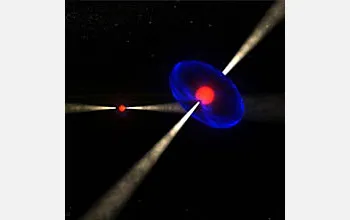
A pulsar is a rapidly spinning neutron star, the core left behind when a massive star explodes. Astronomers have cataloged nearly 1800 pulsars. Although most were found through their pulses at radio wavelengths, some of these objects also emit energy in other forms, including visible light and X-rays. However, the source in CTA 1 only pulses at gamma-ray energies.
"We think the region that emits the gamma rays is broader than the one responsible for the pulses at lower-energy radiation. The radio beam probably never sweeps toward Earth, so we never see it. But the broader gamma-ray beam does sweep our path," explains Alice Harding, from the Goddard Space Flight Center.
Scientists think CTA 1 is only the first of a large population of similar objects.
The pulsar in CTA 1 is not located at the center of the expanding gaseous shell of the remnant. Supernova explosions can be asymmetric, often giving a kick that sends the neutron star wandering through space. Based on the age of the remnant and the distance of the pulsar, astronomers believe the neutron star is moving at over a million kilometers per hour, a typical speed.
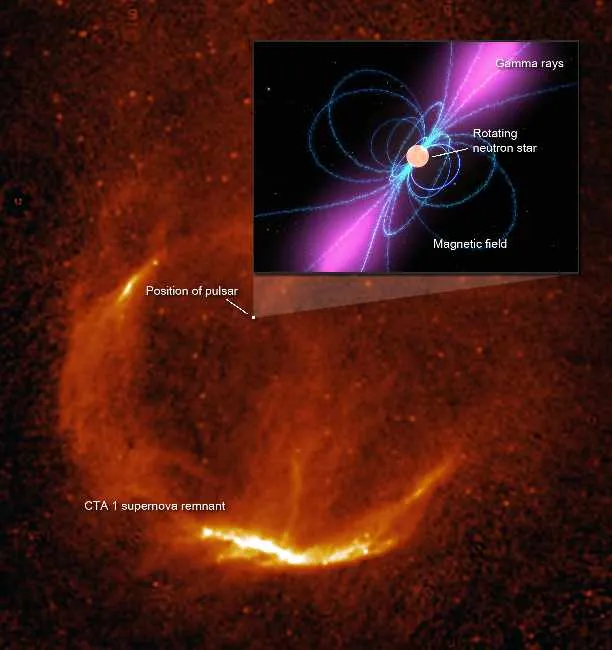
The Fermi Telescope scans the entire sky every three hours and detects photons whose energies range from 20 million to over 300 billion times the energy of visible light. The instrument detects a gamma ray every minute from CTA 1, enough for scientists to piece together the behavior of the neutron star, its rotation period, and the rate at which it is slowing down.
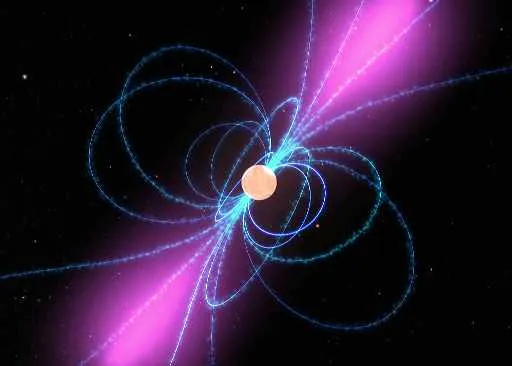
A pulsar beam arises because neutron stars possess intense magnetic fields and spin rapidly. Charged particles stream out from the star's magnetic poles at near light speed to create the gamma-ray beams that Fermi detects. Because the beams are generated by the star's rotation, they gradually slow the pulsar's spin. In the case of CTA 1, the rotation period is increasing by about one second every 87,000 years.
The measurement is vital for understanding the dynamics of the pulsar's behavior and can be used to estimate its age.
Sources and related links
- NASA'S Fermi Telescope Discovers First Gamma-Ray-Only Pulsar
- The Fermi Gamma-Ray Space Telescope Discovers the Pulsar in the Young Galactic Supernova Remnant CTA 1
Published Online in Science Express October 16, 2008
DOI:10.1126/science.1165572
About the images
Clouds of charged particles move along the pulsar's magnetic field lines (in blue) and create a gamma-ray beam, like a lighthouse (in purple), in this illustration.
Credit NASA
The Fermi Gamma-ray Telescope discovered the first pulsar that only emits in gamma rays. The pulsar illustration (in the inset), lies in the supernova remnant CTA 1 in the constellation Cepheus.
Credit:NASA/S. Pineault, DRAO
Note: An animation, in various formats, can be accessed at the Conceptual Image Laboratory of the Goddard Space Flight Center:
Gamma Rays in Pulsars