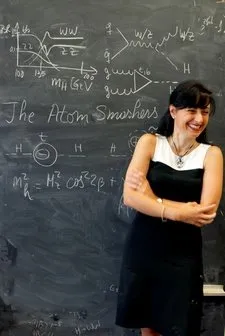
At the Tevatron, an underground particle accelerator, scientists at Fermilab, among whom there is an Argentine, make particles collide with each other, at a speed close to that of light, in search of the famous Higgs boson. The documentary The Atom Smashers examines 15 months of this search for fundamental answers.
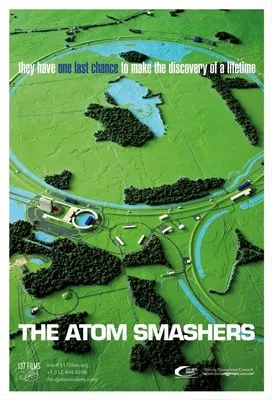
Inspired by The God Particle, by Leon Lederman, the development of The Atom Smashers began in February 2004. 137 Films was then founded to support and produce films from the world of science.
Why 137

In physics, there is a constant called the "fine-structure constant", usually represented by the symbol alpha, it is the fundamental physical constant that characterizes the strength of the electromagnetic interaction. It is a dimensionless quantity, so its numerical value is independent of the system of units used and its value is approximately 1/137. They say that if you need a physicist's help, you just need to stand on a street corner with a sign that says "137" and very soon physicists will start arriving, like insects attracted to light. The phrase is attributed to the great physicist Leon Lederman, paraphrasing a saying by another enormous scientist, Richard Feynman, who said that physicists should put a sign in their offices to remind them of all they don't know. The sign would say...
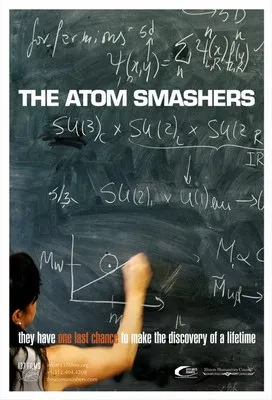
The director, Clayton Brown, explores the hidden stories and fascinating characters that emerge when people pursue their passions.
Monica Long Ross, director, writer and teacher, is interested in telling the lives of women in the complicated American culture and the state of women in the scientific field.
The documentary follows the architects of the discoveries: the scientists, their lives and how they dedicate themselves to colliding subatomic particles. Politicians and journalists add an external perspective to the story.
The film includes interviews with Natalie Angier, Pulitzer Prize winner for science for The New York Times; John Conway, physics professor at the University of California; Ben Kilminster, particle physics researcher at Ohio University; Edward W. Kolb, from the astrophysics group at Fermilab; Leon Lederman, experimental physicist and Nobel Prize winner, Director Emeritus of Fermilab; Dennis Overbye, the great science editor of The New York Times and author of a book I never stop recommending, "Lonely Hearts of the Cosmos"; and Marcela Carena, theoretical physicist, expert on the Higgs boson and, they say, a very good tango dancer. That's because Carena is an Argentine working at Fermilab, a graduate of the Balseiro Institute, Bariloche, in 1985 and she obtained her doctorate at the University of Hamburg in 1989. A true national pride who has earned a place in the incredible world of particle physics and works at Fermilab, no less.
According to Carena, who was kind enough to send me a comment about the documentary, "The film was an interesting experience for me. It is a documentary film that is more about the scientists and how passionate they are about what they do than about the science (in this case the search for the Higgs) itself. People who saw it and commented to me about it, liked the film very much. The first time I saw it I thought: they have taken out all the physics!.
That is, I appear as a physicist who is a mom and dances tango! Well, not only like that, but almost. However, people who have seen it liked it very much, including my colleagues at Fermilab, where they screened the film this Thursday.".
I would like to be able to review the documentary properly, that is, after having seen it, but I have not yet had the chance to access a copy. For the moment, the film is scheduled to be presented at various festivals, such as Vancouver's, and they plan to take it to the independent film market in New York (IFP Market) to find potential business partners.
The researchers at Fermilab can ultimately tell us what we are made of, on a journey of research and search to better understand the workings of the universe. To help tell the complex relationship between culture and science, the producers need all the collaboration possible. The directors live on grants and other donations to do the work. If readers know of anyone interested in contributing to make this work happen, do not hesitate to contact 137Films.
Telling the story of scientists, both current ones and those who have been building science for several centuries, is of great importance to put their work and the consequences it generates for the rest of society into context.
In that sense, documentaries (I mean those made with a certain rigor) have a positive impact among young people that could lead to them becoming interested in studying science. In general, there is often a concept, especially among young people, that "scientific stuff" is difficult and unattainable. It's that the fascinating world of discovery and its significance is not transmitted by educators and the media.
Researchers and communicators have been working to change that concept, considering that current technical possibilities (especially multimedia and the internet) are tools that can be used to create valuable and entertaining content.
In Argentina, some scientists are carrying out a fundamental task by disseminating science content in an accessible way. I think of the names of Diego Golombek, a graduate in Biology, writer of several very entertaining books and host of the television program "Proyecto G"; Adrián Paenza, doctor in mathematics, host of television series like "Alterados por Pi" and "Científicos, Industria Argentina"; or Diego Hurtado, Doctor in physics and professor of history of science, whose work in producing the television series "Territorios de ciencia", is simply impeccable, telling the history of scientific institutions and their vicissitudes in our country.
These television series have been broadcast on the channel Encuentro, the television channel of the Ministry of Education of the Nation.
The wonder that arises from knowing at least a little about quantum mechanics is something invaluable. A wonder I still have, by the way. The incredible history of discoveries, the finding of chemical elements and the famous periodic table, etc., involve not only greater knowledge of what we are, but also a change in mindset. Implicitly in these narratives lies the dissemination of the scientific method and the generation of critical thinking. I believe it is vitally important that this happens in young people. If one becomes aware of this when one is already a bit older, the possibilities for education (due to time, responsibilities, etc.) are much lower. And because that has been my case, I applaud those attempts to bring science closer to youth. So that they can make better use of their lives, by choosing a career that floods them with a passion for discovery.
From what I've read, The Atom Smashers goes in that direction. Another documentary I'm gathering information about and interested in seeing is 400 Years, about the four centuries of the telescope, to be presented next year for the International Year of Astronomy.
I hope both can be seen in our country. According to Carena, the producers would like that, but of course, it doesn't depend on them. For now, the Argentine scientist tells me she will visit Buenos Aires soon for a conference (perhaps HP².2?). If I had the chance to meet her, I would surely ask her to tell me a bit more about the famous boson and how particles acquire mass, what it's like to work at Fermilab, or maybe teach me a step of the 2x4...
Sources and related links
- The Atom Smashers website
- The Atom Smashers blog
- Cosmic Variance: Premiere of The Atom Smashers
- Peculiar Velocity: The Atom Smashers
- Fermilab Tevatron
- The Atom Smashers trailer
About the images
Credit: ©137 Films