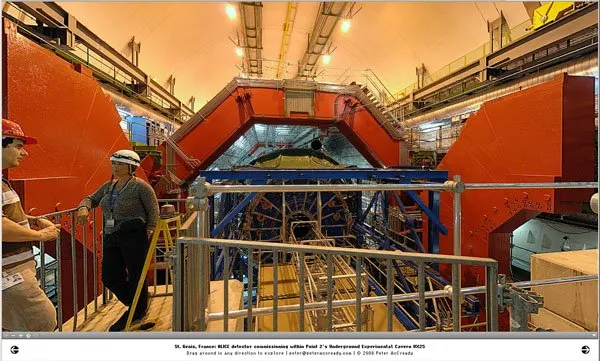
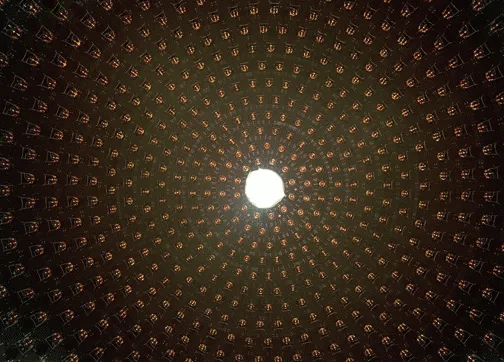
The ATLAS collaboration is continuously expanding and recently its message reached South America with the formalization of the presence of Latin American research teams in the experiment. The first particle beam is expected to circulate on September 10. Is it safe?
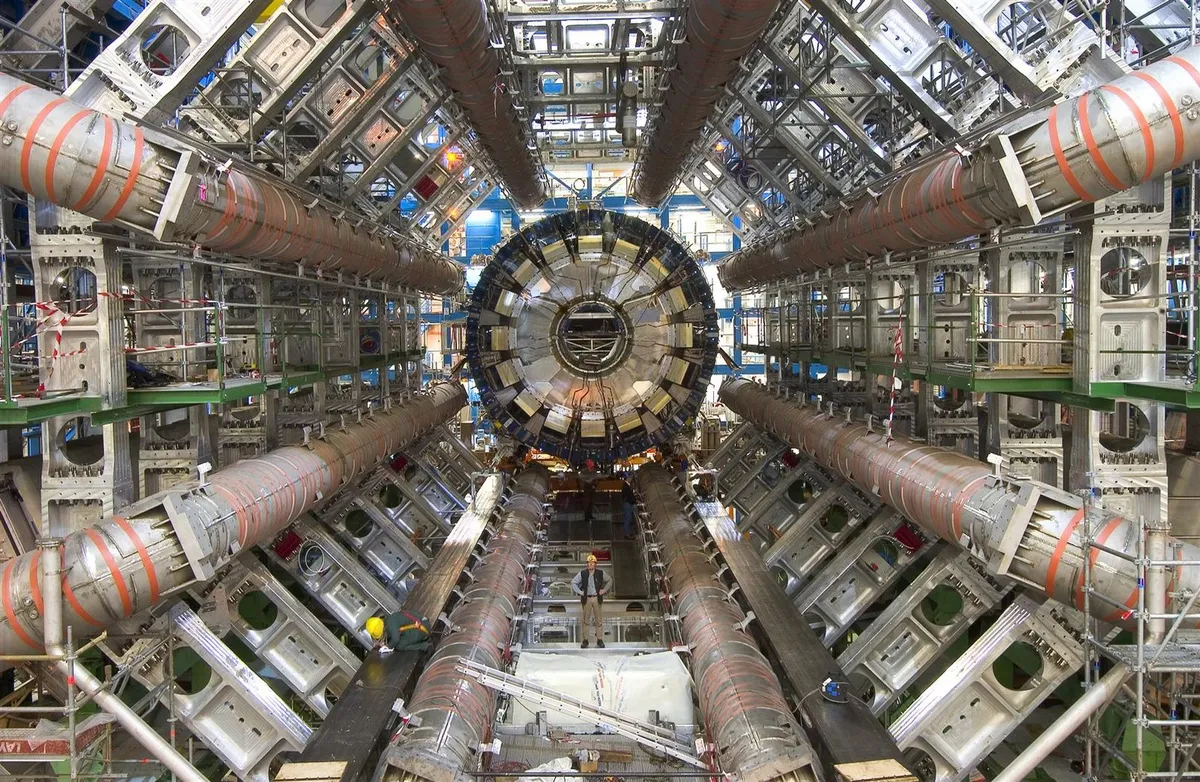
ATLAS (A Toroidal LHC ApparatuS) is one of the five particle detectors (along with ALICE, CMS, TOTEM and LHCb) under construction at the Large Hadron Collider, the new particle accelerator at CERN in Switzerland.
ATLAS is expected to investigate the new types of particles that may be detected in the high-energy collisions of the LHC, in particular the elusive Higgs boson.
"These South American groups have been working on ATLAS for many years, so this is the official and well-deserved recognition of their hard work," said Jorge Mikenberg, an Argentine resident in Geneva, head of the Atlas Muon Spectrometer project, who made many personal efforts to forge the collaboration with his homeland.
Jorge Mikenberg was born in Buenos Aires in 1947. At 16 he left for Israel and changed his name to Giora. He began studying physics, inspired by Prof. Yehuda Shadmi, and finally landed at the Weizmann Institute of Science. At CERN they know him as George.
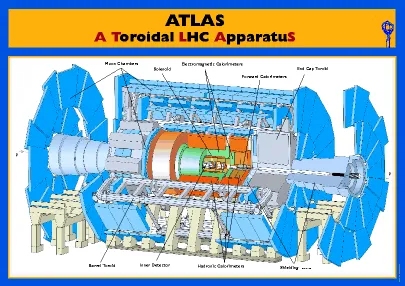
This is not new. Latin American scientists have been collaborating with CERN for many years. These agreements on the Large Hadron Collider date back to 2006. On April 18 of that year, the Argentine Chamber of Deputies in its Order of the Day 160 stated: "The Science and Technology Committee has considered the draft declaration by Deputy Canteros expressing satisfaction for the participation of Argentine scientists in the Atlas experiment at the European Center for Nuclear Research; and, for the reasons set out in the accompanying report and those to be given by the reporting member, recommends its approval as a draft resolution."
These agreements were signed at the beginning of the year with ATLAS spokesperson Peter Jenni, formalizing the collaboration of these countries.
In Latin America, particle physics faces the obstacle of the high cost of building experimental facilities. However, since researchers in those countries began their work on ATLAS back in 2002, they have shown how much and creative work can overcome budget shortages. "Latin American researchers have made important contributions to science, despite being far away and working with low budgets," said Mikenberg.
The collaboration of Latin American groups with ATLAS has been promoted by the European Union through HELEN, the European network of Latin American high-energy physicists launched in 2002.
For now, the South American universities collaborating with ATLAS are the Pontifical Catholic University and Federico Santa María Technical University, in Chile; the University of Buenos Aires and the University of La Plata, in Argentina; and the Antonio Nariño University in Colombia.
Argentine physics and the Large Hadron Collider
Maria Teresa Dova, who holds a doctorate in Physical Sciences from UNLP and is a Conicet researcher dedicated to analyzing ultra-high-energy cosmic rays and data from the Pierre Auger Observatory. She was part of the international team that studied the highest-energy cosmic rays with violent black holes.
Dova promoted an agreement for Argentine physicists, engineers, mathematicians and computer specialists to collaborate with the Large Hadron Collider (LHC) initiative, the world's largest and most powerful particle accelerator, a 27-kilometer circular tunnel buried one hundred meters deep near the border between Switzerland and France.
"This moves the frontier of knowledge. And it's not just a figure of speech. It's literally like that. We are entering a region of energy never before studied in the way we are going to do it," says María Teresa Dova from Switzerland to La Nación, a researcher at the University of La Plata (UNLP) and responsible for Argentine participation in the project of the European Center for Nuclear Research (CERN).
Precision calculations for interactions
Between October 7 and 10, 2008, HP².2 will take place in Buenos Aires. This is the second edition of the workshop "High Precision for Hard Processes at the LHC" on precision in calculations of particle interactions (Cross section)
More info at:
http://www.df.uba.ar/users/deflo/hp2.html
And is all this safe?
Given the proximity of the LHC's start-up date, questions about the safety of its operation are the order of the day. As we already reported in LHC: Earth is not in danger, the experiments to be carried out involve high energy levels, which opened the (purely theoretical) possibility of generating mini black holes. If these were to be produced, they would decay very quickly and the available energy would be the same as in other collision processes at the LHC. Thinking that these energies could endanger Earth makes no sense since they are much lower than the energies that have been produced for 4,500 million years in the cosmic rays that permanently reach our planet. The LHC will only allow us to see these processes in the laboratory, albeit at much lower energies than many cosmic rays.
On September 10, the first beam is expected to be accelerated to an energy of 450 GeV. It is assumed that it will take a few more years (it is said by 2010) to reach optimal specifications.
Why is it underground?
The LHC was built in a tunnel originally built for a previous collider (LEP – the Large Electron Positron collider). This was the most economical solution since it was cheaper to build a tunnel underground than to acquire the equivalent land. It also reduces environmental impact.
The rocks surrounding the LHC are a natural shield that reduces the amount of radiation reaching the LHC and reduces interference with the detectors. The radiation produced when the LHC is in operation is shielded by between 50 and 100 meters of rock. Synchrotron radiation is the characteristic electromagnetic radiation produced by charged particles moving at high speed in a magnetic field.
What radiation is produced and why?
Radiation is the transport of energy through particles or waves, such as X-rays. It occurs, for example, when an unstable atom "breaks" to form a stable one and releases some of its energy. Rocks, the Sun, and space naturally emit ionizing radiation that we can detect on Earth. Artificial ionizing radiation is produced in medical treatments and in mining and nuclear energy industries. In small doses it is safe, but in very large doses it can be dangerous as it can remove electrons from atoms, ionizing them. The dose is usually measured in Sieverts (Sv), which is a measure of the effect of radiation on the body.
CERN experiments involve the collision of particle beams with each other or with a stationary target. When this happens, some particles release radiation or new particles are created. This is very different from the radiation from a nuclear power plant where, without human intervention, radiation levels could increase exponentially. At CERN this occurs when the particle beam is active and turning it off stops the emission immediately. Collisions are also rare events: at the LHC only 2 nanograms (one millionth of a milligram) of protons per day will be accelerated and only a small portion of these will collide. Proton beams can circulate for hours in the collider without being totally lost. In fact, it would take millions of years to collide 1 gram of protons. Radiation sometimes activates some pieces of components around the collision points, making them radioactive. The small amount of material is well confined and when the accelerator is dismantled it will be handled with the appropriate regulations.
How much ionizing radiation is produced at CERN?
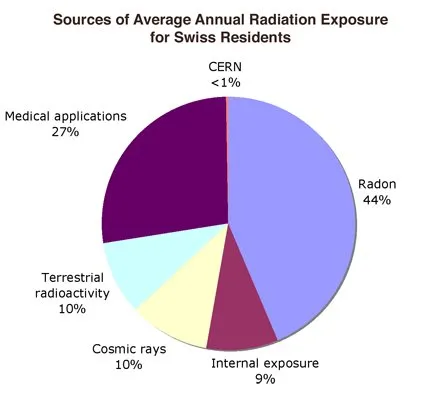
Someone residing in the local area receives about 0.01 mSv of effective radiation dose per year. This is less than 1% of the total annual dose of 3.7 mSv that individuals receive on average, either naturally or through radioactive elements in soil, rocks or cosmic rays and artificially through medical procedures, for example, as shown in the attached graph.
To put it in context, if you live for a year near CERN you would receive radiation equivalent to that experienced from exposure to cosmic rays on a flight from Geneva to Athens.
And those of us who don't live near CERN, are we exposed?
Most of the radiation produced in collisions will be absorbed by various components and cannot escape the facilities, so the public is not in danger. It is dispersed following appropriate radiation protection regulations. The air used in ventilation and the water used in cooling may contain small amounts of radioactive elements, for which there are measures to prevent them from reaching the environment. Even so, it should be said that most of these elements have an average lifetime of just minutes or hours, which means they are radioactive only for a short time. This small amount of emissions is in the form of gamma and beta radiation. Combined with their short lifetime and their physical and chemical properties, these radionuclides pose a low radiation hazard.
Emissions are controlled and remain below regulatory limits, for which there are 200 monitoring stations and a safety commission that takes samples and performs analyses.
Several organizations conducted a study to determine the state of the environment around CERN before the construction of the LHC. Based on the results obtained over two years, the report concludes that the impact on the local environment during CERN's 53 years of activity is negligible. Furthermore, the study provides a benchmark for future monitoring by the control authorities.
Will the work at CERN be used to create more lethal weapons?
It is very unlikely for two reasons. First, because scientists and engineers have no such interest. They are trying to better understand how the world works, not how to destroy it.
Secondly, high-energy particle beams require an enormous machine (27 km in circumference weighing over 38,000 tons) that consumes 120 MW of power and needs 91 tons of super-cold liquid helium. The beams have a lot of energy (equivalent to a Eurostar-type train traveling at top speed) but can only be maintained in a vacuum; if released into the atmosphere they would immediately interact with atoms in the air and dissipate their energy over a very short distance.
Are the energies to be produced at the LHC dangerous and what happens if something goes wrong?
The LHC produces very high energies, but these levels are confined to very small volumes inside the detectors. Many high-energy particles from proton-proton collisions will be produced every second, but the detectors are designed to track and stop all particles (except neutrinos) since capturing all the energy from the collisions is essential in identifying what particles have been produced. And yes, a very small amount of energy from these collisions may be able to escape the detectors.
The greatest danger from these energy levels is to the machine itself. The particle beam could become unstable and deflect to the walls of the pipe and the magnets, releasing all the energy and causing serious damage to the facilities. Therefore, there are several automatic safety systems that monitor critical parts. Something could fail, for example the magnets could fail, but the particle beam would be immediately diverted to a "blind" tunnel where the energy would be dissipated safely. All this happens in milliseconds. The beam, which travels 11,000 circuits in one second, would complete less than 3 circuits before this diversion was completed.
Sources and related links
- Argentina, Chile and Colombia Join ATLAS Experiment
- Radiation at CERN
- Large Hadron Collider Safety
About the images
Photo Credit: CERN
The eight toroidal magnets can be seen in the enormous ATLAS detector with the calorimeter before being moved to the center of the detector. This calorimeter will measure the energies of particles produced when protons collide at the center of the detector. ATLAS will work together with the CMS experiment in search of new physics at the 14 TeV level.