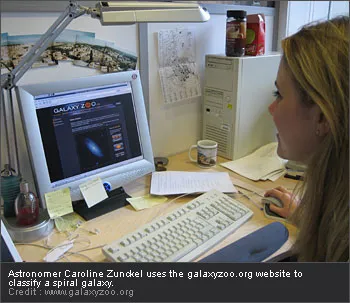
In this space we have commented on the Galaxy Zoo project, which enables internet users around the world to help in the classification of galaxies. We also talked about the initiative, from the same group, to classify supernovas. Now we announce that Moon Zoo is coming.
Between June 9 and 11, 2009, a scientific meeting of the LRO mission was held at the University of Arizona. A group of researchers presented a document announcing Moon Zoo.
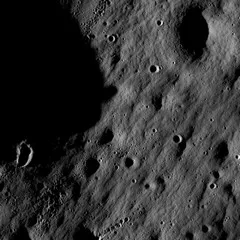
As explained, the initiative will use high-resolution images from the camera of the Lunar Reconnaissance Orbiter mission. Here we commented on the LRO/LCROSS missions in the note Two dust clouds on the Moon.
Participants in the new initiative will be able to classify and measure the characteristics of the lunar surface, focusing on different objectives.
The first objective (or project) is divided into two parts:
1a-Count the number of craters and measure their size. This count allows estimating the apparent age of the lunar surface by comparing the number of impact craters in different regions. Technical issues such as the classification between primary and secondary craters would be outside the tasks to be performed by users.
1b-Determine the state of the crater rims.
Users participating in both objectives will thus be able to catalog and identify the location of lunar features of interest such as lava channels, lava-flooded craters, etc.
The second objective will allow users to determine the degree of hazard from rocks on the lunar surface, by comparing two images (of the same scale and similar lighting conditions) and thus estimating the rock density. With this data, maps can be produced to help choose the most suitable locations for the landing of future missions.
The third objective will be to identify recent changes (in the last 40 years) on the lunar surface by comparing new images from LRO with previous photos from the Apollo missions. In this way, they will be able to count new impacts and calculate a rate of great interest for determining the danger of asteroid impacts in the Earth-Moon system.
For all three objectives, the possibility of identifying the locations of space missions, Apollo and Russian lunar rovers, European and Chinese probes will be included, and a database available to the world community will be created.
According to the document presented at the meeting, the team for Moon Zoo is being assembled and better defining its objectives. The design of the database and interface has also begun.
It will also be a good way to promote lunar exploration and foster learning about the processes involved in scientific discoveries. In virtue of the 40th anniversary of Apollo 11 and the recent launch of the LRO/LCROSS missions, added to the passion that the Moon arouses, Moon Zoo could become much more popular than its "sibling" projects Galaxy Zoo and Supernova Zoo.
Galaxy Zoo: a growing family
The initial project to classify galaxies was launched in 2007 and no one thought it would arouse the enthusiasm and level of participation it achieved. Due to its success, Galaxy Zoo 2 was created for a detailed classification of more than 245 thousand selected galaxies.

Recently, the family expanded with Galaxy Zoo: Supernovae, to classify the violent events in which the life of massive stars ends. In this case, there are programming routines that select, through complex algorithms, the best supernova candidates. For this, they have images of different parts of the sky that they compare with new images taken. This enables, through an image subtraction process, comparing the differences between the old and new images. Thus, the routines can automatically search for brightness changes between the photographs. But this can occur not only in supernova events, but also due to variable stars and other phenomena, including programming errors. That is where users, guided through a series of questions, can indicate different aspects of the differences between the images. That allows researchers to discard many of the candidates and focus on those that passed that questionnaire. The resulting best candidates are then followed up by observation from the Palomar Observatory in the USA.
The announcement of Moon Zoo extends the family of initiatives to the classification of an object that, despite not having the spectacularity of galaxies and supernovas, is wrapped in an aura of romanticism and attraction.
What will be the next Galaxy Zoo project?
Sources and related links
- Moon Zoo: Utilizing LROC Lunar Images for Outreach and Lunar Science
Joy, K. H. et al.
Lunar Reconnaissance Orbiter Science Targeting Meeting, June 9-11, 2009, Arizona.
LPI Contribution No. 1483, p.64-65 - Moon Zoo is coming
- Blog LRO Update
About the images
- Detail of one of the first LROC NAC images
Credit: NASA/GSFC/Arizona State University - Astronomer using GalaxyZoo.org and Supernova GZ Logo
Credit: Galaxy Zoo