Murray Gell-Mann had a successful collision with particles, notorious fights with Feynman and a missed opportunity with Einstein.
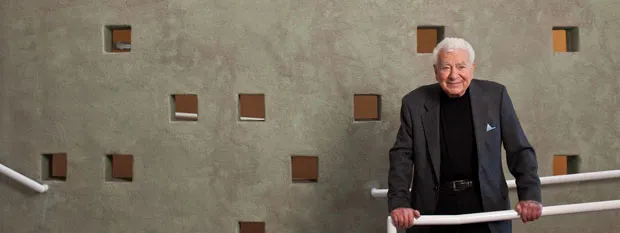
Discover interview by Susan Kruglinski; Photo by Jamey Stillings
It is no accident that the quark—the building block of protons and neutrons and, by extension, of you and everything around you—has such a strange and charming name. The physicist who discovered it, Murray Gell-Mann, loves words as much as physics. He is known for correcting the pronunciation of strangers and giving names to objects or ideas that don't have one. That's how the word quark came to be for his most famous discovery. The name originates from a poem by James Joyce titled Finnegans Wake and from there its spelling was used:
Three quarks for Muster Mark!
Sure he has not got much of a bark
And sure any he has it's all beside the mark.
From the book Finnegans Wake by James Joyce
Gell-Mann said about this:
In 1963, when I assigned the name quark to the fundamental constituents of nucleons, I had the first sound, without spelling, which could have been kwork. Then, in one of his occasional readings of Finnegans Wake, by James Joyce, I came across the word quark in the phrase Three quarks for Muster Mark. So quark (which means, on the one hand, the cry of the gull) was the clear attempt to rhyme with Mark, as with bark and other similar words. I had to find an excuse to pronounce it as kwork. But the book represents the dream of a publican named Humphrey Chimpden Earwicker. Words in the text often come from several sources at once, like the portmanteau word in Through the Looking Glass. From time to time, phrases that appear in the book are determined to name drinks in a bar. I argued, therefore, that one of the multiple sources of the phrase Three quarks for Muster Mark could be Three quarts for Mister Mark, in that case the pronunciation of "kwork" could be fully justified. In any case, the number three fit perfectly in the way the quark appeared in nature.
The phrase three quarks fit particularly well (as mentioned in the quote) since at that time there were only three known quarks and then quarks were in groups of three in baryons.
Gell-Mann's obsession with words comes from his youth, when his fascination with languages, natural history and archaeology helped him understand the diversity of the world. The New York native skipped three grades in elementary school and entered college early. After going through Yale and MIT, he was only 21 when he began his postdoctorate at the Institute for Advanced Study in Princeton, New Jersey, when Albert Einstein still walked the campus. Gell-Mann later worked with Enrico Fermi at the University of Chicago and passionately debated with the renowned physicist Richard Feynman during his many years at Caltech.
It was at Caltech where Gell-Mann helped lay the foundations of our understanding of the components that make up matter. He designed a scheme of subatomic physics that he called the Eightfold Way. At that time, physicists understood that atoms are built of protons and neutrons, but they had also found many other mysterious particles. The Eightfold Way made sense of that bewildering collection, finding places for particles never before imagined. The work was so important that it earned him the Nobel Prize in Physics in 1969.
In 1984 Gell-Mann pursued his dream of working in other fields by co-founding the Santa Fe Institute, a think tank where scientists are encouraged to cross disciplines. Located on a hilltop in the New Mexico desert, surrounded by cottonwoods and outcrops of pink quartz, the institute is a place where an ornithologist can exchange data at lunch with a political scientist, while excitedly scribbling statistical equations on a window with a Sharpie for lack of paper and pencil. With its geometric design, brightly colored walls, abundant surrounding trails, and generous supply of candy in the kitchen, the Santa Fe Institute seems a bit like a playground for scientists.
Discover editor Susan Kruglinski recently sat down with Gell-Mann in the comfortable leather armchairs of the institute's library to talk about what it was like to have lived the history of modern physics.
You are best known as the person who discovered the quark, one of the fundamental particles that create the universe, although for years many of your colleagues were not convinced that quarks really existed. Why?
You can't see them directly. They have some unusual properties and so it was difficult for people to believe in them at first. And many didn't. Many people thought I was crazy. Quarks are permanently trapped inside other particles like neutrons and protons. You can't take them out individually to study them. So they are somewhat peculiar in that aspect.[Note about individual quarks, see below]
How should someone who is not a physicist visualize quarks? Like little spheres trapped inside atoms?
Well, in classical physics you could think of a quark as a point. In quantum physics a quark is not exactly a point, it's like a flexible object. Sometimes it behaves like a point, but it can blur a bit. Sometimes it behaves like a wave.
When people imagine particles colliding in a particle collider, what should they imagine? It's not like billiard balls colliding, is it?
It depends on the circumstances. At very high energies, two colliding particles do not bounce but create a large number of particles. You would have all kinds of little bits flying in all directions... that would be something like it.
So would it be like colliding an apple and an orange and getting bananas?
No, no, no. Little pieces of all kinds of things. Getting a whole bunch of little bits of apple and orange, but also of banana and antibanana, grapes...
How many types of elementary particles are there?
We have something called the Standard Model, which is based on about 60 particles, but there could be many more. These are the ones that have low energy, so we can detect them.
The 1960s and 1970s could be considered the heyday of particle physics, when many subatomic particles—and not only elementary ones—were discovered. Could you talk a bit about the events that led to your discovery of the quark?
That was very dramatic for me. I had been working for years on the properties of particles that participated in the strong interaction. This is the interaction responsible for holding the atomic nucleus together. The family of strong interaction particles includes neutrons and protons, those are the most familiar. But now dozens, hundreds of other particles were being discovered in experiments where protons collided with each other in particle accelerators. There were many energy states in which we saw relatives—cousins—of neutrons and protons.
Are these particles similar to protons and neutrons but normally do not exist in nature?
They are produced in a particle collision in an accelerator and decay after a short time. After a tiny fraction of a second, they disintegrate into other things. A particle that I predicted, the omega-minus, can decay into a neutral pion and a xi-minus, and then the pion decays into photons and the xi-minus decays into a negative pion and a lambda. And then the lambda decays into a negative pion and a proton. The interior of the Sun has a very high temperature, but even that extremely high temperature is not enough to create all these things.
Do these exotic particles exist anywhere outside of physics experiments?
They existed right after the Big Bang, when temperatures were incredibly high. And they occur in cosmic ray events. [Cosmic rays themselves are mainly protons, but when they collide with atomic nuclei in the Earth's atmosphere these rare particles can be produced.]
But when you predicted the quark in 1964, you realized it wasn't just another "cousin," right?
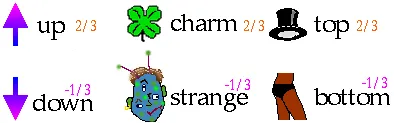
That's right. Looking at the table of known particles and the experimental data, it was clear that the neutron and the proton could be made of three particles with fractional charges, which I called quarks. [Until then all known particles had charges that were a multiple of the charge of a proton] The quarks were permanently confined in the neutron and proton, so you couldn't take them out to examine them individually. The neutron and proton would no longer be considered elementary. It wasn't something difficult to deduce. What was difficult was believing it, because no one had heard that the neutron and proton were composite. No one had heard of these fractional charges. No one had heard of particles permanently confined inside observable things and not directly reachable.
As time passes, physicists seem to find more and more particles. Could there be an infinite number of them?
We theorists believe in simplicity. Simplicity has always been a reliable guide for theory in fundamental physics. But simplicity might not lie in the number of particles. It could be that the theory, expressed simply, gives rise to a large number of particle types. The particles could be infinite, but you detect only those that are light enough to play a role in your experiments.
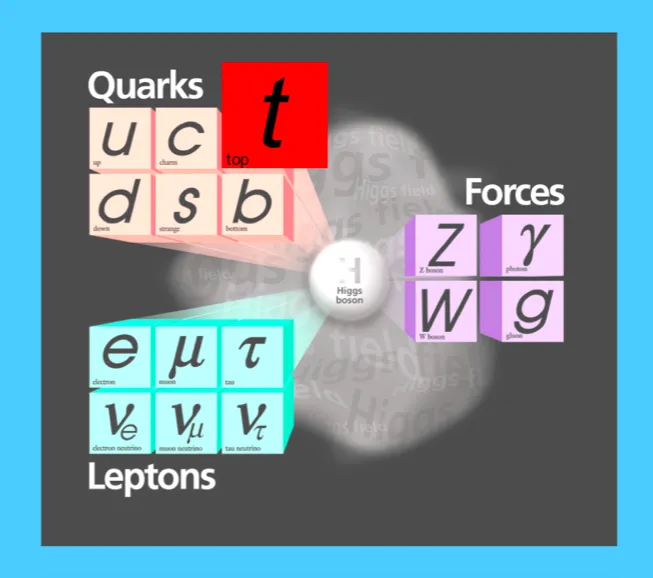
Now researchers are placing a lot of hope in finding another set of particles in experiments at the Large Hadron Collider. Do you think this could bring greater clarity?
Well, there is another possibility, that they find a phenomenon that is completely unexpected. We will be displeased if we find something totally new, totally puzzling, but that would be more exciting.
You were a mathematical prodigy as a child, but mathematics wasn't your only passion, was it?
I remember when I was about 5 [years old], I looked at my father's books. He had an important library, a large library. And when bad times came—the Depression—he had to get rid of them when we moved to a small apartment. He had to remove the furniture. He couldn't sell it, he had to pay to have it taken away. He paid someone five dollars to take the library away. Heartbreaking. But he kept some books, 50 books or something like that. One of them was a book that gave the etymology of English words taken from Greek or Latin. So I learned all these Greek and Latin roots and how they had formed English words. It was exciting. That started me on etymology, and I have loved it ever since.
I always did well in mathematics. In fact, I loved mathematics, studying it, using it. I loved history. I particularly liked archaeology and linguistics. And I could discuss anything with my brother—archaeology, etymology, anything. He never did anything with it, but he was very, very smart and very knowledgeable about that kind of thing. He was passionate about birds and other living things. Not so much about the scientific principles of ornithology, but seeing the birds and identifying them and knowing where they went, what kind of nests they had and what songs they sang. Going on a bird trip with him was the best thing—the best thing—I did in those years. My brother taught me to read from a cookie box when I was 3 years old.
When you were about to go to college, you were interested in studying archaeology, natural history or linguistics, but your father wanted you to make money as an engineer.
I said I would rather be poor or die than be an engineer because I wouldn't be good at it. If I design something, it will fall down. When I was admitted to Yale, I took an aptitude test and then the counselor gave me the test results and said: 'You could be a lot of things. But don't be an engineer.'
So how did you settle on physics?
After my father gave up on engineering, he told me: 'How about we commit to physics? General relativity, quantum mechanics, you'll love it.' I thought I'd give my father's advice a try. I don't know why. I didn't take his advice on anything else. He told me how beautiful physics could be if I stuck with it, and that notion of beauty impressed me. My father studied those things. He was a great admirer of Einstein. He would lock himself in his room and study general relativity. He never really understood it. My opinion is that you must despise something like that to be good at it.
Why is that?
If you admire it enough, you will respect it and never learn it. My father thought it would be difficult and that it would take years to understand it and only a few people understood it and that. But I had a fantastic professor at Yale, Henry Margenau, who had the opposite attitude. He thought general relativity was for everyone. Just learn the math. He said: "We'll prepare the math on Tuesday and Thursday, and cover general relativity on Saturday and next Tuesday." And he was right. It's not so bad.
You met some of the greatest physicists in history. Who would you put at the top of the pedestal?
I don't usually put people on pedestals, especially not physicists. Feynman [who won a Nobel Prize in 1965 for his work in particle physics] was very good, though not as good as he thought he was. He was very self-absorbed and spent a great deal of energy generating anecdotes about himself. Fermi [who developed the first nuclear reactor] was good, but again with limitations. I don't know anyone without some limitations in my field of theoretical physics.
Back then, did you understand how special the people around you were?
No. I grew up thinking that the previous people were the special ones. Although I met most of them. I didn't meet Erwin Schrödinger [a pioneer in quantum mechanics]; I missed an opportunity to meet him for some reason. But I do know Werner Heisenberg quite well. He was one of the discoverers of quantum mechanics, which is one of the greatest achievements of the human mind. But by the time I met him, although he wasn't extremely old, he was a bit of a crank.
How?
He said a lot of nonsense. He had things he called theories that weren't really theories, they were nonsense. His goal was to find a unified theory of all particles and forces. He worked on an equation, but it had no practical meaning. It was impossible to work with him. There were no solutions. It was nonsense. Anyway, it was interesting that Wolfgang Pauli [discoverer of the exclusion principle], who didn't go in for crazy things -at least not in physics- was with Heisenberg. He agreed to join his program.
But then Pauli came to the United States, where many people worked with him -including Dick Feynman and me. Many of us talked to Pauli and told him, "Look, you shouldn't associate with this. It's garbage and you have a reputation to consider." Pauli agreed and wrote a letter to Heisenberg saying something like: "I quit. This is nonsense. There is nothing. Erase my name." In another letter, Pauli drew a rectangle on a page and next to it wrote: "This is to show the world that I can paint like Titian. Only the technical details are missing. W. Pauli." In other words, Heisenberg had provided only a frame, without a picture. I knew Pauli quite well. I met Paul Dirac [another founder of quantum mechanics]. He was a remarkably eccentric person.
Of course I met these people when they were old, not when they were young and doing their most important work. But still, I met them. And those were the people we were supposed to admire. I didn't think the people around me were going to be special. I suppose, looking back, the era seemed interesting.
There is a big difference, however, that my professor Victor Weiskopf continues to point out. And it is that the people who were working on the consequences of quantum mechanics, shortly after its discovery in 1924 and 1925, began to understand how atoms and molecules really worked, and asked elementary questions about the world that even an ordinary person could ask. For example, Victor used to say, that one question is, why can't one finger go through another finger? Well, it ultimately refers to the exclusion principle [which shows that two particles cannot occupy the same space at the same time]. And so on. Whereas now you have to be sophisticated even to ask the questions we are answering.
One of the best-known interactions was with Richard Feynman at Caltech. How was that?
We had offices essentially next to each other for 33 years. I was very enthusiastic about Feynman when I arrived at Caltech. I greatly enjoyed working with him. He was funny, amusing, cool.
What about the stories that you both had major problems with each other?
Oh, we argued all the time. When we were very friendly, we argued. And then, when I was less enthusiastic about him, we argued too. At one point he was doing very good work -not terribly deep, but it was very important, on the structure of protons and neutrons. In that work he refers to quarks, antiquarks and gluons, but he doesn't call them that. He calls them "partons," which is half Latin, half Greek, a stupid word. Partons. He said he didn't care what they were, so he gave them a name. But they were quarks, antiquarks and gluons and he could have said that. And then people realized they were quarks and then you had the "quark-parton" model. Finally we built a theory -I didn't do it myself, it was the result of several of us. We built the correct theory, called Quantum Chromodynamics [Quantum Chromodynamics, QCD: Describes the interactions between quarks and gluons]. And Feynman didn't believe it.
He didn't believe the theory was correct?
No. He had a crazy scheme based on his partons. Finally, after a couple of years, he gave up because he was very bright and realized after a while that we were right. But he resisted and I didn't understand why it had to be that way. Partons...
Feynman was famously eccentric. Did you ever do anything crazy together?
We did many fun things. One of his friends was an old Armenian painter. My late wife Margaret and I were friends with him too. He had an important birthday and Margaret and I dreamed up this idea of giving him a peacock. So we conspired with the Feynmans to do it. They distracted him elsewhere while Margaret and I took the peacock from the car and put it in the bedroom. A peacock in his bedroom! It's a wonderful way to give someone a gift.
Did you find it strange that Feynman became a celebrity?
Feynman was a peculiar case because he was a very bright, incredible, successful scientist, but also a clown. He was more of a clown than a scientist sometimes.
But did you and Feynman have deep conversations about physics?
For a few years and then I got fed up with him. He had become too much into himself. Everything was a test of his brilliance. So if in a discussion we reached some interesting conclusion, his interpretation was, "Hey, I'm smart". And that is irritating, so after a few years I didn't work with him.
When you think of people like Feynman or Einstein or some of the other legends of physics, do you think they are geniuses? Is there such a thing?
Einstein was very special, I mean, creating that theory, general relativity [which describes gravity as a product of the geometry of space and time]. Doing it today or doing it 34 years ago would be incredible, remarkable, a completely remarkable achievement. But doing it when he did it, in 1915, that is incredible.
When you were at the Institute for Advanced Study, Einstein was there too, although he was near the end of his life. Were you able to absorb anything from him?
I could have done it. I could have made an appointment with his secretary, the formidable Helen Dukas, and go and talk with him. I could have asked him some questions about the old days. If it were today, I would do it at some point. But all I could see then was that he was the past. He didn't believe in quantum mechanics, he didn't know about the particles we were studying. And he didn't know about this and that. If I showed him what I was doing, he wouldn't have done anything with it. And if he showed me what he was doing, I wouldn't have believed it. So I did nothing. I would have said: "Hello. Good morning". And he would have said: "Guten morning". That's all.
What are you working on today?
Together with many other people around the world, I am looking for whether there are alternative ways to mathematically characterize entropy, the measure of disorder of a system. It could be useful to employ alternative formulas to search, in different circumstances, like financial markets or social interactions. Perhaps this becomes an extremely flexible tool for handling all kinds of situations. That is what people hope. Other people think it's crazy.
Detection of individual quarks
For several years there has been evidence of individual top quark production. For example, see:"Elementary, my dear Watson. It's single top."
Much more recently, March 2009, papers were published in the same vein. See for example, "What does it mean that an isolated quark has been observed for the first time?".
It is precisely because of these latest news, as well as my interest in the life and work of those who achieve important discoveries that transform our vision of the universe, that I believed the translation of the Discover interview with Gell-Mann, author of "The Quark and the Jaguar", was appropriate.
Sources and related links
- The Man Who Found Quarks and Made Sense of the Universe
- Words to the Wise: Quarks
- Introducción a la Ciencia. Isaac Asimov (Part VI. The particles)
- La aventura de las partículas: Quarks
About the images
Credit: Jamey Stillings for Discover.
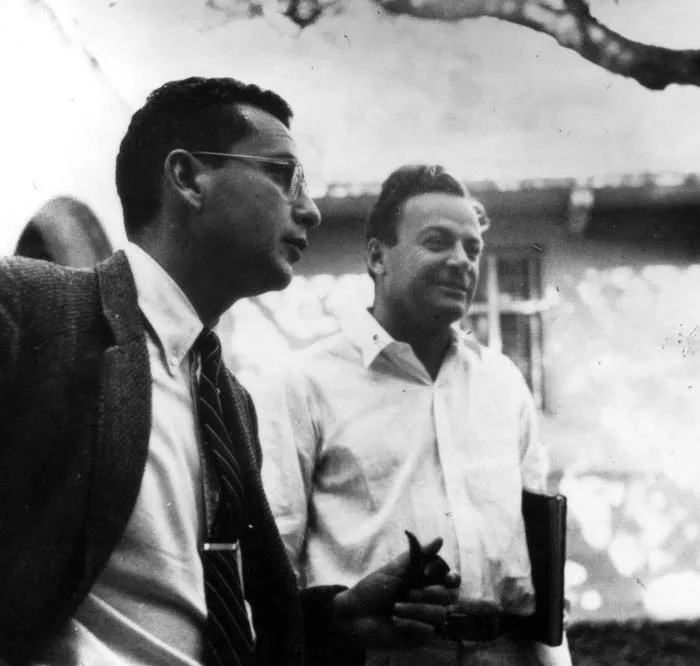
Richard Feynman and Murray Gell-Mann 1959 Photo Joe Munroe. Rights of Caltech.