Experiments that reveal the weirdness of the quantum world usually involve precise and highly specialized equipment. But now, scientists from Switzerland and the United Kingdom have proposed a way to use human vision to observe the effect.
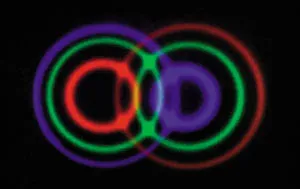
The experiment, which still needs to be performed in a laboratory, would involve entangling a pair of photons and then creating thousands of identical copies of one.
What is entanglement?
Quantum entanglement is a property predicted in 1935 by Einstein, Podolsky and Rosen, formulated in the EPR Paradox. It is a phenomenon in which the quantum states of the objects in a system are correlated with the quantum states of the other objects in the system. For example, if two particles are entangled, their quantum states will be inverse. If the spin of one is up, the other will have spin down.
What is even stranger, is that this "entanglement" would occur independently of the spatial separation of the two particles. And this implies the "instantaneous" transportation of the quantum states of one particle to the other. And here "instantaneous" implies "faster than the speed of light".
This strange quantum feature was criticized by Einstein and his mentioned EPR Paradox was nothing more than an attempt to demonstrate its invalidity. Despite this, since then, many experiments have been carried out that agree with the quantum postulates. In fact, quantum entanglement is used both in quantum computing and in quantum cryptography.
It must also be said that this "instantaneous communication" does not occur in classical systems. It is not possible, as far as is known, to transmit classical information at a speed greater than that of light. Of course, if it were applied to macroscopic systems, it could have some very romantic implications.
The new experiment, proposed by Nicolas Gisin and colleagues from the University of Geneva and the University of Bristol, would involve creating a pair of entangled photons. This can be done, for example, by passing light through a nonlinear crystal in which a high-energy photon is absorbed, followed by the emission of two low-energy photons.
One of the photons is then "cloned" to create thousands of identical photons. This is done by stimulated emission -the same process as in a laser- where the original photon is sent through a pumped optical medium.
Since the clones are created in a coherent quantum process, it produces a light pulse intense enough to be seen with the naked eye. Measuring the polarization of the pulse will then reveal the polarization of the second photon.
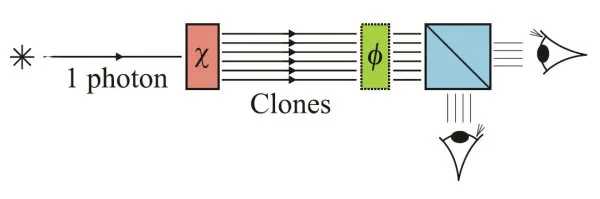
The team proposes measuring the polarization of the pulse by passing it through a filter, which allows light with parallel polarization to pass and deflects light with perpendicular polarization by 90 degrees. Two human observers -one looking along the parallel path and the other along the perpendicular path- will be able to determine the polarization of each pulse.
Meanwhile, the polarization of the second photon of the pair will be determined by passing it through a similar filter monitored by two detectors.
If the experiment is successful, humans should be able to predict the result of the measurement of the second photon based on the observation of the polarization of the pulse. In other words, if the pulse is polarized vertically, the second photon will be polarized horizontally.
While entanglement in photons was observed more than 30 years ago, Gisin emphasizes an important distinction between this experiment and previous ones. In previous work, the choice of measurement that forces the entangled pair into different polarization states is made before the state is amplified to a level where it can be perceived by a human observer. For example, a photon is passed through a polarization filter and then converted into an electrical pulse amplified by a detector.
In contrast, in this experiment, the entangled state is amplified to a human level before the measurement is made, bringing the observer one step closer to the strange world of quantum mechanics. Gisin believes that if successful, the experiment could be extended by cloning the second entangled photon and using a total of four human observers to verify the entanglement.
Elegant experiment
Seth Lloyd, from the Massachusetts Institute of Technology, told physicworld.com that the proposal "does a considerable service by designing an elegant experiment where the human eye functions in a very efficient way as an entanglement detector". He also pointed out that the eye is an extremely efficient light detector, so it is not surprising that it can be used to detect entanglement.
According to Gisin, the challenges involved in performing the experiment are mainly related to the cloning process. "The cloning cannot be perfect," he explained, adding that unwanted spontaneous emissions during cloning could create a significant number of non-entangled photons.
The problem can be reduced using a technique called "phase-covariant" cloning, but not eliminated. As a result, the experiment should be repeated many times before the observers see enough entangled pulses to verify the effect.
Another challenge, according to Gisin, is producing cloned pulses of green light, to which the eye is most sensitive. Most cloning systems currently produce photons in the infrared.
"First we plan to amplify the photon so it can be seen, the rest should be relatively straightforward," he finally added.
Sources and related links
- physicworld.com:Do you have an eye for entanglement?
- Ciencia Kanija:The Einstein-Podolsky-Rosen argument in Quantum Theory (I)
About the images
Entangled photons:M Reck and P G Kwiat
A photon is amplified through cloning by stimulated emission in a nonlinear crystal (pink block). The clones are separated into two orthogonal polarization modes by a filter (blue block) and each mode is detected by the human eye. The polarization can be varied with the help of a wave plate (green block)
Credit:Nicolas Gisin