Who are the best physicists of the 20th century? It is very likely that the first one on the list that comes to mind is Albert Einstein, but the rest is more difficult.
A couple of gentlemen propose that Google results establish who have been the best, in accordance with "the wisdom of the masses". Nonsense.
There are several ways to determine who have been the best: by the number of publications published or by citations, for example. However, measuring it only quantitatively does not seem the best.
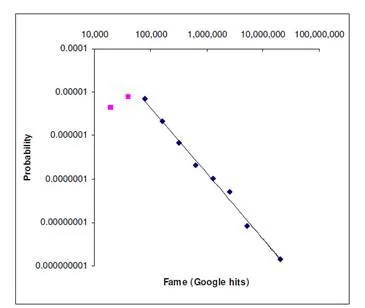
Now, Mikhail Simkin and Vwani Roychowdhury from the University of California proposed a ranking of physicists by equating their achievements with their fame, by measuring the "hits" on Google.
They tried their idea using a list of winners of the Nobel Prize in physics before World War II. At the top is Einstein with 23 million hits.
According to Simkin, the ranking agrees quite well with a list created by the Soviet physicist Lev Landau, who classified theoretical physicists using a logarithmic scale of his own invention.
According to these researchers, the correspondence between both lists is an example of the wisdom of the masses. The hits on Google are simply pages that mention the names in question. "Each web page about a particular person expresses the opinion of its creator that the person in question is worthy of it," they indicate. "Thus, the fact that our estimate of achievements of Nobel Prize winners based on statistical analysis of the number of web pages that mention them agrees quite well with the opinion of an expert (Landau) could be another demonstration of the wisdom of the masses," they state, using the phrase taken from the book "The Wisdom of Crowds" by James Surowiecki.
Before judging this list for yourself, think of Charles Wilson, who won the Nobel Prize in 1927 for his development of the cloud chamber. Wilson has such a common surname that Simkin and company could not determine his fame using Google hits, and had to exclude him from the analysis!!
These same gentlemen had already performed a similar analysis with the supposed best pilots of World War I. There they concluded that the fame of the pilots grew exponentially with their achievements (number of victories). The hypothesis, then, was transferred to other professions, where there is no unquestionable and universally accepted measure of their achievements. Thus, they obtained that Paul Dirac, who is a hundred times less famous (255,000 hits) than Einstein, contributed to physics almost as much as the second (two times less).
Lev Davidovich Landau won the Nobel Prize in physics in 1962. According to Landau's classification, Newton received the highest ranking (0), followed by Einstein (0.5) and then (with 1): Bohr, Heisenberg, Schrödinger, Dirac, Bose, Wigner and others. Landau gave himself a modest ranking of 2.5. The list continues down to those classified with 5.[1]
Let's say that for Landau there were different "classes" of physicists. The highest class was only Newton, followed by another kind of superclass of only one individual, Einstein. Then, the rest.
The authors of this new analysis indicate, however, that the correspondence between their list and Landau's is compatible if one takes into account a previous classification by Landau in which Lorentz, Planck, Einstein, Bohr, Heisenberg, Schrödinger and Dirac all belonged to the first class.
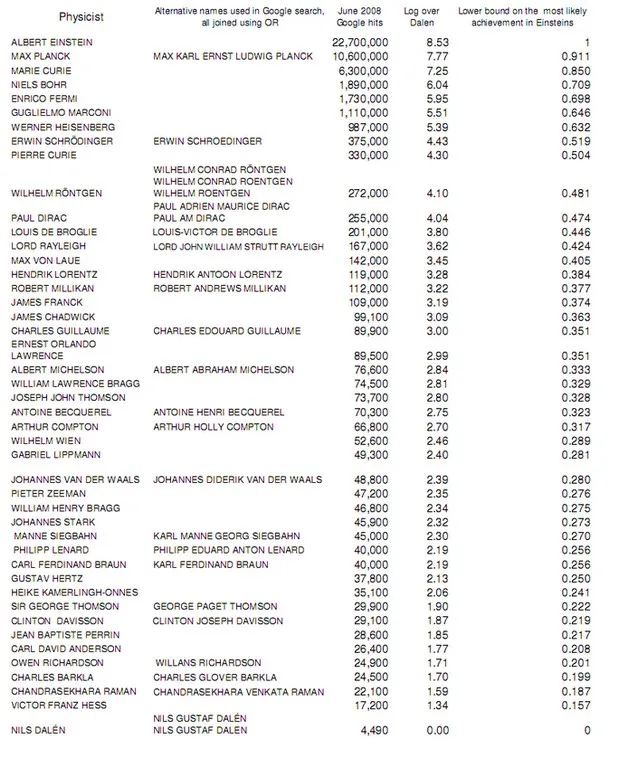
The one who must not be very happy is Nils Gustaf Dalén, whom Simkin and Roychowdhury list as the last one in the barrel, since he only has 4,490 hits on Google (as of June 2008).
The Top 10 (minus the poor Wilson) are:
1. Albert Einstein
2. Max Planck
3. Marie Curie
4. Niels Bohr
5. Enrico Fermi
6. Guglielmo Marconi
7. Werner Heisenberg
8. Erwin Schrodinger
9. Pierre Curie
10. Wilhelm Rontgen
The complete list can be seen in the following image or in the pdf of the analysis on Arxiv (see related links):
Sources and related links
- The World's Greatest Physicists (As Determined by the Wisdom of Crowds)
- Estimating achievement from fame
M.V. Simkin, V.P. Roychowdhury
arXiv:0906.3558v1 - Theory of Aces: Fame by chance or merit?
M.V. Simkin, V.P. Roychowdhury
arXiv:cond-mat/0310049v2 - [1] Letter about the article "Why No 'New Einstein'?" by Asoke Mitra
Physics Today, Nov. 2006, Volume 59, Issue 11, pp. 8-112 - Einstein's mirror, by Anthony J. G. Hey, Patrick Walters - 1997 - 291 pages
About the images
Credit: Mikhail Simkin and Vwani Roychowdhury