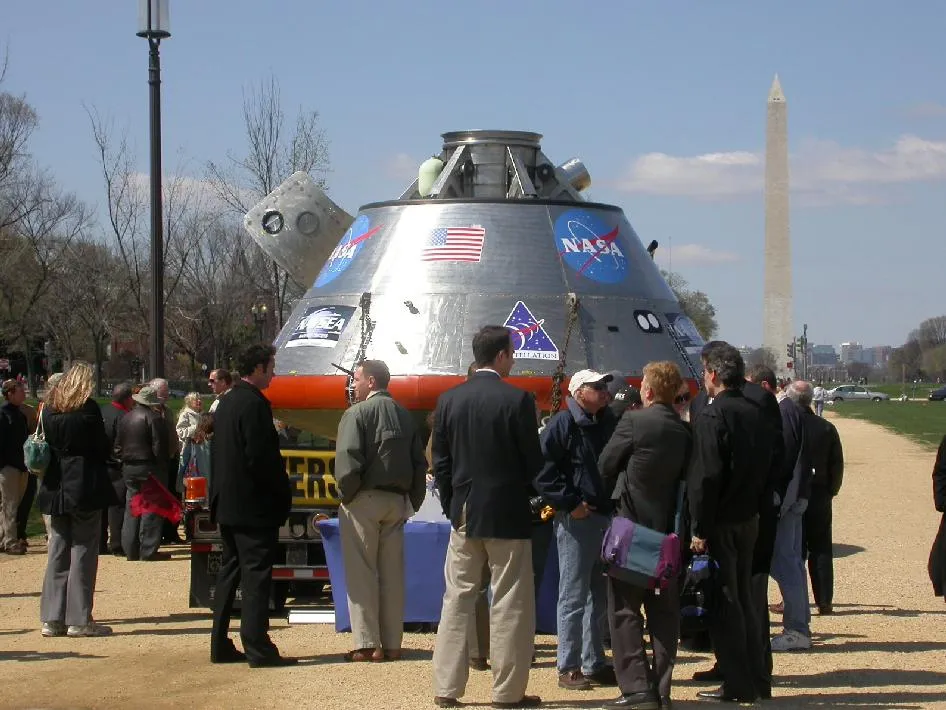
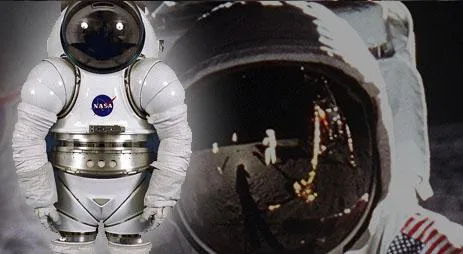
In February 2009, NASA signed a contract with an engineering firm to develop space suits that could be used in the replacement for the space shuttle, the Orion capsule. NewScientist reviewed the suits of the last 50 years and some potential designs for the future. Also, NASA has a page dedicated to the subject.
Project Mercury
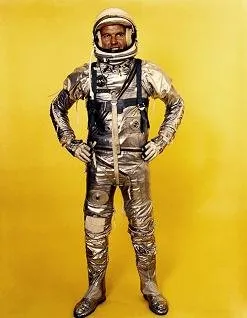
Gordon Cooper, one of NASA's original seven astronauts chosen in 1959, poses in his Mercury suit.
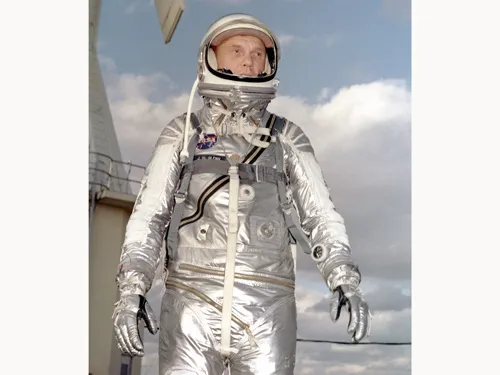
Astronaut John Glenn, the first American to orbit the Earth, with his space suit, designed for the Mercury program (1958-1963).
The suits were adapted from those used by the U.S. Navy for high-altitude flights and were not designed for space. That is why they folded at the joints, decreasing the volume of the suit. That increased the pressure in the rest of the suit, making it harder for the astronauts to bend their arms or legs. As a result, the suits were used as protection against emergency pressure loss.
Project Gemini
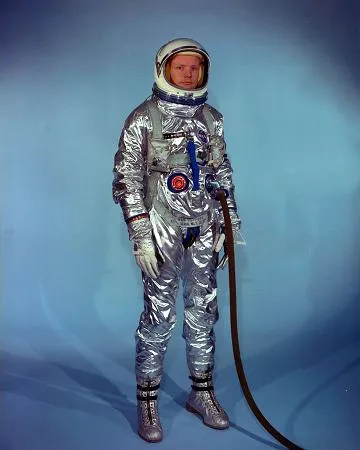
Neil Armstrong in his Gemini G-2C training suit.
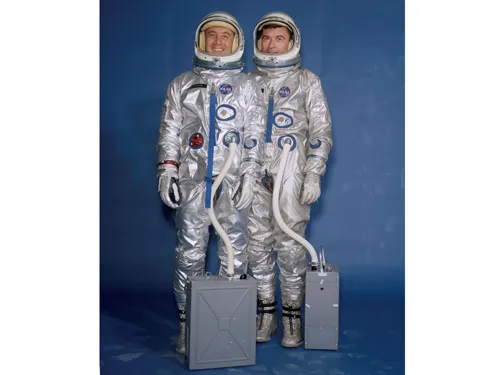
Gus Grissom (left) and John Young, the crew of the first human Gemini mission, a five-hour orbital flight, on March 23, 1965, in their suits, connected to equipment that keeps the suits cool.
The suit design evolved in the Gemini program. To isolate the astronauts from the low pressure and extreme temperature of space, the suits had additional layers
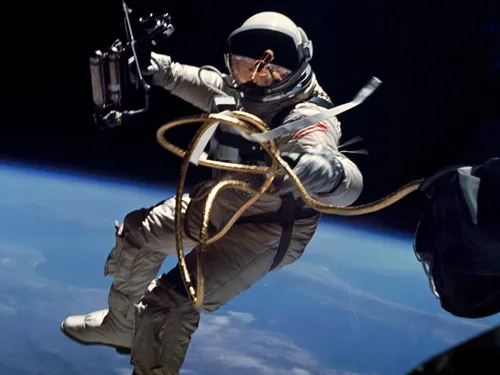
The Gemini mission is remembered for being the first in which the first spacewalk was performed on June 3, 1965.
The suit functioned in the spacewalk as Edward White's personal spacecraft when he left the Gemini IV capsule.
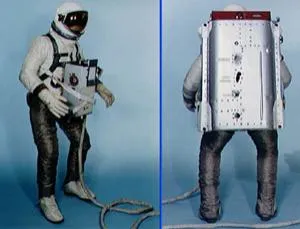
This design was used on the Gemini 9 mission. The legs of the suit were covered with steel fiber fabric, used to protect the astronaut from the weight of the Astronaut Maneuvering Unit (AMU), a propulsion system. Gene Cernan achieved a spacewalk of 2 hours, 9 minutes during the mission, but it was not possible to test the AMU.
Project Apollo
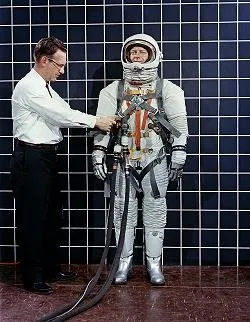
Engineer Bill Peterson helps test pilot Bob Smyth with his suit harness during a test in 1968.
The Apollo suits brought new challenges, as the astronauts would need protection from the lunar terrain and temperature, as well as the ability to allow the astronauts to bend down to pick up lunar rocks.
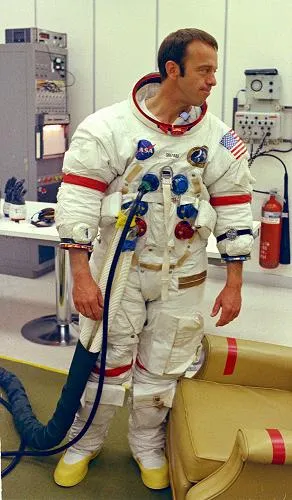
Apollo 14 commander Alan Shepard during suit check before his trip to the lunar surface in 1971. The astronaut was the first to wear the Mercury suit in space, on the first American flight in 1961.
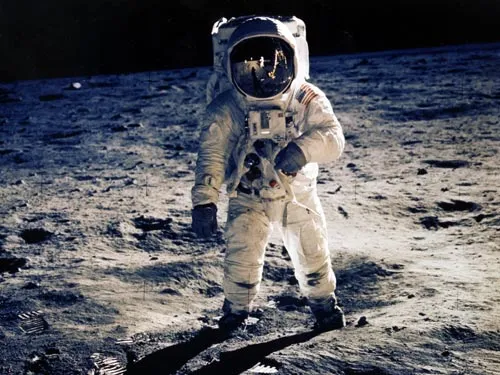
For the 1969 moon landing, the Apollo suits had a backpack that provided oxygen for breathing and suit ventilation for seven hours of lunar walking. Buzz Aldrin wears it here while exploring the Moon's surface on the Apollo 11 mission. The suits performed well on the six landing missions, but dust was a concern. Astronauts reported that the abrasive dust damaged their suits and infiltrated the seals.
Space shuttle
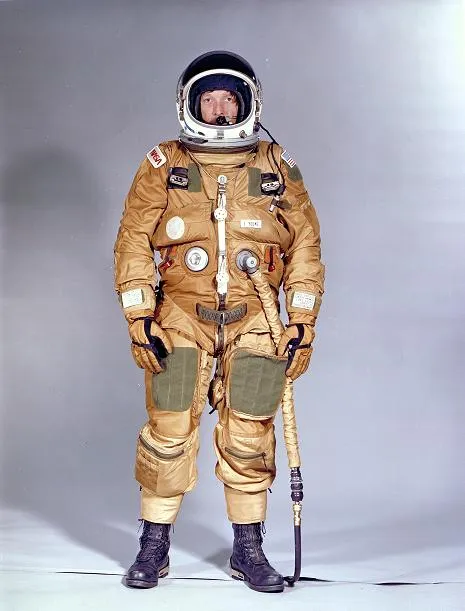
The first shuttle flight, STS-1, launched on April 12, 1981. Astronauts John Young and Robert Crippen wore on that occasion a suit like this, a modified design of the one used by the U.S. Air Force at high altitude.
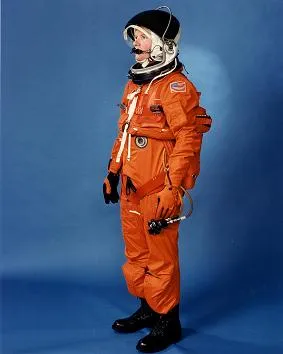
The familiar orange launch and entry suit worn by shuttle crews, nicknamed the "pumpkin suit," for its color.
The suit includes the helmet with communication equipment, parachute and harness, life support unit, gloves, oxygen tubes, boots and survival equipment.
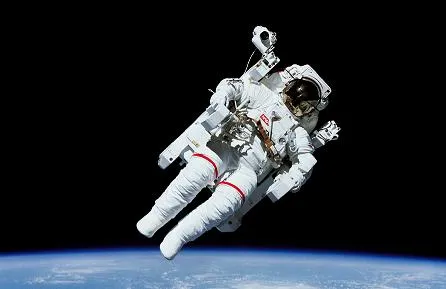
In February 1984, astronaut Bruce McCandless was the first to float in space without a connection to the shuttle, a "wireless" flight, thanks to the device called the Manned Maneuvering Unit (MMU), that is, Human Maneuvering Unit or propulsion backpack.
MMUs are no longer used, but astronauts use a similar device in case of emergency.
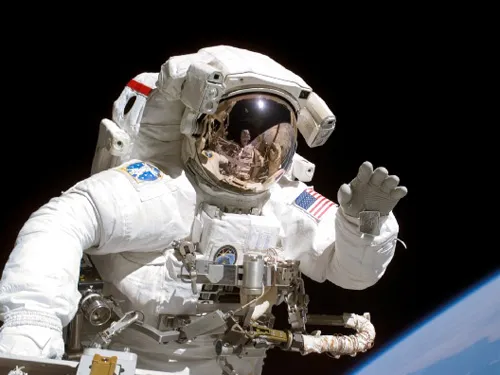
NASA astronauts now use a two-piece suit for spacewalks called the Extravehicular Mobility Unit (EMU). Unlike the Apollo suits, custom-made for each astronaut, the EMU has interchangeable parts that can be used in different ranges of body sizes.
The EMU is pressurized to one-third of atmospheric pressure, so astronauts now "camp" in a low-pressure airlock before spacewalks to remove nitrogen dissolved in the blood and tissues. Moving too quickly to low pressures can cause nitrogen to create bubbles and obstruct blood flow, which can be fatal. The suit can weigh 180 kg and operate for about 8 hours in space. They have a lifespan of 30 years.
Russian suits
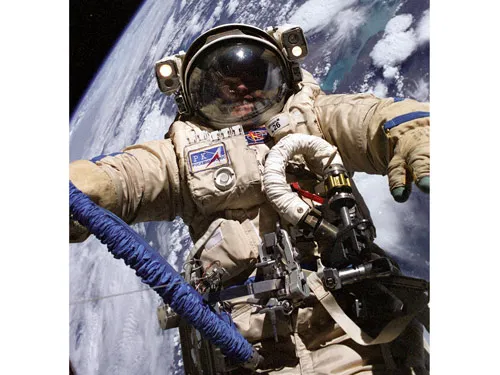
Astronaut Mike Fincke wears a Russian Orlan suit here while performing work on the International Space Station in 2004. He, along with cosmonaut Gennady Padalka, were originally going to use American suits but discovered a problem with the cooling unit. Unlike NASA's EMUs, which have separate sections for the torso and legs, the Orlan suits have an opening in the back. This allows the suits to be put on and taken off quickly. The suit weighs almost 110 kg and can be used for 7 hours in space, designed to last for 12 spacewalks.
Gloves
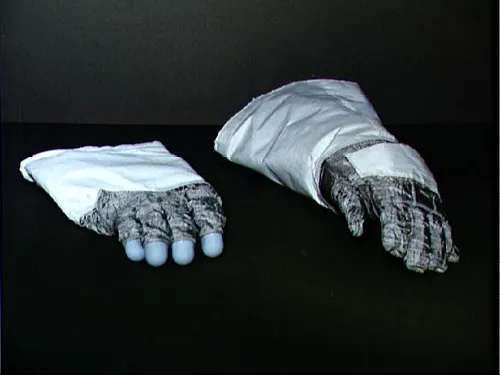
Gloves are possibly the most important part of the suit, from the astronauts' point of view. It's that, besides using their hands to manipulate objects and tools, astronauts use their hands to "walk" during Extra-Vehicular Activities (EVA). The gloves are pressurized, which makes finger mobility difficult.
In the annals of space apparel are this pair of Apollo gloves, consisting of an inner layer (left) with finger covering, and an outer layer of fabric, mylar (an insulator) and metal mesh.
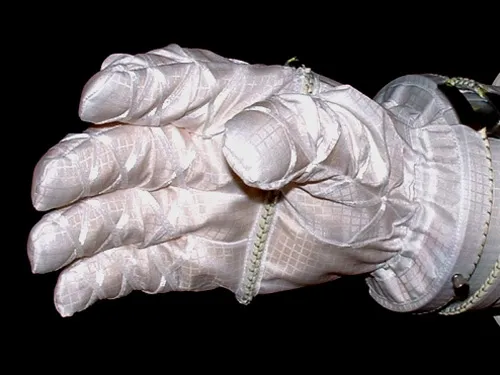
In May 2007, engineer Peter Homer of Southwest Harbor, won $200,000 when his design beat NASA's in an agency competition. His company, Flagsuit LLC, along with Orbital Outfitters, work on suits for tourist suborbital flights.
Homer indicated that, unlike current gloves, folded in a way that causes the fingers to curve like a banana, his gloves fold at the same points as the fingers. That makes it easier to move the astronauts' fingers.
Image: Flagsuit.com
The Future
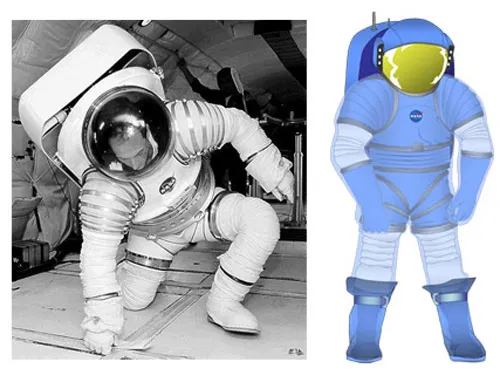
The Mark III prototype began its development in the late 1980s and has a back system and bearings that allow astronauts to kneel and perform other tasks.
In the push for the return to the Moon, NASA signed a contract with Oceaneering International, Inc for the development of suits for the crew of the Orion capsule, planned for 2015.
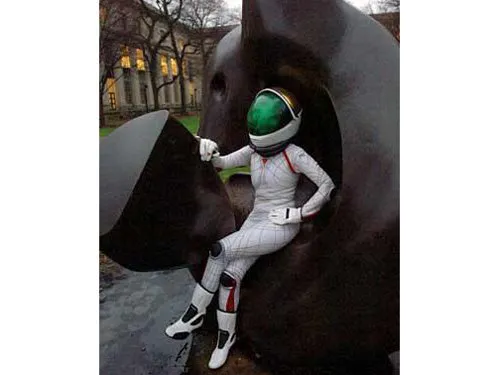
The "Biosuit" developed by Dava Newman and colleagues at MIT uses tight layers of material to maintain pressure.
The suit is designed with rigid lines that do not extend when an astronaut moves a part of their body. These lines provide a kind of skeleton but do not restrict movements. However, the team thinks it will take several years of development before an astronaut can wear a suit like this in space.
Other researchers are developing materials that one day could generate energy, eliminate germs, and "self-repair," thanks to the use of a gel.
Image: Donna Coveney
Sources and related links
- NewScientist: Gallery: the evolution of the spacesuit
- NASA: Evolution of the NASA Spacesuit (Flash)
- About the Argentine spacesuit
About the images
The images belong to NASA Headquarters/JSC, except when indicated.