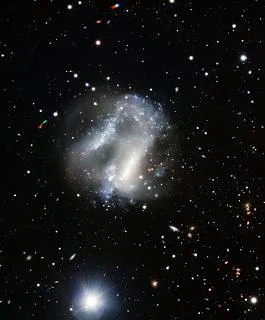
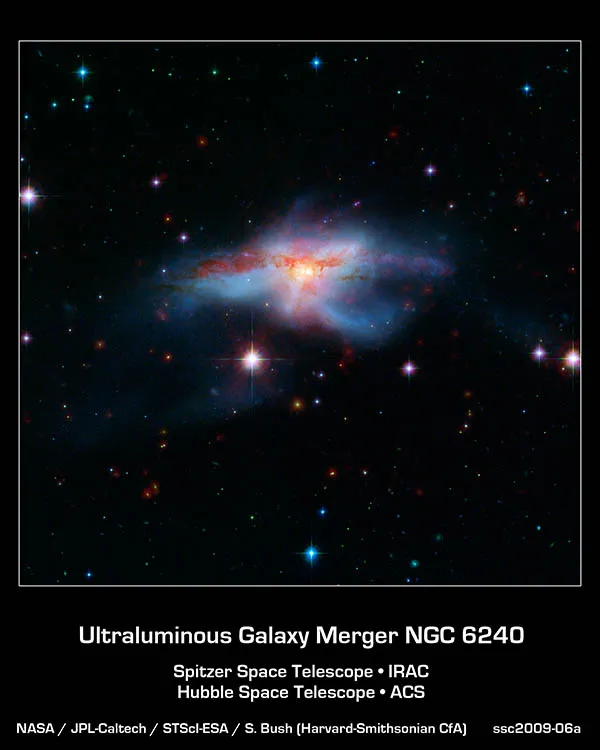
Astronomers have obtained three-dimensional views of distant galaxies, seen when the universe was half its current age, by combining the precise vision of the Hubble Space Telescope and the VLT of ESO's ability to examine the motion of gas in small objects. By looking at this "historical page" of the Universe, an epoch in which the Sun and Earth did not yet exist, scientists hope to solve the enigma of how galaxies formed in the remote past.
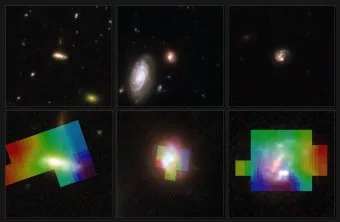
For decades, distant galaxies that emitted their light six billion years ago were nothing more than specks of light in the sky. With the launch of Hubble in the 1990s, astronomers were able to scrutinize the structure of distant galaxies with some detail for the first time. Under the incredible skies of Paranal, in Chile, the FLAMES/GIRAFFE spectrograph of the Very Large Telescope can obtain simultaneous spectra of small areas of large objects and observe the movements of the gases in those remote galaxies.
"This unique combination of Hubble and VLT allows us to model distant galaxies almost as well as nearby ones. Indeed, FLAMES/GIRAFFE allows us to measure the velocity of the gas at several locations in these objects. This means we can see how the gas is moving, which provides us with a three-dimensional view of galaxies halfway across the Universe," said François Hammer, who led the team.
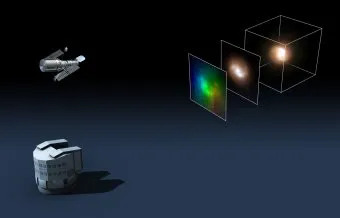
The team has undertaken the Herculean task of reconstructing the history of about a hundred remote galaxies that have been observed with Hubble and GIRAFFE on the VLT. The first results are coming in and already provide useful insights into three galaxies.
In one galaxy, GIRAFFE revealed a region full of ionized gas, that is, hot gas composed of atoms that have had one or several electrons removed. This is normally due to the presence of very hot young stars. However, after observing the region for over 11 days, Hubble detected no stars! "Clearly this unusual galaxy has some hidden secrets," said Mathieu Puech, lead author of one of the study reports. Comparisons with computer simulations suggest that the explanation lies in the collision of two very gas-rich spiral galaxies. The heat produced by the collision would have ionized the gas, making it too hot to form stars.
Another galaxy that the astronomers studied showed the opposite effect. They discovered a central bluish region wrapped in a reddish disk, almost completely hidden by dust. "The models indicate that the gas and stars could be spiraling rapidly," explained Hammer. This could be the first example of a disk reconstructed after a major merger.
Finally, in a third galaxy, the astronomers identified a very unusual elongated structure, a bar, extremely blue, composed of young massive stars, rarely observed in nearby galaxies. Comparison with simulations showed that the properties of the object are well reproduced by a collision between two galaxies of unequal mass.
Because astronomers can now see how the gas is moving they can trace the mass and orbits of ancestral galaxies with relative precision, explained Sébastien Peirani, author of another of the study reports.
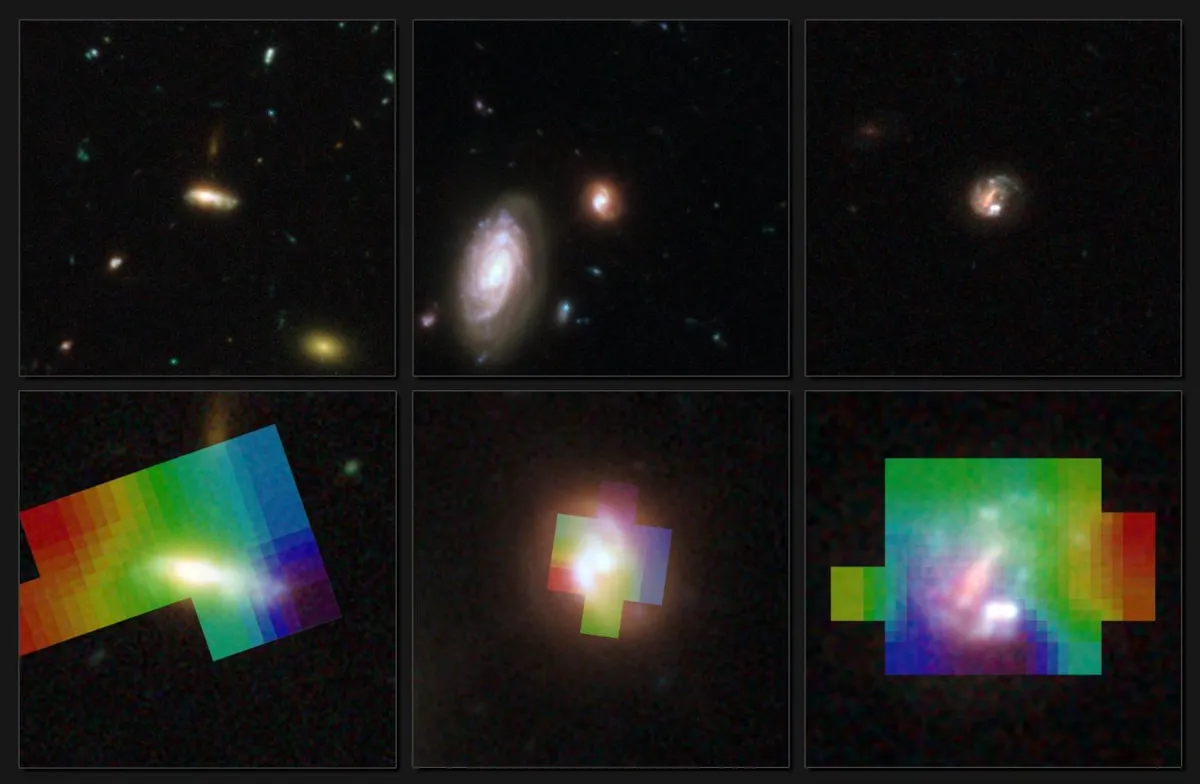
Astronomers are extending their analysis to the entire sample of observed galaxies. "The next step will be to compare this with closer galaxies, and thus, form a picture of the evolution of galaxies over the last six to eight billion years, that is, over half the age of the universe," concluded Hammer.
The galaxies studied in the reports are:
J033241.88-274853.9 at z=0.6679
J033245.11-274724.0 at z=0.43462
J033239.72-275154.7 at z=0.41
Sources and related links
- ESO:Hubble and ESO’s VLT provide unique 3D views of remote galaxies
- A forming disk at z~0.6: Collapse of a gaseous disk or major merger remnant?
Puech et al. 2009, A&A, 493, 899
arXiv:0811.3893v1
DOI: 10.1051/0004-6361:200810521 - A giant bar induced by a merger event at z=0.4?
Peirani et al. 2009
arXiv:0812.1593v1
DOI: 10.1051/0004-6361/200810760 - A forming, dust enshrouded disk at z=0.43: the first example of a late type disk rebuilt after a major merger?
Hammer et al. 2009
arXiv:0901.0718v2
DOI: 10.1051/0004-6361:200810488
About the images
Images from ESO.
On the ESO site there is an animation in various formats.